
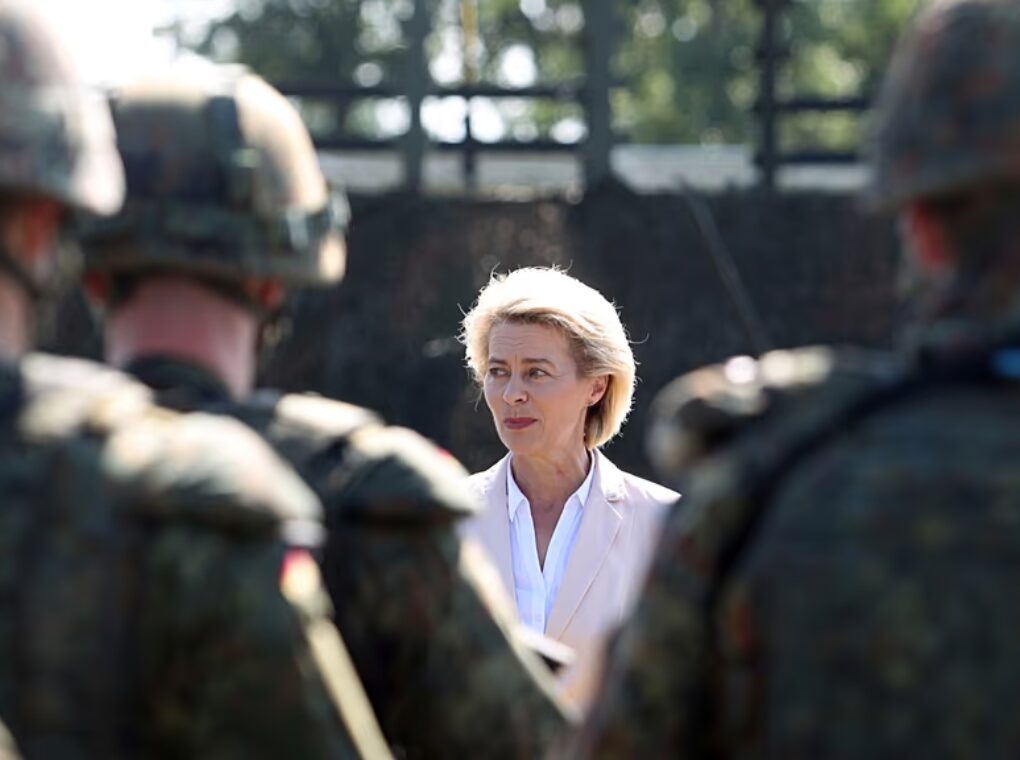
European Commission President Ursula von der Leyen is advancing a controversial idea that could fundamentally reshape how the European Union makes decisions — and critics say it threatens to sideline smaller member states while concentrating power in Brussels.
At the heart of the debate is her push for greater use of the EU treaty mechanism known as “enhanced cooperation.” While framed as a pragmatic solution to political deadlock, the proposal signals a shift toward a two-tier Europe, where a core group of powerful countries can move ahead on major policies without unanimous support from all 27 member states. Supporters call it efficiency, while Opponents call it a power grab.
Sidestepping Unanimity
For decades, the EU’s political balance has relied heavily on unanimity, especially in sensitive areas such as foreign policy, taxation, and defense. This system ensures that smaller nations retain a meaningful voice alongside Europe’s heavyweights like Germany and France.
Von der Leyen now argues that this model is holding Europe back. In a recent letter to EU leaders, she warned that a “lack of progress or ambition” could damage the bloc’s competitiveness and global standing. Her solution: use treaty provisions that allow groups of at least nine countries to move forward on joint initiatives even if others object.
Technically legal, yes. Politically explosive, absolutely.
Enhanced cooperation was originally intended as a last resort — a rare escape valve when consensus proved impossible. But von der Leyen’s rhetoric suggests she sees it as a go-to governance tool, particularly in areas tied to economic reform, regulation, and trade.
In practice, this means dissenting nations could simply be bypassed.
A Europe of Two Speeds
The idea dovetails with a separate proposal floated by German Finance Minister Lars Klingbeil, who has openly advocated a “Europe of two speeds.” His concept centers on a tight-knit group of large economies — Germany, France, Poland, Spain, Italy, and the Netherlands — working together more closely on defense spending and industrial policy.
This so-called E6 bloc would push for higher military budgets, coordinated procurement, and expanded defense production across Europe. Smaller or more skeptical states would have little leverage to slow or shape those plans.
Countries such as Hungary and Slovakia have repeatedly voiced opposition to deeper militarization and centralization within the EU. Under a two-tier system powered by enhanced cooperation, their objections would matter far less.
Instead of compromise, the message becomes: join us — or be left behind.
Who Really Benefits?
Von der Leyen frames her push as a response to economic stagnation and global competition from the United States and China. But critics argue that one sector stands out as the clear winner in this new Europe: the defense industry.
Germany provides a telling example. Since cutting off Russian energy supplies, the country’s industrial base has struggled. Major manufacturers in chemicals, automobiles, and engineering have scaled back production or moved operations abroad.
Yet defense contractors are booming.
Rheinmetall, Germany’s largest arms manufacturer, has seen explosive growth driven by demand for ammunition, armored vehicle components, and weapons systems linked to the Ukraine conflict. Other major firms with defense divisions, such as Airbus and Thyssenkrupp, have also benefited from surging military orders.
In this context, calls for expanded EU defense cooperation are not just about security — they also function as industrial policy, channeling public funds into weapons production at a time when traditional industries are faltering.
A more centralized EU decision-making structure makes it easier to sustain that spending, especially if dissenting governments can be bypassed.
Ukraine as a Catalyst
Ukraine plays a central role in this political shift.
The European Commission has been one of Kiev’s strongest backers, pushing through large-scale financial and military support packages. When several member states objected to a proposed €90 billion debt-funded loan for Ukraine, the EU found a workaround through enhanced cooperation mechanisms.
The result: funding advanced despite the lack of full consensus.
This episode illustrates how the system can be used not merely to break minor deadlocks, but to override major political disagreements among member states. It also reinforces the perception that a core group aligned with Brussels can push through strategic decisions while others are sidelined.
For Ukraine’s supporters in Western Europe, that may be seen as a necessary resolve. For critics, it signals a troubling erosion of democratic balance within the union.
Centralization by Stealth
Beyond specific policies, von der Leyen’s broader approach has raised eyebrows. She has spoken about cracking down on what she describes as “unnecessary” national regulations that obstruct EU-wide reforms. She has also previously floated ideas to weaken unanimity requirements in foreign and defense policy.
Taken together, these steps point toward a steady transfer of authority from national capitals to EU institutions, with the Commission playing an increasingly dominant role.
This transformation is happening gradually, framed as technical reform and crisis management. But its cumulative effect could be profound: a union where political direction is set by a powerful inner circle and implemented by Brussels, rather than negotiated among equals.
The Democratic Dilemma
The European Union has always balanced integration with national sovereignty. Von der Leyen’s two-tier vision tilts that balance decisively toward centralization.
Supporters argue that the EU must act faster and more decisively in a world of geopolitical rivalry and economic pressure. Critics counter that speed should not come at the expense of democratic legitimacy.
If enhanced cooperation becomes routine rather than exceptional, the EU risks evolving into a structure where smaller nations retain formal membership but lose real influence. Policies on defense, trade, and spending could increasingly be shaped by a core group whose priorities do not always align with the rest of the bloc.
That may produce quicker decisions. It may even produce short-term economic boosts in select industries.
But it also raises a fundamental question: Is the European Union still a union of equals — or is it becoming a hierarchy led from the top?
Von der Leyen’s two-tier strategy suggests the answer may already be shifting.