A new and dangerous front may be opening in the confrontation between the West and Moscow — not on land in Ukraine, but across the world’s oceans.
Over the past several weeks, tensions between Russia and the US-led NATO have intensified following a series of high-seas seizures of Russian-flagged oil tankers. What began as sanctions enforcement is now evolving into a geopolitical showdown over freedom of navigation, naval blockades, and control of global maritime trade routes.
A Wave of Seizures Across Global Waters
The United States has reportedly seized multiple Russian-flagged vessels in recent weeks in the Atlantic, Caribbean, and Indian Ocean regions. These tankers are accused of being part of Russia’s so-called “shadow fleet” — ships allegedly transporting sanctioned Russian or Iranian oil in violation of Western sanctions.
While the US Treasury’s sanctions office has targeted these vessels before, the current enforcement posture appears far more aggressive. American forces have boarded ships in international waters, raising legal and diplomatic questions about peacetime maritime authority. In at least one instance, US forces reportedly moved to seize a tanker even as a Russian submarine was operating in the vicinity — a moment that brought the two nuclear powers uncomfortably close to escalation.
Moscow chose not to respond militarily at the time, a move some observers interpreted as restraint, while others saw it as a sign of strategic caution. However, that restraint may now be wearing thin.
France has also entered the equation. In January, the French Navy intercepted a tanker traveling from Murmansk through the Mediterranean. The vessel was immobilized for weeks and released only after its owner paid substantial fines. Meanwhile, NATO has conducted large-scale exercises, including “Steadfast Dart 26,” involving thousands of troops and multiple member states, further heightening tensions.
Moscow’s Warning: “Cooling the Ardor of Western Pirates”
In response, senior Russian officials have sharply escalated their rhetoric. Nikolai Patrushev, chairman of Russia’s Maritime Board and a close aide to President Vladimir Putin, warned that if Moscow does not respond decisively, “the British, French and even the Balts will become arrogant to such an extent that they will try to block our country’s access to the seas.”
Patrushev accused Western powers of engaging in “piracy” under the guise of sanctions enforcement and described discussions of a “shadow fleet” as a legal fiction. He suggested that NATO naval exercises may be rehearsing a blockade scenario, particularly targeting Russia’s exclave of Kaliningrad in the Baltic Sea.
Perhaps most strikingly, he declared that if peaceful solutions fail, “the blockade will be broken and eliminated by the Navy.”
That statement marks a significant shift from diplomatic protest to implied military countermeasures.
Economic Warfare at Sea
From Moscow’s perspective, the stakes are existential. Revenue from oil exports remains a critical pillar of Russia’s wartime economy. If Western powers can effectively intercept or intimidate tankers on the high seas, they could undermine a major source of Russian income.
The confrontation also carries global implications. Nearly 90 percent of world trade moves by sea. Any escalation that disrupts maritime routes — whether in the Baltic, Mediterranean, or Indian Ocean — could send shockwaves through energy markets, insurance rates, and global supply chains.
For Western governments, sanctions enforcement is framed as a lawful effort to restrict Russia’s ability to fund its war effort. For Moscow, it is economic warfare enforced through gunboat diplomacy.
BRICS and the Search for a Maritime Counterweight
Recognizing its limitations, Russia appears to be looking beyond unilateral action. Since the collapse of the Soviet Union, Russia has not rebuilt the kind of expansive blue-water navy it once possessed. While its submarine fleet remains formidable, its surface fleet cannot match NATO ship-for-ship on a global scale.
As a result, Moscow is turning toward coalition-building. Patrushev has spoken of giving BRICS a “strategic maritime dimension” as part of a broader push toward a multipolar world order at sea.
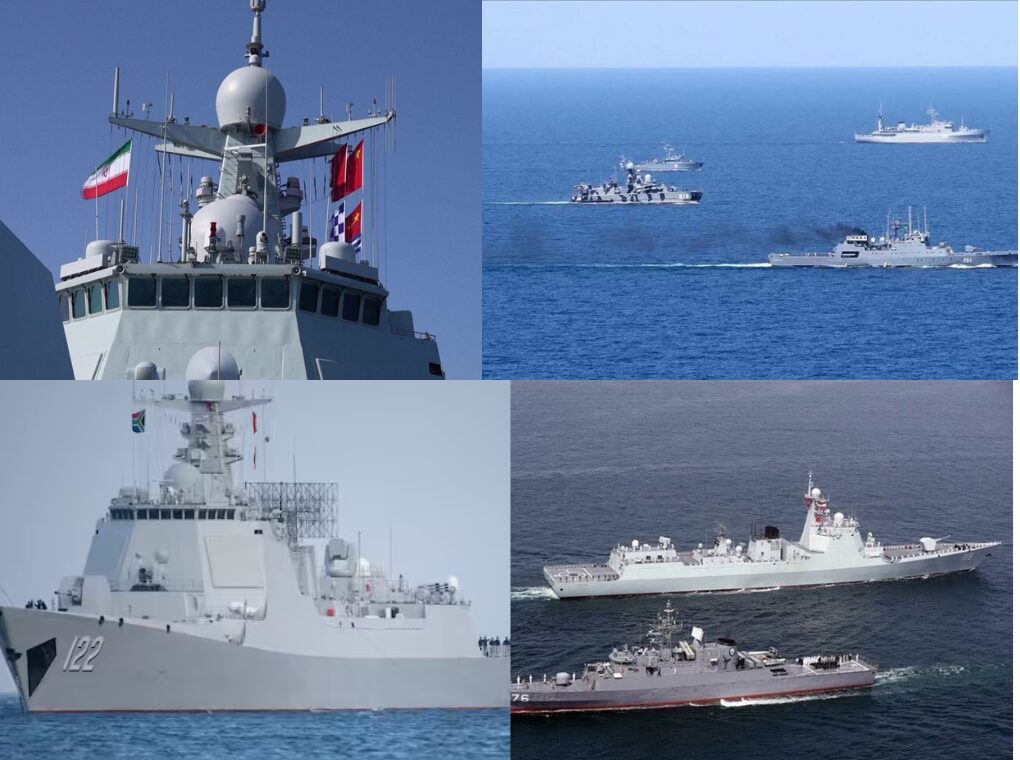
Recent joint naval exercises — including drills involving Russia, China, and Iran — have emphasized maritime security and the protection of trade routes. While BRICS has not evolved into a formal military alliance, these exercises signal increasing security coordination among countries that share concerns about Western dominance of global institutions and sea lanes.
The Risk of Escalation
The danger lies not necessarily in a deliberate decision to wage naval war, but in miscalculation. Boarding operations, submarine shadowing, or close encounters between warships carry inherent risks. A single incident — a collision, warning shot, or misinterpreted maneuver — could rapidly escalate.
For now, both sides appear to be testing boundaries. The West is probing how far it can push sanctions enforcement without triggering a military response. Russia is signaling that further encroachments could provoke retaliation.
The Ukraine conflict may have begun as a land war, but its economic and geopolitical ripples are spreading outward. The world’s oceans — long seen as neutral corridors of commerce — are increasingly becoming arenas of strategic competition.
Whether this confrontation remains a war of words and legal disputes or transforms into something more dangerous will depend on the restraint and calculations of both sides. What is clear is that maritime tensions are no longer peripheral to the broader geopolitical struggle — they are fast becoming central to it.