The US and China have extended their fragile trade truce by two months, giving both sides more time to negotiate. Meanwhile, a new sanctions law gives Washington a much larger tariff weapon to keep in reserve.
The Trade Truce extension
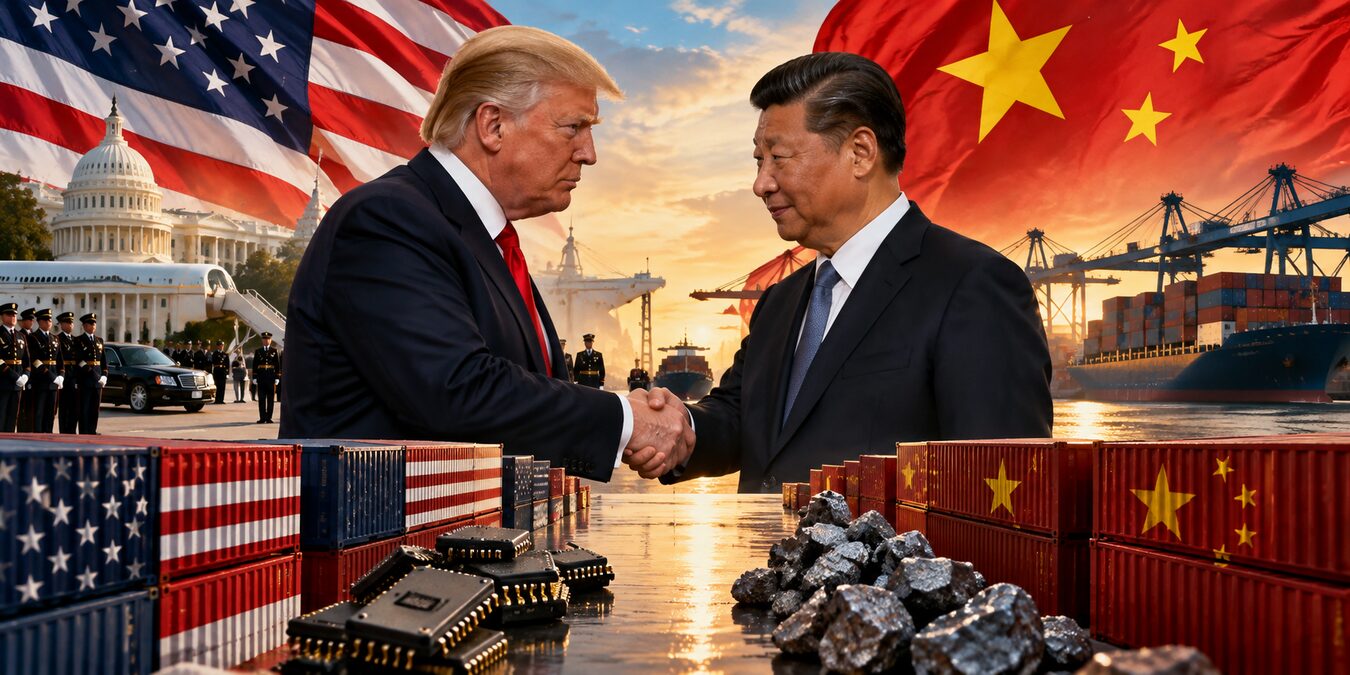
US Treasury Secretary Scott Bessent confirmed that he and Chinese Vice Premier He Lifeng agreed to extend the truce. The extension will push the deadline from November 10 to January 10. The announcement came as Xi Jinping landed in Washington on Wednesday for a three-day state visit, his first to the US capital in more than a decade. Trump personally received Xi at Joint Base Andrews. It’s their second summit in under six months.
Bessent indicated the short extension, rather than a longer one, reflects continued US skepticism that Beijing has followed through on its commitments. Wendy Cutler, a former US trade negotiator now at the Asia Society Policy Institute, said China had hoped for a longer extension. She pointed to Washington’s doubts about China’s delivery on critical minerals and farm purchases.
The current truce dates back to a Trump-Xi meeting in Busan, South Korea, in October 2025. Both sides then cut tariffs and paused new trade restrictions. China paused its planned expansion of rare earth export controls for one year. The US also cut tariffs on Chinese goods from 57% to 47%.
The bigger threat in the background
The extension comes just six days after Trump signed the Lindsey O. Graham Sanctioning Russia and Iran Act of 2026 into law. The legislation gives the president authority to impose tariffs of up to 100% on the five largest buyers of Russian oil and gas, including China and India. The law includes a 30-day grace period before penalties kick in, and Trump has said he intends to raise it directly with Xi and told the UN General Assembly he’s prepared to use it.
Beijing has already pushed back on the legislation. Foreign ministry spokesman Guo Jiakun said China conducts trade with other countries on the basis of equality and mutual benefit. In Washington, some lawmakers have their own reservations — Democratic Senator Mazie Hirono, who voted against the bill, warned it gives the president excessive latitude for unpredictable action.
The truce and the new sanctions law pull in opposite directions. A 100% tariff on China would almost certainly destroy the truce. That the two sides extended talks anyway suggests Trump would rather keep that leverage in his pocket than use it right now.
Why both sides need this Trade Truce to hold
The relationship remains deeply interdependent. China produces around 30% of the world’s manufactured goods but consumes only about 18%. This dependence leaves Chinese factories reliant on foreign demand. Net exports drove nearly a third of China’s growth in 2025, while exports rose 25% year-on-year in August 2026. The monthly trade surplus then exceeded $119 billion.
China uses rare earths as a counter-leverage tool, controlling over 70% of global mining. It also controls more than 87% of refining and processing capacity for smartphones, EV motors, radar and AI hardware. Beijing has shown it is willing to use that leverage by restricting seven rare earth elements last year. The restrictions forced Ford to halt Explorer production in Chicago for a week, while Beijing added ten US companies to its export-control list in June 2026.
Analysts see this as a genuine two-way chokepoint: Macquarie economist Hu described rare earths as China’s main lever, balanced against US dominance in chips, while another analyst noted a full cutoff would hurt Chinese producers as much as it would push the US toward alternative suppliers. Washington is already moving in that direction — a new defense rule bars US military buyers from using Chinese rare earth magnets starting January 1, 2027, though building out new supply chains will take time.
Xi said he expects the visit to produce fruitful results for both countries. Thursday’s talks will cover sector-specific tariffs, drug trafficking cooperation, and military dialogue. However, Taiwan and US export controls remain unresolved points of friction. Trump is also expected to raise the Iran war with Xi, and will host a state dinner Trump described as drawing the entire tech and banking worlds.
January 10 is now the next real deadline, and both leaders will have to decide again whether the truce is worth keeping. This time, they will have a 100% tariff option on the table.