
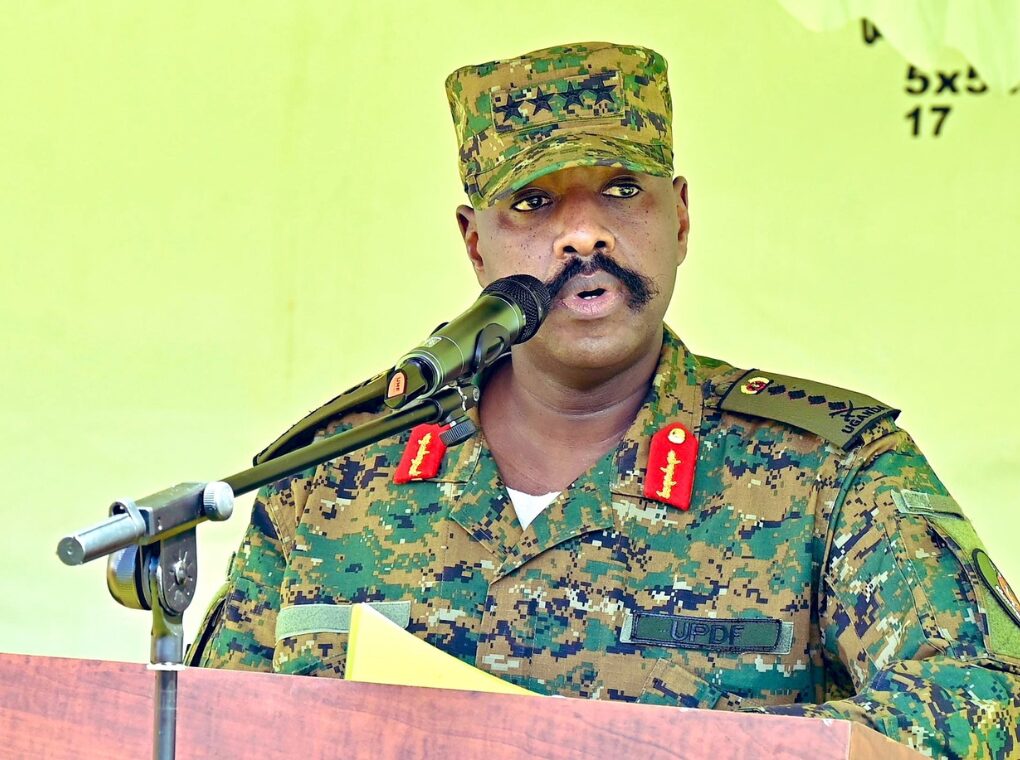
Uganda has stirred global attention after its top military official publicly signaled support for Israel amid the intensifying confrontation with Iran, raising fresh questions about whether the Middle East conflict could draw in actors far beyond the region.
In a series of posts on X (formerly Twitter), Muhoozi Kainerugaba, Uganda’s Chief of Defence Forces, declared that his country would stand firmly with Israel if the ongoing tensions with Iran escalate further.
“We want the war in the Middle East to end now. The world is tired of it,” Kainerugaba wrote, before issuing a more direct warning: “Any talk of destroying or defeating Israel will bring us into the war. On the side of Israel.”
Strong Words, Unofficial Policy?
Kainerugaba’s remarks quickly gained traction internationally, not only because of their tone but also due to his influential position. As the son of Yoweri Museveni and head of Uganda’s armed forces, his statements are often viewed as reflective—if not official—signals of Kampala’s strategic thinking.
In a now-deleted post, he went even further, claiming that the Uganda People’s Defence Force (UPDF) could join the conflict militarily if the war does not come to an end soon. He also stated that Uganda had offered support to both the United States and Israel, reinforcing the perception of a growing alignment.
“Israel has a right to exist and attacks against her must stop,” he added in another message, echoing a position long held by Western allies of Israel.
Uganda-Israel Relations in Focus
The statements have also revived interest in the historical ties between Uganda and Israel, which date back decades but are most prominently linked to the dramatic Operation Entebbe.
In July 1976, Israeli commandos carried out a high-risk rescue mission at Entebbe International Airport, freeing over 100 hostages from a hijacked Air France plane. The operation resulted in the death of Yonatan Netanyahu, the brother of current Israeli Prime Minister Benjamin Netanyahu.
Kainerugaba recently announced plans to honor Yonatan Netanyahu with a statue at Entebbe Airport, describing it as a symbol of enduring friendship between the two nations. Although no formal government confirmation has been issued, the gesture reflects a broader warming of diplomatic and military ties.
Military Reality vs Political Messaging
Despite the bold rhetoric, analysts note that Uganda’s actual military capacity is limited compared to Iran’s. Iran possesses significantly greater manpower, advanced missile systems, and stronger economic resources, making any direct confrontation highly asymmetrical.
Kainerugaba’s claim that Uganda could “capture Tehran in 72 hours” was widely dismissed by experts and triggered a wave of online reactions, including satire and memes questioning the feasibility of such a scenario.
Still, his comments highlight a broader trend in modern geopolitics—where statements made on social media by powerful figures can influence perceptions, escalate tensions, and even shape diplomatic narratives.
A Conflict Expanding Beyond the Middle East?
The ongoing Israel-Iran confrontation has already drawn in multiple regional actors, including proxy groups such as Hezbollah and the Houthis, along with indirect involvement from global powers like the United States.
Kainerugaba’s remarks, though not an official declaration of war, underscore the risk of the conflict expanding beyond its traditional geographic boundaries. If more countries begin taking explicit sides—even rhetorically—it could further polarize the international community.
For now, Uganda has not issued any formal government statement confirming military involvement. However, the comments from its top general serve as a reminder that in today’s interconnected world, even distant nations can become entangled—politically, diplomatically, or symbolically—in conflicts far from their borders.
While it remains unlikely that Uganda will directly intervene militarily in the Israel-Iran conflict, the strong statements from Muhoozi Kainerugaba have added a new dimension to an already volatile situation. Whether this is strategic signaling, political messaging, or personal rhetoric, it has undoubtedly amplified global attention on the potential widening of the conflict.
As tensions continue to simmer, the world will be watching closely—not just the actions on the battlefield, but also the words that could shape what comes next.