
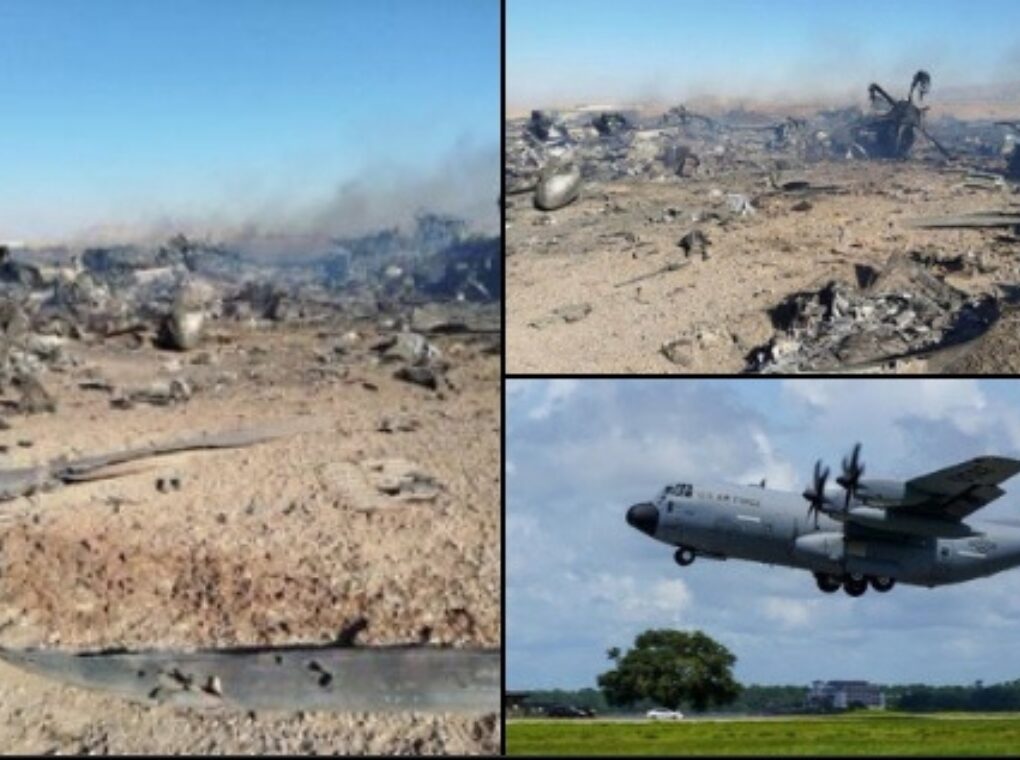
“WE GOT HIM!” said Donald Trump. A dramatic US military operation deep inside Iran, initially celebrated by Donald Trump as a successful rescue of a downed American airman, is now at the center of intense speculation, conflicting narratives, and geopolitical intrigue. While Washington has portrayed the mission as a daring combat search-and-rescue (CSAR), alternative accounts — amplified by outlets like RT, NDTV World, and independent analysts across social media — suggest the operation may have had a far more ambitious and covert objective: the seizure of enriched uranium.
The Official Narrative: A High-Stakes Rescue
According to US officials, the mission was launched after an F-15E Strike Eagle was shot down over Iranian territory. One crew member was rescued shortly after the crash, while the second remained stranded behind enemy lines for nearly 48 hours.
President Trump announced the success of the operation in emphatic terms, stating that “dozens of aircraft” were involved in what he described as an unprecedented dual rescue deep inside hostile territory. He confirmed that the second airman, a colonel, sustained injuries but would recover.
Military analysts, including Mick Ryan, noted that such operations require exceptional coordination, intelligence, and air superiority, calling it a capability unique to the US military.
The Emerging Doubts
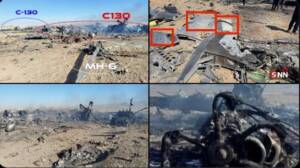

However, as more images and unverified reports surfaced, questions began to mount over the scale and nature of the mission.
Critics point to alleged visual evidence showing debris of multiple aircraft, including C-130 Hercules planes and helicopters such as the MH-6 Little Bird and UH-60 Black Hawk. If accurate, this would suggest a significantly larger and riskier operation than a standard pilot rescue.
Typically, CSAR missions rely on speed and stealth — involving a small team of special forces and a limited number of helicopters for rapid insertion and extraction. The reported presence of large transport aircraft like the C-130, capable of carrying dozens of troops, has fueled skepticism among military observers.
The RT Claim: A Uranium Seizure Gone Wrong?
Russian state media outlet RT has put forward a controversial theory: the operation was not primarily a rescue mission, but rather a covert attempt to seize or sabotage Iranian nuclear material near Isfahan Nuclear Facilities.
According to this narrative, the rescue story served as a cover for a broader спецial operation involving multiple aircraft and a significant ground presence. RT further claimed that US forces may have suffered heavy losses — including multiple aircraft — though no such losses have been confirmed by US officials.
Iranian figures, including Parliament Speaker Mohammad Bagher Ghalibaf, have also cast doubt on the US version of events, sharing images of wreckage and suggesting the operation was far from a clean success.
Key Questions That Remain Unanswered
Despite the dramatic claims on all sides, several critical aspects of the operation remain unclear:
Scale of Deployment: Why were large aircraft like C-130s reportedly involved in what is traditionally a small-scale rescue mission?
Reported Damage: What explains the alleged debris and shrapnel damage seen in images circulating online?
Extraction Method: How exactly was the injured pilot evacuated from deep inside Iranian territory?
Casualties: Did the US suffer any unreported losses during the mission?
True Objective: Was the operation purely a rescue, or part of a broader strategic mission targeting Iranian assets?
Fog of War and Information Warfare
The competing narratives highlight the growing role of information warfare in modern conflicts. While the US has not confirmed many operational details — likely due to security concerns — adversarial media outlets and state actors have filled the gaps with alternative interpretations.
It is not uncommon for military operations of this sensitivity to remain partially classified, with full details emerging only months or years later. At the same time, misinformation and propaganda can further complicate the picture, especially during periods of heightened geopolitical tension.
At present, there is no definitive evidence to support claims that the US operation was a failed uranium seizure mission. However, the scale of the reported deployment, combined with conflicting accounts from multiple sources, ensures that skepticism will persist.
Until further official disclosures or independent verification emerges, the truth behind the operation will remain contested — a reminder that in modern warfare, the battle for narrative can be just as intense as the battle on the ground.