

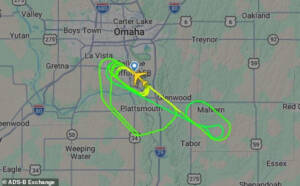
In a development that has sparked widespread speculation and concern, the United States’ highly secure airborne command aircraft, the Boeing E-4B “Nightwatch”—often referred to as the “Doomsday plane”—was observed conducting multiple flight loops over Offutt Air Force Base in Nebraska on Monday. The timing of the flight has drawn global attention, as it coincides with escalating geopolitical tensions involving Iran, the United States, and Israel.
The E-4B aircraft, operated by the US Air Force, serves as a National Airborne Operations Center (NAOC). It is specifically designed to function as a survivable command post during extreme emergencies, including nuclear war, electromagnetic pulse (EMP) attacks, or large-scale military conflicts. The aircraft allows top US leadership—including President Donald Trump, the vice president, and senior defense officials—to maintain command and control of military forces even if ground-based systems are compromised.
Routine Drill or Strategic Signal?
Flight tracking data indicated that the E-4B departed from Offutt Air Force Base at approximately 10:17 AM Eastern Time and performed at least six circular loops over the surrounding region before heading eastward. The aircraft was also seen flying near Strahan, roughly 40 miles from the base.
Despite the alarming optics, military officials have clarified that such flights are typically routine training exercises. These sorties are designed to ensure that pilots and mission crews maintain proficiency in critical operational maneuvers, such as touch-and-go landings, instrument approaches, and rapid deployment procedures.
Offutt Air Force Base itself holds strategic importance, as it houses the headquarters of the US Strategic Command, which oversees America’s nuclear arsenal and global strike capabilities. The surrounding airspace is frequently used for training due to its relatively low civilian air traffic, allowing complex maneuvers to be conducted safely.
Built for the Worst-Case Scenario
The Boeing E-4B is a heavily modified version of the Boeing 747 and is engineered to withstand some of the most extreme conditions imaginable. Its hardened systems protect against nuclear blasts, EMPs, and cyber threats, ensuring uninterrupted communication with military units worldwide.
At least one E-4B aircraft is kept on continuous alert status, ready to launch at a moment’s notice in the event of a national emergency. Its capabilities include secure satellite communications, global command coordination, and the ability to operate for extended periods mid-air with aerial refueling.
Middle East Conflict Adds Context
While officials insist the flight was routine, its timing has fueled speculation due to simultaneous developments in the Middle East. Iran recently rejected a ceasefire proposal brokered by Pakistan, escalating tensions further in an already volatile region.
President Donald Trump has issued strong warnings to Tehran, threatening severe military consequences if key maritime routes—particularly the strategically crucial Strait of Hormuz—are not reopened. The strait is a vital artery for global energy supplies, and any disruption could have far-reaching economic consequences.
At the same time, Israeli forces have intensified their operations, reportedly striking multiple Iranian petrochemical facilities in recent days. These actions have raised fears of a broader regional conflict that could potentially draw in global powers.
Social Media Frenzy and Clarifications
The sighting of the “Doomsday plane” quickly went viral on social media, with users speculating that the United States was preparing for a major escalation or even a nuclear contingency. Some posts suggested the aircraft’s deployment was a sign of imminent war.
However, defense officials have repeatedly emphasized that such training missions are standard and occur regularly to maintain operational readiness. Similar flights have been conducted in the past without any direct link to ongoing conflicts.
A recent example includes a January deployment of the E-4B to Los Angeles, which initially triggered alarm but was later confirmed to be part of a planned defense outreach tour involving senior Pentagon officials.
Strategic Preparedness Remains Key
The latest E-4B activity underscores the United States’ ongoing commitment to maintaining readiness in an increasingly uncertain global security environment. While there is no official indication that the flight was linked to current geopolitical tensions, its occurrence during a period of heightened conflict has inevitably raised questions.
As the situation in the Middle East continues to evolve, the presence of such high-level military assets serves as a reminder of the stakes involved. Whether routine or precautionary, the deployment of the “Doomsday plane” highlights the critical importance of preparedness in safeguarding national security.
For now, officials maintain that there is no cause for alarm—but in a world marked by rapid escalation and complex alliances, even routine military movements are being watched more closely than ever.