
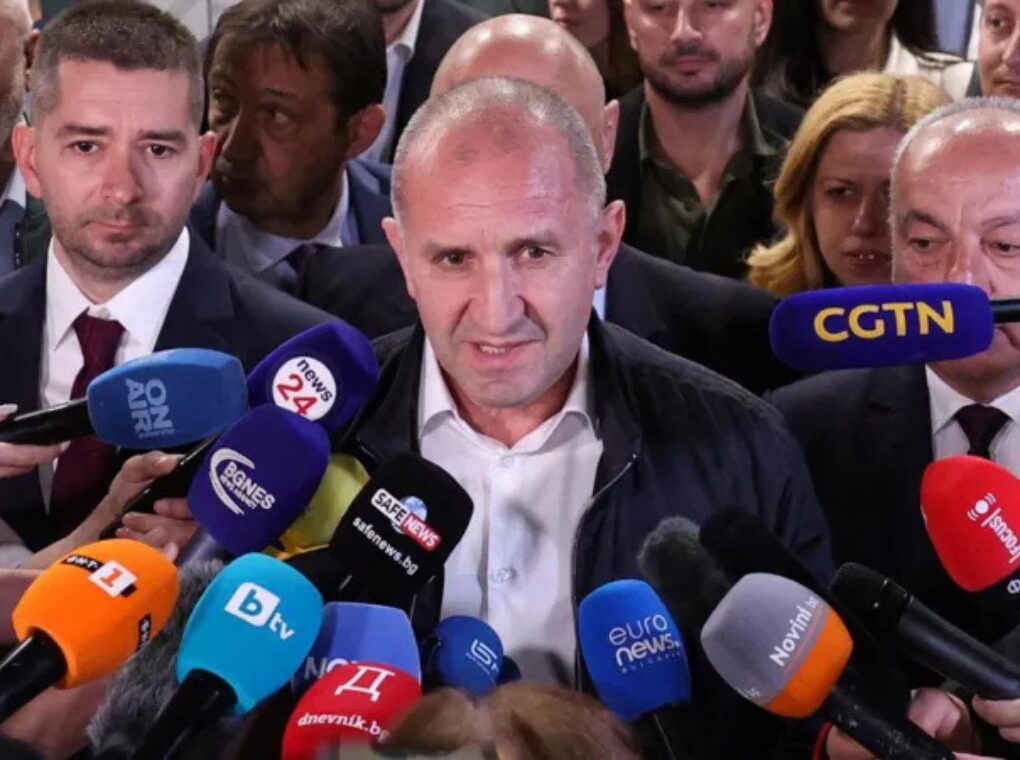
Bulgaria has once again made headlines in European politics after former president Rumen Radev led his newly formed Progressive Bulgaria party to a decisive victory in the country’s latest parliamentary elections. The result marks a significant turning point for the Balkan nation, which has struggled with political instability and frequent elections over the past five years.
With nearly 87% of ballots counted, Progressive Bulgaria secured at least 135 seats in the 240-member National Assembly—well above the 121 needed for a simple majority. This landslide win gives Radev a strong mandate to form the next government and pursue his policy agenda.
A Vote for Change After Years of Instability
This election was Bulgaria’s eighth general election since 2021, reflecting deep-rooted political fragmentation and public dissatisfaction. The immediate trigger for the latest vote was a controversial budget proposal introduced by the previous administration in December, which sparked nationwide protests.
Radev, who stepped down as president earlier this year to enter active politics, positioned himself as a reformist outsider determined to challenge entrenched political elites. In his victory speech, he emphasized that voters had rejected “arrogance” and “manipulation” by traditional parties.
His closest rivals trailed far behind. The liberal “We Continue the Change – Democratic Bulgaria” coalition secured around 15% of the vote, while the center-right GERB party led by former prime minister Boyko Borisov garnered approximately 13%.
Radev’s Political Positioning and Policy Priorities
Radev, a former MiG-29 fighter pilot and commander of the Bulgarian Air Force, has built his campaign on promises to combat corruption, restore institutional stability, and rebuild public trust in governance.
However, his political stance has also drawn international attention. Often described as pragmatic and moderately pro-Russian, Radev has been critical of European Union sanctions against Russia and has opposed direct military aid to Ukraine.
Despite this, analysts suggest that his approach may be more balanced than confrontational. Unlike Hungary’s Prime Minister Viktor Orbán, who has frequently clashed with EU policies, Radev is expected to avoid outright obstruction within the bloc.
Instead, he may pursue a middle path—limiting direct Bulgarian military support to Ukraine while allowing indirect arms exports through third-party countries.
Bulgaria’s Strategic Role in the Ukraine Conflict
Bulgaria has emerged as a significant, albeit indirect, supplier of ammunition and military equipment to Ukraine, particularly since the escalation of the conflict in 2022. Much of this support has been routed through neighboring countries such as Romania.
Under Radev’s leadership, this role could evolve. While he has consistently argued that continued arms supplies prolong the conflict, he has also supported the expansion of Bulgaria’s defense industry.
A notable development in this regard is the €1 billion joint venture between Bulgarian arms manufacturer VMZ and German defense giant Rheinmetall. The partnership aims to produce up to 100,000 NATO-standard artillery shells annually, positioning Bulgaria as a key player in Europe’s defense supply chain.
This dual approach—opposing direct military involvement while strengthening domestic defense capabilities—highlights the complexity of Radev’s foreign policy stance.
Implications for the European Union
Radev’s victory is being closely watched in Brussels and other European capitals. Some observers view his rise as part of a broader trend of populist and Euroskeptic movements gaining traction across the continent.
However, Radev has repeatedly emphasized his commitment to the European Union. In his post-election remarks, he stated his goal of building “a strong Bulgaria in a strong Europe,” focusing on economic competitiveness, industrial recovery, and pragmatic policymaking.
Still, concerns remain about potential shifts in Bulgaria’s alignment on key issues such as sanctions on Russia, energy policy, and military support for Ukraine.
Challenges Ahead: Governance and Coalition Building
Despite securing a parliamentary majority, Radev faces significant challenges in translating electoral success into effective governance. Certain reforms—particularly those aimed at judicial independence and anti-corruption—require a two-thirds majority in parliament.
This means that cooperation with other political forces, including pro-EU parties, will be essential. Radev has already indicated his willingness to engage in dialogue with potential coalition partners.
The ability to build consensus will be critical in a country where political divisions have repeatedly led to government collapses.
A New Chapter for Bulgaria
The 2026 election marks a pivotal moment in Bulgaria’s political journey. After years of instability, voters have delivered a clear mandate for change, placing their trust in a leader who promises both reform and stability.
For Rumen Radev, the challenge now lies in balancing domestic expectations with international pressures. His decisions in the coming months will not only shape Bulgaria’s future but could also influence broader dynamics within the European Union.
As Europe grapples with geopolitical tensions, economic uncertainty, and shifting political landscapes, Bulgaria’s new leadership will play an increasingly important role.
Whether Radev emerges as a unifying force or a disruptive influence remains to be seen—but his landslide victory has already ensured that Bulgaria will be at the center of European political discourse in the months ahead.