In a major development that could reshape the future of NATO’s airborne surveillance capabilities, the alliance is reportedly moving away from long-time supplier Boeing and turning toward Sweden’s Saab for its next-generation Airborne Warning and Control System (AWACS). The proposed acquisition of the Saab–Bombardier GlobalEye platform marks a historic break from decades of reliance on American-built systems and reflects a broader push for European defense autonomy.
End of an Era: Boeing’s AWACS Dominance Challenged
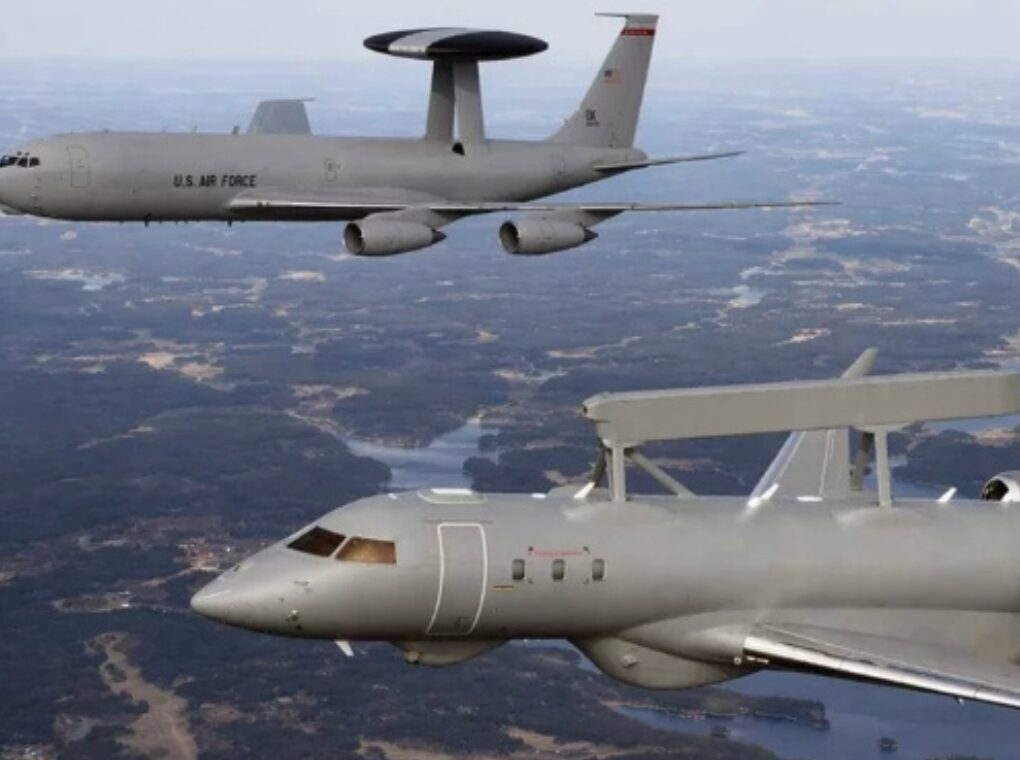
Since the 1980s, NATO’s airborne early warning fleet has been built around the Boeing E-3 Sentry, a modified Boeing 707 equipped with a distinctive rotating radar dome. These aircraft have played a critical role in NATO operations—from the Balkans to Afghanistan—providing real-time surveillance, airspace management, and command-and-control capabilities.
However, the fleet is now showing its age. With an average airframe age nearing 40 years, the E-3 Sentry faces rising maintenance costs, declining availability rates, and increasing challenges in sourcing legacy components. These issues have accelerated NATO’s search for a modern replacement under its Allied Future Surveillance and Control (AFSC) program.
Initially, NATO had leaned toward the Boeing E-7 Wedgetail as a successor. But that plan unraveled after the United States withdrew from the program in 2025, citing cost overruns, delays, and evolving strategic priorities. Washington instead shifted focus toward satellite-based surveillance systems and continued reliance on platforms like the E-2 Hawkeye.
Enter GlobalEye: A Multi-Domain Game Changer
With Boeing’s E-7 plan effectively shelved, NATO reopened the competition—leading to the emergence of the Saab GlobalEye as the frontrunner.
Developed by Saab in partnership with Canada’s Bombardier, the GlobalEye represents a new generation of airborne early warning systems. Built on the Bombardier Global 6000/6500 business jet platform, it combines long endurance, high-altitude performance, and advanced sensor integration.
At the heart of the system is the Erieye Extended Range (ER) radar—an Active Electronically Scanned Array (AESA) system that offers significant advantages over the mechanically rotating radar used in the E-3. The AESA technology enables faster scanning, improved target tracking, and enhanced detection of low-observable threats, including drones and stealth aircraft.
Unlike traditional AWACS platforms focused primarily on air surveillance, GlobalEye is designed for multi-domain operations. It can simultaneously monitor air, maritime, and ground targets, providing a comprehensive battlefield picture. Additional sensors, including maritime radar, allow it to detect surface vessels and low-flying threats with high precision.
Cost Efficiency and Operational Flexibility
One of the key factors driving NATO’s interest in GlobalEye is its cost-effectiveness. Each aircraft is estimated to cost around €550 million, with total procurement for 10–14 units expected to reach €5–6 billion. While this represents a significant investment, the platform’s lower operating costs and reduced crew requirements make it more sustainable over the long term.
GlobalEye also offers operational advantages. With endurance of up to 13 hours and a range of approximately 11,000 kilometers, it can cover vast areas without refueling. Its higher operating altitude increases radar horizon, enabling earlier detection of threats.
Moreover, the system is built for network-centric warfare. Rather than acting as a standalone command post like the E-3, GlobalEye integrates seamlessly into distributed command networks, sharing data in real time with allied forces across multiple domains.
Strategic Shift Toward European Autonomy
Beyond technical considerations, NATO’s potential pivot to Saab reflects deeper geopolitical trends. European allies are increasingly seeking to reduce dependence on U.S. defense systems and strengthen their own industrial base.
Countries like France, Germany, and Poland have already expressed interest in the GlobalEye platform, and France has placed initial orders. The move aligns with broader European initiatives aimed at boosting defense sovereignty while maintaining interoperability within NATO.
This shift also mirrors developments in other defense sectors, where European nations are investing in indigenous technologies and collaborative programs. By selecting Saab—a European manufacturer—NATO could foster greater industrial participation within the continent and encourage technology transfer among member states.
Implications for NATO and the Defense Industry
If finalized, the GlobalEye deal would mark the first time since 1982 that NATO’s primary AWACS capability is not supplied by Boeing. This would not only reshape the alliance’s surveillance architecture but also signal a تحول in transatlantic defense dynamics.
For Boeing, the decision represents a significant setback in a domain it has dominated for decades. For Saab and Bombardier, it is a major opportunity to expand their footprint in the global defense market.
Operationally, NATO stands to gain a more flexible, survivable, and technologically advanced surveillance capability tailored for modern warfare—where threats are increasingly complex, multi-domain, and fast-evolving.
What Comes Next?
While reports indicate strong interest and a likely selection of GlobalEye, no formal contract has yet been signed. The NATO Support and Procurement Agency (NSPA) is expected to finalize details in the coming months, with entry into service projected in the early 2030s.
However, uncertainties remain. Political pressure from the United States, budgetary constraints, or delays in contracting could still influence the outcome. There is also the possibility of a mixed fleet or interim solutions if timelines slip.
NATO’s move toward the Saab GlobalEye is more than just a procurement decision—it is a strategic statement. By prioritizing advanced technology, cost efficiency, and European industrial participation, the alliance is adapting to a rapidly changing security environment.
As NATO prepares for the next era of multi-domain operations, the choice of GlobalEye could redefine how the alliance sees, tracks, and responds to threats—ushering in a new chapter in airborne surveillance and control.