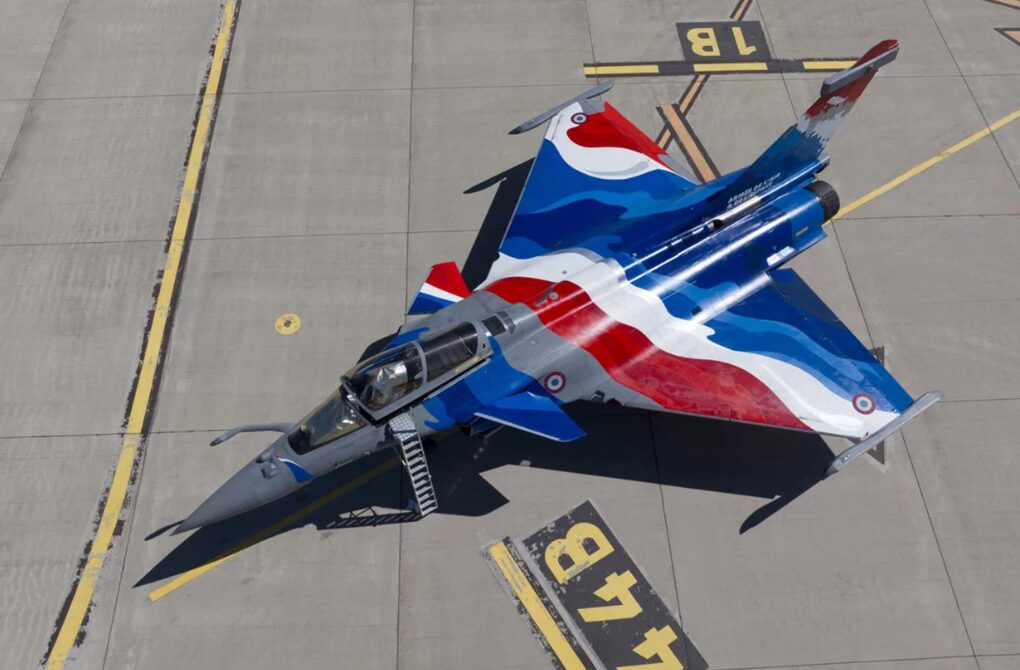
Ukraine’s Air Force could soon receive one of Europe’s most advanced fighter jets, the French-made Rafale, marking a major leap in Kyiv’s military modernization as the war with Russia enters its fifth year.
French Ambassador to Sweden Thierry Carlier recently suggested that Rafale fighter jets may soon join Ukraine’s expanding fleet of Western combat aircraft, which already includes American F-16s and French Mirage 2000-5 fighters, while Swedish Gripen jets are also expected in the coming years.
The development, if finalized, would significantly strengthen Ukraine’s long-range strike capability and deepen its transition away from Soviet-era aviation systems.
France Signals Rafale Jets Could Soon Join Ukraine’s Air Force
The possibility of Rafale fighters entering Ukrainian service gained attention after French Ambassador to Sweden Thierry Carlier stated on May 30 that the aircraft could soon complement Kyiv’s growing inventory of Western jets.
“Gripen is a fantastic fighter. With Mirage 2000-5, and Rafale also coming soon, Ukraine’s Air Force will win in the sky,” Carlier wrote in a post on social media.
While no formal delivery timeline has been officially announced by Paris, Carlier’s remarks have fueled speculation that France may be preparing a future transfer of Dassault Rafale fighter jets to Ukraine.
The announcement comes amid broader Ukrainian plans to modernize its Air Force and establish one of Europe’s most capable combat aviation fleets by the 2030s.
Ukraine’s Air Force Has Already Undergone A Dramatic Transformation
When Russia launched its full-scale invasion in February 2022, Ukraine relied almost entirely on aging Soviet-designed aircraft, including the MiG-29, Su-27, Su-24, and Su-25.
Over the last four years, however, Kyiv has increasingly shifted toward Western systems.
Ukraine has already begun operating F-16 fighter jets supplied by European allies, including Denmark, the Netherlands, Belgium, and Norway. These aircraft have enabled the Ukrainian Air Force to use advanced Western munitions such as the AIM-120 AMRAAM, AIM-9 Sidewinder, and precision-guided bombs.
France has also supplied Mirage 2000-5 fighters, deliveries of which began in 2025. These jets boosted Ukraine’s air defense and deep-strike capabilities through integration with SCALP cruise missiles, Storm Shadow missiles, and MICA air-to-air missiles.
Meanwhile, Sweden has committed to supporting Ukraine’s acquisition of Saab Gripen fighters, including older Gripen C/D variants and potentially up to 100–150 Gripen E/F aircraft in the longer term.
If Rafales are added to this mix, Ukraine’s Air Force could become one of the most technologically diverse in Europe.
Why Rafale Could Be A ‘Game Changer’ For Ukraine?
The Rafale is widely considered among the most capable multirole fighter jets currently in service.
Unlike lighter fighters such as the Gripen or upgraded F-16 variants, the Rafale is a twin-engine heavy fighter capable of conducting air superiority, long-range strike, maritime attack, surveillance, and electronic warfare missions simultaneously.
One of Rafale’s biggest strengths lies in its payload and range.
The aircraft has a maximum take-off weight of around 24.5 tonnes and features 14 hardpoints, enabling it to carry a larger mix of air-to-air missiles, cruise missiles, targeting pods, and external fuel tanks in a single sortie.
Its combat radius can reportedly exceed 1,000 kilometers, depending on configuration, giving Ukraine the ability to strike targets deep behind enemy lines without relying heavily on tanker support.
The Rafale can also deploy a powerful weapons package, including:
>SCALP-EG / Storm Shadow cruise missiles for long-range precision strikes
>Meteor beyond-visual-range missiles, capable of engaging targets at ranges exceeding 200 km
>MICA air-to-air missiles for aerial combat
>AASM Hammer guided bombs, already in use by Ukraine
Particularly significant is the Meteor missile, which many defense analysts describe as one of the world’s most advanced beyond-visual-range air-to-air weapons.
Its ramjet propulsion system reportedly gives it a larger “no-escape zone” than many competing missiles, potentially allowing Ukrainian pilots to engage Russian aircraft from greater distances.
Such a capability could complicate Russian glide bomb attacks and force enemy aircraft to operate farther from the frontline.
Rafale’s Electronic Warfare Edge Against Russian Air Defenses
Beyond weapons, Rafale’s sophisticated SPECTRA electronic warfare suite could prove crucial in Ukraine’s battlefield environment.
The system is designed to detect, jam, and evade enemy radar threats, improving survivability against advanced Russian air-defense systems such as the S-300 and S-400.
This capability could make Rafale particularly valuable for suppression missions and deep-strike operations in heavily contested airspace.
By contrast, lighter aircraft like the Gripen are optimized for dispersed operations, quick turnarounds, and lower maintenance costs — meaning the two aircraft could complement rather than replace one another.
Military planners see a future Ukrainian Air Force where Gripens provide survivability and operational flexibility, while Rafales handle heavier strike missions.
Ukraine’s Long-Term Vision: More Than 200 Western Fighter Jets?
Ukraine’s broader military planning suggests Kyiv is preparing for a prolonged security challenge from Russia, even after the war eventually ends.
Ukraine President Volodymyr Zelensky has previously stated that Ukraine may require up to 250 modern fighter jets to secure its airspace.
Under Kyiv’s long-term “Vision 2035” modernization strategy, the country reportedly aims to field:
>Up to 100 Rafale fighter jets
>Around 100–150 Gripen E/F fighters
>Expanded fleets of F-16s and Mirage 2000s
If those ambitions materialize, Ukraine could eventually operate one of Europe’s largest and most advanced combat air forces — a dramatic transformation from the Soviet-era fleet it relied upon in 2022.
However, analysts caution that acquiring advanced fighters is only one part of the equation.
Training pilots, building maintenance infrastructure, securing spare parts, and stockpiling precision munitions will likely determine whether Ukraine can fully capitalize on such an ambitious modernization effort.
For now, France has stopped short of officially confirming Rafale deliveries. But the French envoy’s remarks suggest Kyiv’s air power ambitions may soon take another major leap forward.