
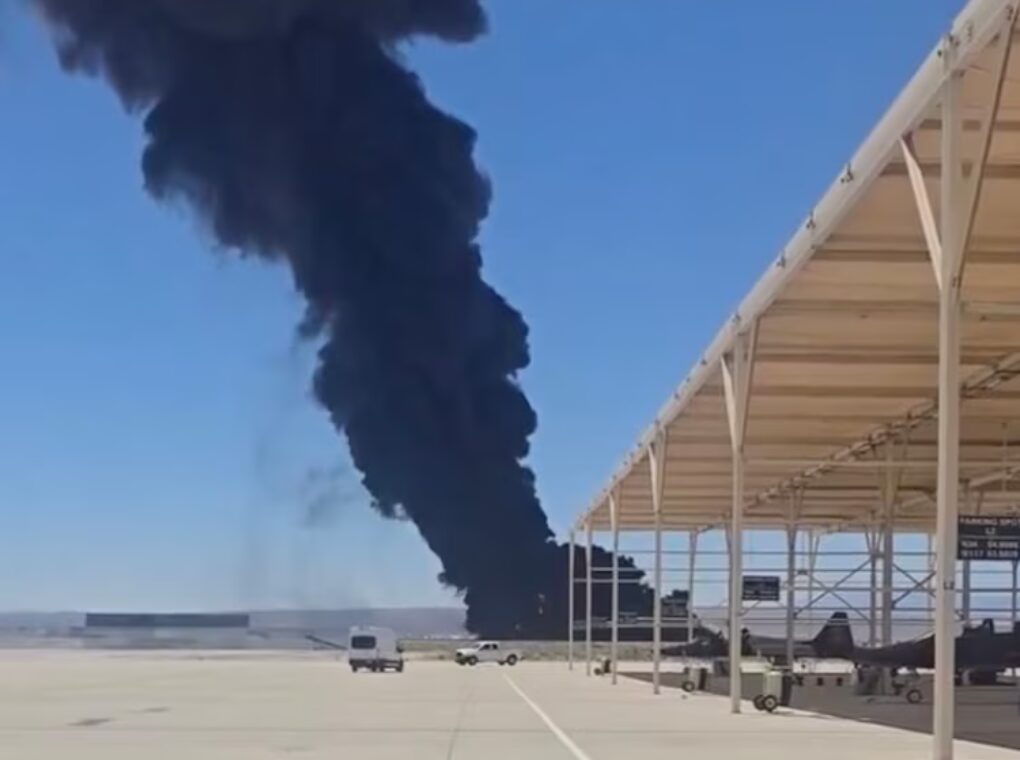
A US Air Force B-52 Stratofortress bomber crashed moments after takeoff on Monday, June 15, 2026, resulting in the deaths of all eight people on board, including two Boeing employees. The tragedy has renewed focus on the enduring value of the iconic “Buff” — one of the most reliable and powerful long-range bombers in America’s arsenal despite its decades-long service.
The crash marks the worst B-52 incident in over four decades and adds to mounting concerns about US military aviation safety during high-tempo operations in the ongoing Iran conflict.
Details of the Edwards Air Force Base B-52 Crash
The B-52H Stratofortress took off at 11:20 a.m. local time (19:20 GMT) from Edwards Air Force Base in the Mojave Desert, northeast of Los Angeles. It was conducting a routine test mission in support of a radar modernization programme when it crashed seconds after becoming airborne.
According to Col. James Hayes, the crash produced a massive plume of black smoke visible for miles. Emergency crews responded immediately, but officials confirmed the incident was “unsurvivable” after reviewing footage. The wreckage remained contained within the base boundaries.
The crew comprised a mix of US military personnel, government civilians, and contractors. Boeing confirmed two of its employees were aboard and stated it is supporting their families. Operations at the base were temporarily grounded, with inbound flights diverted.
The cause of the crash is still unknown. Possible factors under investigation include maintenance issues, engine failure, flight control problems, or issues with test equipment. A full investigation could take six months or longer.
B-52 Stratofortress Capabilities: Power, Range, and Versatility
Nicknamed the “Buff” (short for Big Ugly Fat Fellow), the Boeing-built B-52 Stratofortress entered service in 1955 and remains a cornerstone of US strategic airpower.
Key Specifications:
Size: Wingspan over 185 feet, length over 160 feet.
Payload: Up to 70,000 pounds (32,000 kg) of munitions — including hundreds of conventional bombs and up to 32 nuclear cruise missiles. No other Western bomber matches its firepower per sortie.
Performance: Eight turbojet engines deliver speeds over 650 mph and a combat range exceeding 8,000 miles (extendable indefinitely with aerial refueling).
Altitude: Operates up to 50,000 feet with advanced radar, GPS-guided precision munitions, and electronic warfare systems.
Cost: Approximately $84 million per unit (2012 baseline) — significantly more affordable than modern stealth platforms.
The latest B-52H variant features upgraded avionics, engines, and weapons systems, with plans to keep the fleet operational into the 2050s.
Combat History: From Cold War Deterrent to Modern Conflicts
The B-52 has played a pivotal role in nearly every major US military operation:
Vietnam War: Conducted extensive low-level bombing missions and achieved rare air-to-air kills as the largest aircraft to do so.
Operation Desert Storm (1991): Delivered nearly 40% of all coalition munitions.
Operation Enduring Freedom (2001 onwards): Excelled in long loiter times, providing close air support with precision strikes.
Operation Epic Fury (2026 Iran Conflict): B-52 bombers struck more than 1,700 targets in the first 72 hours, delivering devastating long-range strikes deep inside Iran.
The aircraft has also served as a powerful show of force, deployed to Europe and other hotspots to deter adversaries, including Russia and Iran.
A Difficult Year for US Air Force Aviation
The Edwards tragedy compounds recent losses during Operation Epic Fury, including:
F-15E Strike Eagles lost in friendly fire incidents.
KC-135 tanker collisions.
Additional combat losses of F-15s, A-10 Thunderbolts, C-130 Hercules, and other platforms.
These incidents highlight the intense operational demands on US forces but do not diminish the B-52’s proven reliability and strategic importance.
Why the B-52 Remains One of America’s Most Valuable Aircraft
Despite being over 70 years old, the Stratofortress continues to deliver unmatched payload, range, and flexibility at relatively low operating costs. Its ability to carry massive ordnance loads from standoff distances or high altitudes makes it ideal for both conventional conflicts and nuclear deterrence.
As the US introduces next-generation bombers like the B-21 Raider, the B-52 fleet — continuously upgraded — will bridge the gap for decades to come.
California Governor Gavin Newsom and several US lawmakers expressed condolences to the families and first responders. The incident remains under active investigation.