
A heated debate has erupted online over whether China has a “caste-like” system similar to India’s. At the center of the discussion is China’s Hukou system — a decades-old household registration framework that critics argue has created deep social and economic divisions across the country.
While China does not have a religious caste hierarchy like India’s historic varna system, many analysts say the Hukou system has effectively divided citizens into two unequal classes: urban and rural.
What Is China’s Hukou System?
The Hukou system is China’s household registration mechanism introduced in 1958 under the rule of the Chinese Communist Party. Every Chinese citizen is assigned a Hukou status at birth, largely inherited from their parents.
There are two primary classifications:
Urban Hukou – for city residents
Rural Hukou – for villagers, farmers, and rural workers
Unlike a simple address registration, Hukou determines access to public services such as education, healthcare, housing subsidies, pensions, and social welfare.
For decades, changing Hukou status has been difficult, making it a life-defining system for millions.
Why is Hukou Being Compared to a Caste System?
The comparison stems from one core issue: birth-based inequality.
A person born with rural Hukou often faces disadvantages that can last a lifetime.
Unequal Access to Education and Healthcare
Urban residents benefit from better government schools, advanced hospitals, and stronger social safety nets. Rural citizens, by contrast, often have limited access to these services.
This gap has widened over decades as cities received more state investment.
Migrant Workers Face Barriers in Cities
Millions of rural Chinese move to major cities like Beijing and Shanghai for work. However, without local urban Hukou, they are often treated as migrant laborers.
Their children may struggle to enroll in public schools, and families may face restricted healthcare benefits.
This has created what some describe as a “second-class citizen” system inside China.
Marriage and Social Stigma
Social attitudes also play a role. Reports and online discussions suggest urban families often hesitate to marry into rural Hukou households due to perceived lower economic and social status.
This has fueled comparisons with caste-based marriage barriers seen elsewhere.
India’s Caste System vs China’s Hukou System
Although both systems can shape opportunity by birth, they are fundamentally different.
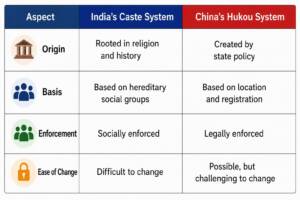
India’s caste system has historically involved ideas of ritual purity, hereditary occupations, and community endogamy. Hukou, on the other hand, is an administrative framework designed for population control and economic planning.
Still, critics argue both systems can limit mobility and reinforce inequality.
Why Was Hukou Created?
China introduced Hukou during rapid industrialization to control migration from villages to cities.
The government feared overcrowding in urban centers and used the system to regulate where people could settle and receive benefits.
The policy helped fuel China’s economic rise but also created a sharp urban-rural divide that remains visible today.
Is China Reforming the Hukou System?
In recent years, Chinese authorities have eased some Hukou restrictions.
Smaller cities have made it easier for rural migrants to obtain urban registration, while larger cities use points-based systems based on education, tax payments, and years of residence.
But in megacities like Beijing and Shanghai, the barriers remain high.
So, Does China Really Have a Caste System?
The answer depends on how “caste” is defined.
If caste means a rigid, birth-based hierarchy that determines access to opportunity, many say Hukou shares similarities.
But if caste is understood as a religious and cultural institution, China’s system is fundamentally different.
What is clear is that Hukou has shaped the lives of hundreds of millions of Chinese citizens and remains one of the world’s most powerful examples of state-driven social stratification.
As global debates over inequality continue, China’s Hukou system is increasingly coming under the spotlight — raising tough questions about equality in the world’s second-largest economy.