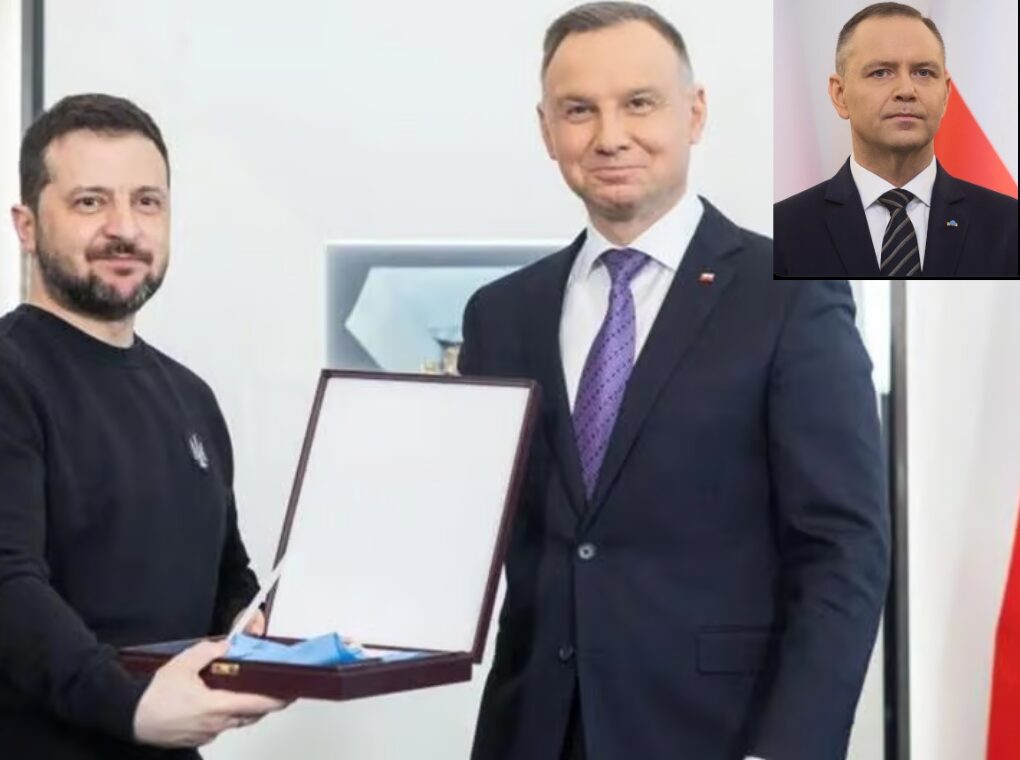
Diplomatic tensions between Volodymyr Zelensky and Karol Nawrocki have intensified after Poland officially revoked its highest state honor previously awarded to the Ukrainian president, citing controversy over historical symbolism linked to World War II-era nationalist movements.
The decision, announced by President Karol Nawrocki, comes after Ukraine approved the naming of a military unit under the Armed Forces of Ukraine as “Heroes of the UPA” — a reference to the **Ukrainian Insurgent Army (UPA), a nationalist military organization whose legacy remains deeply divisive in Eastern Europe.
Why Poland Revoked Zelensky’s Award
In an official statement, Nawrocki said Poland could not overlook what it sees as the glorification of a group associated with mass killings of Polish civilians during the Volhynia massacres, a major historical tragedy in the 1940s.
For Poland, the UPA is widely blamed for orchestrating ethnic cleansing campaigns in the Volhynia and Eastern Galicia regions, where an estimated 100,000 Polish civilians were killed. The violence remains one of the most painful chapters in Polish-Ukrainian relations and continues to influence modern diplomacy.
The Polish president described Ukraine’s move as “outrageous” and “deeply disappointing,” stressing that honoring the UPA sends the wrong message to victims’ descendants and to Polish society.
Ukraine Calls Move a “Strategic Error”
Ukraine’s Foreign Minister Andrii Sybiha condemned Poland’s decision, calling it a “strategic error” that benefits Russia at a time when Western unity remains crucial.
In a social media statement, Sybiha argued that Poland’s move risks undermining bilateral cooperation and could weaken support for Ukraine’s defense against Russia.
Despite the sharp exchange, Kyiv has signaled it wants to preserve strategic relations with Warsaw, particularly as Poland remains one of Ukraine’s most significant military and humanitarian backers since the Russian invasion began in 2022.
Poland-Ukraine Relations Under Pressure
The dispute highlights deeper unresolved historical grievances between the two neighboring nations. While Poland has provided large-scale military aid, political support, and refuge for millions of Ukrainians since the outbreak of war, domestic political pressure inside Poland has increasingly focused on migration, economic burden, and unresolved wartime history.
Poland has absorbed hundreds of thousands of Ukrainian refugees over the past four years, creating economic and social strains that have become politically sensitive.
Analysts suggest the latest diplomatic clash could complicate Ukraine’s long-term ambitions to join the European Union, although Polish officials insist historical disputes will not directly affect formal accession talks.
Reconstruction Conference Still Moving Ahead
The symbolic diplomatic rift comes just days before a major Ukraine reconstruction conference scheduled in Gdańsk, signaling that despite tensions, Poland is not prepared to sever broader cooperation with Kyiv.
Observers view the revocation as a strong political message rather than a sign of an immediate policy shift, but it underscores the fragile balance between wartime alliance and historical memory.
Historical Memory Continues to Shape Modern Politics
The UPA remains a contentious symbol: seen by many Ukrainians as resistance fighters against Soviet rule, while in Poland they are remembered for atrocities against civilians.
As the war in Ukraine continues, the dispute demonstrates how unresolved historical narratives can still shape contemporary alliances in Europe.