
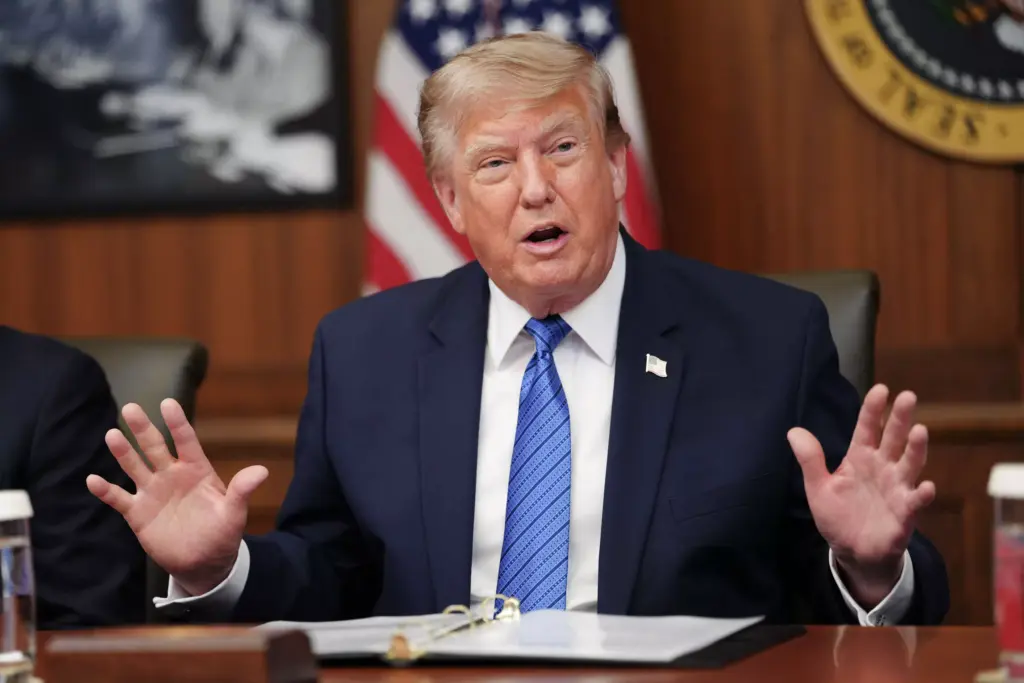
Twenty-five Democratic-led states sued Donald Trump’s administration on Monday, 3 July, at the US Court of International Trade in New York, arguing that his newest round of global tariffs is an unlawful attempt to revive import taxes the Supreme Court has already struck down. They want a judge to void the duties, stop the government collecting them, and refund what has been paid.
It is the third tariff lawsuit this group of states has filed in 16 months. Each time the tariff has looked much the same. Only the law used to justify it has changed.
What the tariffs are ?
On 23 July, the US Trade Representative announced duties of 10 per cent or 12.5 per cent on goods from 60 trading partners, including the European Union, economies that, according to the states’ complaint, account for 99.4 per cent of all American imports. The official reason given was that those countries are not doing enough to keep goods made with forced labour out of their supply chains.
The timing is the states’ first exhibit. The announcement landed one day before a temporary 10 per cent global tariff was due to lapse. The new duties took effect on 24 July, the day the old ones expired. There was no gap.
Why the states say it is illegal?
The complaint argues that forced labour is a pretext. It says the trade representative investigated 60 economies in roughly two and a half months, skipped the country-by-country consultations the statute requires, and set rates without explaining how a near-universal import tax would reduce forced labour anywhere. The suit alleges breaches of both Section 301 of the Trade Act of 1974 and the Administrative Procedure Act, which requires agencies to give reasons for what they do.
The states also point to a contradiction in the government’s own findings: officials named frozen beef from Brazil as one of only three goods linked to forced labour, then exempted it from the tariffs.
“Tariffs are taxes,” said Rob Bonta, the California attorney general co-leading the case with counterparts in Arizona and Oregon. Letitia James, the New York attorney general, said the administration was “once again trying to illegally raise taxes on families and businesses”. Kris Mayes, of Arizona, pointed to “higher grocery prices, bigger bills for small businesses”. Kathy Hochul, the New York governor, called the levies “a tax on hardworking families”.
The White House’s answer
Kush Desai, a White House spokesman, said a country’s failure to enforce a ban on goods made through forced labour burdens American commerce and must be addressed. He described Section 301 duties as “a legally durable tool”, noting they survived a court challenge when Trump used them against China in his first term.
That is the administration’s strongest card. Section 301 is the one tariff power Trump has used before and kept.
Two defeats, and a trap
On 20 February, the Supreme Court ruled 6-3, in Learning Resources v Trump, that the International Emergency Economic Powers Act does not let a president impose tariffs at all, striking down the “liberation day” levies. The administration invoked Section 122 of the Trade Act the same day. On 7 May, the trade court struck that down too.
But the May ruling carries a warning for the states. The court found that most of them lacked standing, because they had not paid the tariffs directly and their indirect losses were too speculative. Only Washington cleared the bar. If that reasoning holds again, the coalition may never reach the forced-labour question.
Midterm elections and politics at play
The case is filed in a court, but it is aimed at November. The cost of living has dominated the US midterm campaign. An NBC News poll in March found 55 per cent of voters said the tariffs had hurt the economy against 33 per cent who said they had helped, with Democrats holding a six-point lead on control of Congress. A CNBC analysis of census data in February put tariff bills across the states at $200 billion between March 2025 and November 2025, with more than $134 billion of that paid in states holding key midterm races. In April, the Democratic Congressional Campaign Committee circulated a memo calling tariffs Republicans’ biggest 2026 liability, and enough Republicans broke ranks in Congress in February to let anti-tariff votes proceed.
For the attorneys general, the litigation doubles as a platform. Their press releases are written in the language of grocery bills rather than trade statutes. Bonta’s office pointedly notes this is his third tariff challenge.
Trump, for his part, has said the Supreme Court ruling vindicates him, pointing to the dissenting justices.
What happens next ?
The states have asked for a three-judge panel. The quiet, expensive question is refunds. The Penn Wharton Budget Model projected up to $175 billion in refunds from the IEEPA reversal alone, and customs officials are still working through tens of millions of entries. The Section 301 duties are being collected now with no refund system built. Every week the case runs, the bill for unwinding it grows.