
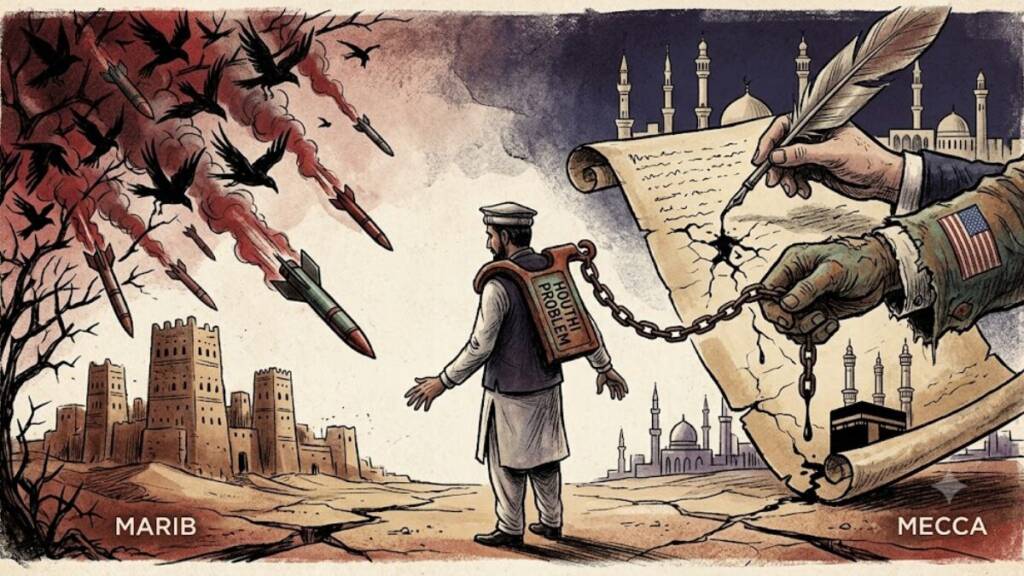
New Delhi: Iran-aligned Houthi forces fired ballistic missiles and drones into displacement camps and residential streets in the government-held Yemeni city of Marib on Friday, killing two people and wounding 14, the state news agency SABA reported. Hours later and 700 miles north, Saudi Arabia, Turkey and Pakistan signed a treaty in Mecca declaring that an armed attack on one of them is an attack on all three.
The timing is the story. Washington has spent 18 months learning that the Houthis are not a nuisance but a chokepoint operator. Now three of America’s Sunni allies have decided to insure themselves, and one of them has nuclear weapons.
What happened in Marib
Yemen’s health minister, Qassem Buhaibeh, called the toll preliminary and described the Houthis as a “terrorist militia”. Arab News put Friday’s total at five, including three government soldiers killed by a drone.
Thursday was worse, and the figures are disputed. Government sources told Reuters that at least 30 troops died in strikes on camps in Marib and Hadramawt; a military source told AFP the number was at least 58. Neither count has been independently verified.
The Houthi spokesman, Yahya Saree, said his forces had hit Saudi-backed troops, depots and equipment at the Sahn al-Jinn camp, and vowed to “strike forcefully any Saudi mobilisation”. Yemen’s army said on Saturday it had hit back along several fronts.
The UN special envoy, Hans Grundberg, said the Marib and Hadramawt attacks, together with renewed strikes on shipping in the Red Sea and Gulf of Aden, had left Yemen at its greatest risk of full-scale war since the truce of April 2022, and warned the fighting could pull the country into a wider regional confrontation.
Why this reaches American petrol pumps
Since the US-Israeli war on Iran began on February 28, most traffic through the Strait of Hormuz has stopped. Saudi crude went the other way instead, and exports through the Bab al-Mandeb strait climbed from roughly 4.2 million barrels a day in 2025 to 7.4 million in June, according to Kpler data.
The Houthis worked that out too. They declared a maritime blockade of the kingdom on July 20, struck two Saudi tankers, and Brent crossed $100 a barrel on July 23 for the first time since May. The US president, Donald Trump, promised “major military punishment” for Iran and its allies.
Bombing has been tried: an opinion column on MS Now noted the 2025 air campaign ran nearly two months and cost over $1 billion, and left the Houthis operational. The Pentagon says 18 American service members have died since February, with nearly 500 injured.
The pact signed in the holy city
Crown Prince Mohammed bin Salman, President Recep Tayyip Erdogan and the Pakistani prime minister, Shehbaz Sharif, signed the Makkah Joint Defence Agreement at Al-Safa Palace on Friday. An attack on one is to be regarded “as an attack against them all”. Sharif called it a “shield of peace”. The Turkish vice-president, Cevdet Yilmaz, said it targets no particular country; Arab News reported a Saudi minister insisting it is not a “military axis or sectarian bloc”.
Read plainly, it is a hedge. Analysts told AFP that Riyadh now sees Washington as a less reliable partner. Three American allies binding their own defence at Islam’s holiest site is a verdict on the old arrangement.
Could Islamabad end up shooting at Houthis?
It is exposed already. Reuters reported in May that Pakistan had sent about 8,000 troops, roughly 16 JF-17 fighters, two drone squadrons and a Chinese HQ-9 air defence system to the kingdom, officially advisory, Saudi-financed. When shells hit Najran on Friday, the coalition spokesman, Major General Turki al-Maliki, said 11 people were injured, among them a Pakistani.
The brake is domestic. In April 2015, Pakistan’s parliament unanimously resolved that the country should maintain “neutrality in the Yemen conflict”. It was moved by Ishaq Dar, now deputy prime minister and foreign minister, and present at Friday’s signing.
Ambiguity is the policy. The defence minister, Khawaja Asif, said nuclear weapons were “not on the radar” of the 2025 Saudi pact, while a senior Saudi official told Reuters the deal “encompasses all military means”. The analyst Mansoor Ahmed told Middle East Monitor that Pakistan’s arsenal is pointed at India, not the Gulf. The Atlantic Council judged the pact not a Nato-style alliance. Islamabad borders Iran and is mediating between Washington and Tehran.
The ghost of the Baghdad Pact
Turkey and Iraq signed the Baghdad Pact in February 1955; Britain, Pakistan and Iran followed. America never joined properly, becoming an associate member in 1959. Iraq walked out that March after its monarchy fell. Renamed Cento, it gave Pakistan nothing in its 1965 and 1971 wars with India, because it had been built against Moscow. Britain withdrew support after 1974. The whole thing dissolved on March 16, 1979.
Signatures follow interests, not the other way round. Watch whether Riyadh actually invokes Mecca over Yemen, and whether Trump strikes again before November.