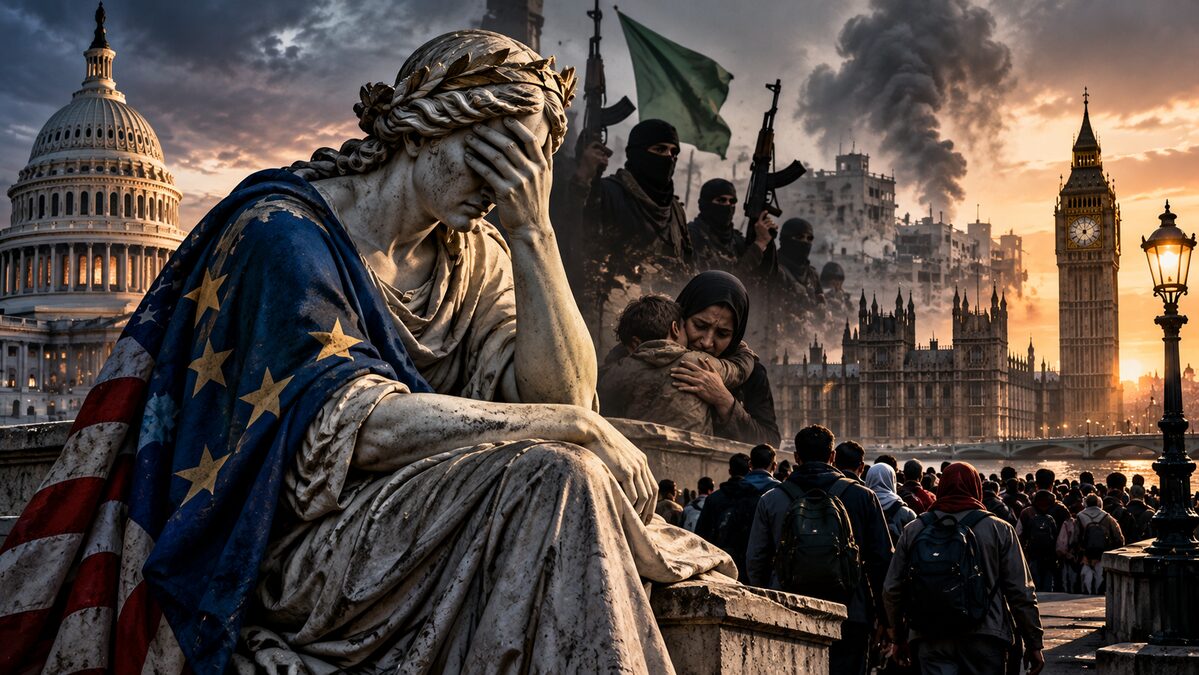
On 7 October 2023, while Hamas terrorists were still inside southern Israel, 34 Harvard student groups put their names to a statement holding ‘the Israeli regime entirely responsible for all unfolding violence’. That is liberal guilt in its purest form: a reflex that reaches for the West’s sins before the victims of its enemies have been counted.
The same reflex explains why Western institutions spent two decades going easy on Islamists for fear of looking Islamophobic, why so many hesitated to name Hamas’s crimes, and why Europe kept its doors open long after the costs were plain. To understand any of it, you have to understand where the guilt came from.
Where Liberal Guilt Came From
Liberal guilt was not born in Brussels. It was born in America after the civil rights era. In his 2006 book White Guilt, Shelby Steele of the Hoover Institution argued that once America confessed its racial sins, its institutions lost their moral authority and spent decades trying to buy it back. The currency was deference: don’t ask the awkward question, don’t enforce the inconvenient standard, prove again and again that you are not a bigot.
Europe had more to confess: two world wars, the Holocaust, centuries of empire. ‘Never again’ became the continent’s creed and, over the decades, quietly widened into ‘never say no’. The French essayist Pascal Bruckner saw it early. In The Tears of the White Man (1983) he described Western pity for the developing world curdling into condescension; in The Tyranny of Guilt (2006) he portrayed a Europe so absorbed in its own sins that it could no longer see anyone else’s.
Islamophobia as a Shield
After 11 September 2001, the guilt found a new object. Iraq’s missing weapons of mass destruction and the photographs from Abu Ghraib gave the left a new story: the West was not jihadism’s victim but its cause. Terrorism became ‘blowback’. Criticism of Islamism became ‘Islamophobia’, a term Britain’s Runnymede Trust had popularised in 1997 and which, after 2001, ended debates rather than starting them.
Let us be precise. Islamism is not the faith of Europe’s Muslims; it is a political ideology. But a culture too frightened to tell the difference ends up shielding the ideology in the name of protecting the faith. When Danish cartoons of the Prophet Muhammad led mobs to torch Danish diplomatic buildings in Damascus and Beirut, most British and American newspapers refused to show readers what the fury was about. IIn October 2020, extremists beheaded Samuel Paty, a history teacher near Paris, after launching an online campaign of lies about how he had treated Muslim pupils during a lesson on free speech.
Looking the Other Way
In 2023 William Shawcross’s official review of Prevent, Britain’s counter-extremism programme, found ‘a double standard’ in how it treated the extreme right and Islamism, even though Islamist terrorism made up three-quarters of MI5’s terrorist caseload. Weeks after 7 October, Scotland Yard reviewed footage of a man chanting ‘jihad’ at a rally organised by Hizb ut-Tahrir and found no offence, noting that the word ‘has a number of meanings’. Three months later the government banned Hizb ut-Tahrir as a terrorist organisation.
The cost of that timidity is counted in lives. In May 2017, a young steward at Manchester Arena sensed something was wrong with Salman Abedi minutes before he murdered 22 people, but fear of being branded a racist stopped the steward from speaking up. The same reflex let grooming gangs operate in plain sight.
An inquiry estimated that perpetrators, mostly men of Pakistani heritage, sexually exploited around 1,400 children in Rotherham between 1997 and 2013. Staff hesitated to identify the abusers’ ethnicity because they feared that others would label them racist. In 2025 Baroness Casey found that such questions had been avoided for years, and a national inquiry was finally ordered.
Hamas and the Cult of ‘Context’
Then came 7 October: some 1,200 people murdered in Israel and about 250 taken hostage. Here, surely, was an atrocity too stark to contextualise. Not quite. The UN Secretary-General condemned the attack and, in the same speech, told the Security Council it ‘did not happen in a vacuum’. UN Women, the body charged with defending women’s rights, took nearly eight weeks to condemn Hamas by name, though UN investigators later found ‘reasonable grounds to believe’ that rape and gang rape had taken place that day.
When an explosion hit al-Ahli hospital in Gaza that month, Hamas claimed an Israeli strike had killed hundreds, and much of the Western press ran with it. American officials concluded Israel was not responsible, and the New York Times conceded it had ‘relied too heavily on claims by Hamas’. Nine staff of UNRWA, the UN’s agency for Palestinian refugees, may have been involved in the massacre and were sacked. And when Congress asked the president of the University of Pennsylvania whether calling for the genocide of Jews broke campus rules, she called it ‘a context-dependent decision’. She resigned within the week.
Guilt cannot see a perpetrator who is not Western, so it goes looking for one who is.
The Open Door
The same guilt shaped Europe’s borders. Western air power helped topple Muammar Gaddafi in 2011, Syria’s civil war sent millions fleeing, and the logic wrote itself: we broke the Middle East, so we owe it a home. On 31 August 2015 Angela Merkel declared ‘Wir schaffen das’ (‘We can do this’), and about 890,000 asylum seekers reached Germany that year. On New Year’s Eve in Cologne, police first said the celebrations had passed off peacefully. Prosecutors went on to receive more than 1,200 criminal complaints, 513 of them for sexual assault or harassment, yet nearly a year later had brought just five indictments for sexual offences.
France tells the same story. France has about 7.6 million immigrants, representing 11.2 per cent of its population. Yet, in 2022, French authorities enforced only about 7 per cent of the more than 134,000 orders requiring people to leave the country. Lola Daviet, aged 12, was raped and murdered in Paris in 2022 by an Algerian woman already under such an order. Even in Norway, the national statistics agency found that refugees and family-reunification migrants were the most over-represented groups among offenders, while migrants from India, China and the Philippines were under-represented. This was never about race. It is about whom a country admits, and whether it insists they become part of it.
From Penance to Constituency
Guilt also proved good politics. In 2011 Terra Nova, a think tank close to France’s Socialist Party, urged the left to look beyond the working class and build a new majority from graduates, the young, women and minorities. The strategy outlived the Socialists. In the first round of the 2022 presidential election, 69 per cent of Muslim voters backed Jean-Luc Mélenchon, the far-left leader who opposed France’s 2021 law against Islamist ‘separatism’. Penance became a constituency, and no politician audits his own base.
The Way Out
The answer is not cruelty. It is adulthood. Denmark shows that the left can also take this approach: in 2021, Social Democratic Prime Minister Mette Frederiksen set a goal of zero asylum seekers and warned that admitting too many people would undermine social cohesion.
The West did not invent conquest or slavery. It is the civilisation that led the fight to abolish slavery and wrote the vocabulary of equal rights, the rule of law and the dignity of women. The West must defend those values by applying them to everyone, including Islamists who cry “Islamophobia” whenever anyone asks them to respect those values.
Guilt is a feeling. Borders, laws and moral clarity are obligations. A civilisation that confuses the two will keep apologising until people forget what it apologised for.