
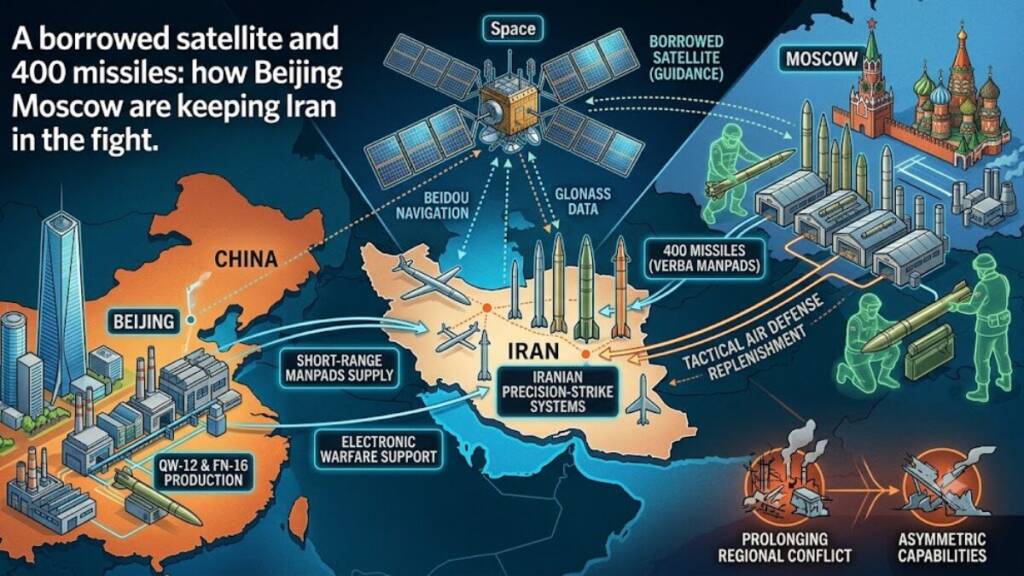
New Delhi: China has lent Iran one of its military satellites and is preparing to ship hundreds of shoulder-fired air-defence missiles to Tehran, while Russia has handed over anti-jamming equipment and intelligence on the whereabouts of American forces, support that has arrived at the exact moment Iranian missiles started landing on target and American interceptor stocks started running out.
The war, in its sixth month since the US and Israel opened their air campaign on February 28, has produced a steady drip of such reports. Washington has answered with sanctions. Beijing and Moscow deny almost all of it. Trump has waved it away.
What Moscow has sent
NBC News reported that Russia has been feeding Iran intelligence on the position of US forces across the Middle East, drawing on a satellite network far larger than anything Tehran can field. A follow-up on July 31, citing a US and a European official, said the sharing extends to electronic intelligence — the radar and communications signatures that let Iranian operators jam American aircraft and precision munitions.
The Ukrainian president, Volodymyr Zelenskyy, said his intelligence services had tracked Russian satellites concentrating on four air bases over two days — two in Bahrain, one each in Jordan and Kuwait — and had passed the material to partners.
Hardware has followed. Sources in Iran’s Revolutionary Guard told The Insider that after fighting resumed in mid-June, Russia began supplying Kometa-M anti-jamming modules, which Iranian technicians fitted to their drones within days, along with countermeasures to confuse air defences tracking ballistic missiles.
What Beijing has sent
Reuters reported on July 29 that Iran is due to receive, within weeks, the first tranche of 300-400 Chinese QW-12 and FN-16 man-portable air-defence systems in a deal worth $60m-$70m, signed through a Hong Kong intermediary. China’s foreign ministry called the reports completely groundless.
The bigger claim is the satellite. Antonio Giustozzi, a senior research fellow at the Royal United Services Institute (RUSI), wrote that Guard sources describe Beijing loaning Iran one of its military satellites, letting Tehran watch the region in real time and put missiles on targets at short notice. If accurate, it is a first for China, and a long way from selling spare parts.
Washington had already moved. In May it sanctioned three Chinese satellite firms, among them Mizar Vision, which it accused of exposing the locations of US aircraft and Patriot and THAAD batteries in Saudi Arabia, Bahrain and Jordan. On July 30 the Treasury sanctioned six more entities and individuals in China, India, Russia and Iran, with the treasury secretary, Scott Bessent, saying such firms were helping sustain a terrorist enterprise.
Denials, and doubts
Not everyone is convinced. Sidharth Kaushal, also of RUSI, argued Iran has mostly hit fixed installations already visible on commercial imagery, and called the resemblance between Iranian and Russian tactics a convergent evolution rather than proof of transfer. His colleague Matthew Savill said the cooperation exists but produces nothing like the returns Nato generates.
The US defence secretary, Pete Hegseth, told senators there was definitely adversary alignment. Trump, who says Xi Jinping and Vladimir Putin both assured him personally they would stay out, called the assistance very impactful.
Can it keep Iran in the war?
It can prolong the war. It probably cannot win it.
Look at what Tehran has actually taken delivery of, and a pattern emerges: everything is small, cheap and quick to fit. Shoulder-launched missiles can be dispersed among a dozen sites and moved nightly. Anti-jam modules go on a drone in an afternoon. Satellite imagery needs no integration at all.
What Iran has not taken is just as telling. Guard sources say the Su-35 fighters Russia offered are still sitting in Russia, because Iranian officers judged they would be destroyed on the ground before reaching shelter. S-400 batteries and J-10C jets would take years to absorb. Iranian ports are under US naval blockade, and Tehran is buying, not being gifted.
The leverage, instead, sits on the American ledger. CSIS analysts estimate fewer than 827 Patriot and fewer than 278 THAAD interceptors remain in US stockpiles, with years needed to rebuild them. Chinese and Russian help does not let Iran take ground. It lets Iran keep shooting for longer than Washington can comfortably keep intercepting, which, in a war of attrition, is the whole point.