
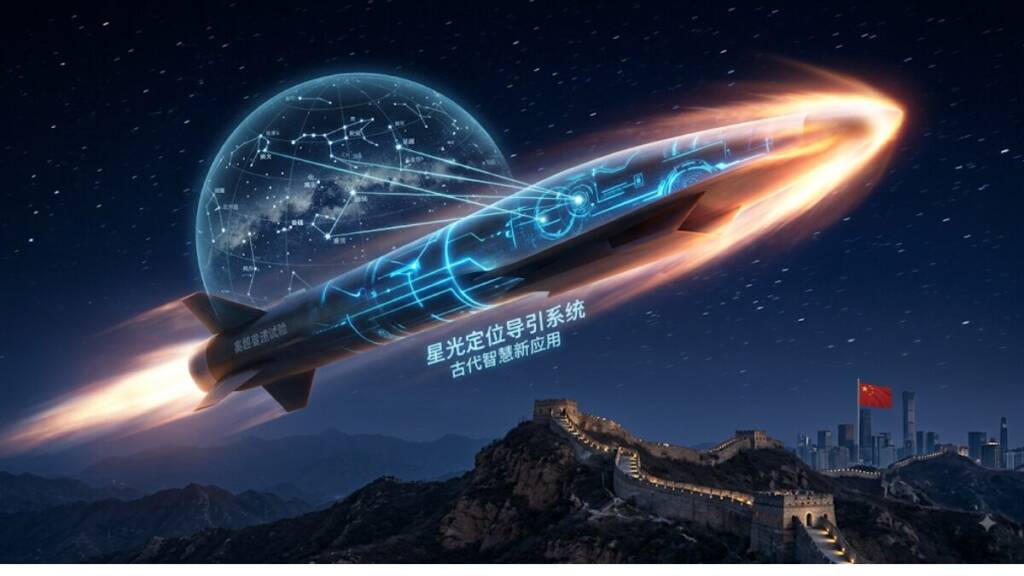
Sailors once found their way home by the North Star. Now a weapon may do the same — while travelling faster than a mile a second.
Chinese researchers say they have cracked a problem that has defeated engineers for decades. The Guangdong Aerospace Research Academy (GARA) led the project, which passed its final expert review on Monday, the South China Morning Post reported, a day after the academy published its findings. The brief was blunt: build a navigation system that can read the night sky at Mach 5 and above. The team says it succeeded, and has built a prototype star sensor to prove it.
The Blind Spot at Mach 5
Hypersonic flight creates its own worst enemy. Air simply cannot get out of the way fast enough, so shock heating strips electrons from the surrounding molecules and wraps the vehicle in a glowing shell of ionised gas — what engineers call the plasma sheath.
That sheath reflects and swallows radio waves, so telemetry drops out and satellite signals vanish too. The US Navy states the problem plainly: plasma blocks GPS reception during flight, and Notre Dame’s hypersonics group reaches the same conclusion. The fastest weapons ever built, in other words, often fly deaf and blind — precisely when accuracy matters most.
Why Stars Are Hard to Read at Speed
Celestial navigation sidesteps the problem entirely. A star tracker transmits nothing; instead, it photographs the sky and calculates its own position, which means no jammer can touch it. The method is, as the SCMP notes, fully self-contained.
Yet heat ruins the view. The optical window glows white-hot, and its own thermal radiation floods the detector, while turbulent air bends the incoming starlight — an effect researchers call aero-optical distortion, which smears star images badly.
Chinese laboratories have chipped away at this for years. In January, a Harbin Institute of Technology team modelled the glare in detail and reached a surprising verdict: the scorching window, rather than the plasma, does most of the damage. The Guangdong group now claims the missing piece, saying its researchers can predict how starlight bends at extreme speed — and have built hardware around that prediction.
GARA is no obscure workshop. It designed the GDF-600 boost-glide vehicle shown at Zhuhai in 2024 and co-developed the MD-22 hypersonic testbed, meaning its guidance research sits very close to the airframes that would actually carry it.
What It Means
Jamming loses its grip. Electronic warfare has become the cheap answer to expensive weapons, and interference has surged since 2022 — on a single day this February, jamming scrambled navigation aboard more than 1,100 ships in Gulf waters, and aircrews report similar chaos over Europe and the Middle East. A star-guided weapon would ignore all of it.
Defence gets harder and dearer. Soft-kill options shrink accordingly, forcing defenders to lean on interceptors and space-based tracking, both of which cost far more than a jammer. Washington’s Golden Dome architecture already reflects that shift, tilting the economics of deterrence further towards the attacker.
Deterrence stability suffers, too. Commanders trust weapons they cannot recall or reroute less easily, and a fully autonomous seeker removes a human check mid-flight — a risk arms controllers have flagged for years, without anyone yet writing rules for it.
China also cuts its own dependence. BeiDou belongs to Beijing, yet it remains a satellite constellation, and satellites can be jammed, dazzled or shot down. An onboard sky camera cannot.
The technology spreads sideways as well. Star trackers also suit spaceplanes, reusable rockets and civil aviation, and Western agencies are chasing the same GPS-free goal, as a 2026 counterspace assessment makes clear.
The Caveats
Restraint is warranted. An expert review is not a battlefield, prototypes routinely fail in flight, and state institutes rarely face independent scrutiny. The academy has published no accuracy figures, no flight-test data and no timeline, and clouds, daylight and violent manoeuvring all complicate star tracking further. Any real system would therefore blend starlight with inertial sensors rather than replace them.
Even so, the direction of travel looks unmistakable. Armies spent two decades learning to sever the link between a weapon and its satellites. Engineers in Guangdong now propose to remove the link altogether.
The sextant, it seems, is making a comeback. This time it flies at seven times the speed of sound.