
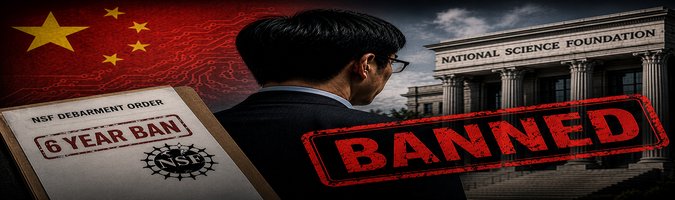
For more than two years, Tao Li helped decide which American computer scientists got federal research money. All the while, US investigators say, he was quietly signed up to two Chinese government talent plans.
The National Science Foundation (NSF) has now barred him from federal funding for six years. Bloomberg first reported the debarment on 13 August. The ban drew on more than 30 documents compiled by the agency’s Office of Inspector General. The NSF never announced the decision. Instead, a single entry appeared on sam.gov, the government’s contracting database.
What the Inspector General Found
Li served as an NSF programme officer from 2015 to 2017. The role covered grants in hardware, software and algorithms. During that stretch, the inspector general concluded, he took part in two Chinese talent plans.
The FBI has long warned that such plans can push members to steal or misappropriate foreign technology. Moreover, investigators found he helped award grants to at least seven other scientists. Those researchers allegedly hid their own membership of one plan, called Dragon Star.
Li rejects any suggestion of favouritism. He told Bloomberg the awards went out on merit, and were “recommended and concurred by the entire panel”. He also said he handled proposal reviews and award management without a single complaint.
The timeline stings more than the finding. The FBI flagged its concerns to NSF leadership in 2019. The inspector general then opened an inquiry. Seven years passed. The Justice Department declined a criminal referral in 2024. The ban followed in May 2026. By then, Li had gone. He now runs an artificial intelligence research centre at a military-affiliated university in central China.
American campuses have seen this film before. In 2021, a jury convicted Harvard chemistry chair Charles Lieber of lying about his Thousand Talents Programme ties. A judge sentenced him in 2023 to home confinement and a $50,000 fine. In April 2025, Lieber joined Tsinghua University as a chair professor in Shenzhen.
Other cases collapsed. Prosecutors charged University of Kansas chemist Feng “Franklin” Tao in 2019. A jury convicted him in 2022. However, the trial judge threw out the wire fraud counts, and the Tenth Circuit acquitted him in July 2024. The court noted that the FBI had found no evidence of espionage at all.
Meanwhile, prosecutors dropped their case against MIT’s Gang Chen in 2022. Emory neuroscientist Xiao-Jiang Li pleaded guilty to a tax charge. The FBI accused Cleveland Clinic researcher Qing Wang of hiding Chinese funding while holding $3.6m in NIH grants.
What Washington has Tried
The Justice Department launched its China Initiative in November 2018. It then shut the programme down in February 2022, after accusations of racial profiling. The NIH ran a parallel sweep, identifying more than 200 scientists at nearly 100 institutions.
Congress then hard-wired the rules. Sections 10631 and 10632 of the CHIPS and Science Act 2022 bar agency staff from joining foreign talent programmes. They also block funding for anyone in a “malign foreign talent recruitment programme”. Applicants must certify their status and sit annual research security training.
Agencies added their own layers. The Energy Department restricted talent plan participation under Order 486.1A back in 2019. The Pentagon introduced a risk decision matrix in 2024. The White House science office issued common disclosure forms the same year. The NSF, for its part, now publishes case studies and runs a $67m research security programme.
So Why Does it Keep Happening?
Firstly, the target moved. Beijing quietly retired the Thousand Talents brand and rebranded the effort as Qiming, run by the industry ministry. Reuters found signing bonuses worth 3m to 5m yuan. Recruiters now work through private messages, not government websites.
Secondly, the system runs on trust. Researchers certify their own affiliations. Universities then verify claims buried in Chinese-language contracts. Few compliance offices can read them.
Thirdly, enforcement crawls. Li’s case took seven years from tip to ban. Courts have also raised the bar, demanding proof that a hidden tie actually changed a funding decision.
Finally, politics keeps shifting the ground. The Justice Department now leans on the False Claims Act to pursue universities rather than individuals. Lawmakers pushed to revive the China Initiative, then dropped the language in January 2026. Many Chinese-American scientists, wearied by suspicion and grant cuts, simply leave.
That leaves Washington with an awkward bind. Loose rules let undisclosed ties slip through. Tight rules push good scientists out. Neither outcome keeps the research at home.
Li’s ban expires in 2032. He is unlikely to need it lifted. The paperwork caught up with him eventually, long after the science had already moved east.