
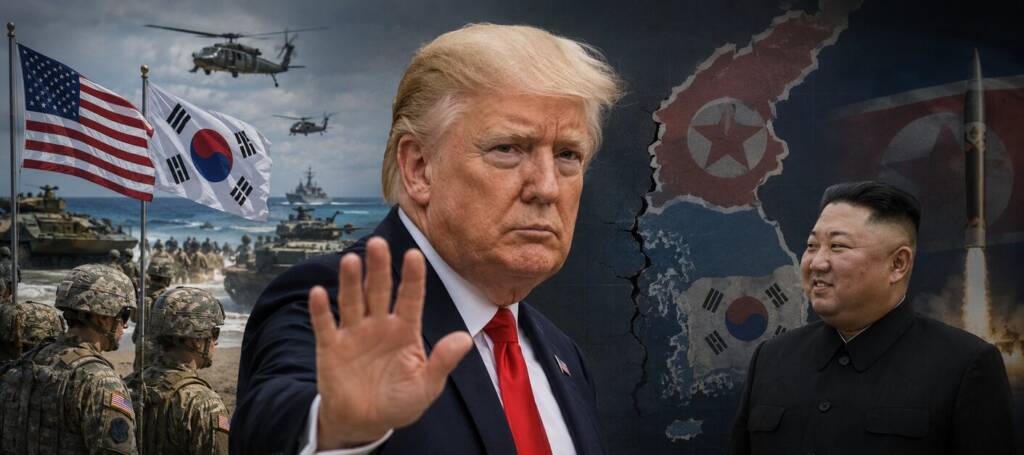
President Donald Trump has ordered a sharp reduction in US-South Korea joint military exercises, announcing the decision just hours before this year’s drills were set to begin. He posted the move on Truth Social on Sunday, August 16, citing two reasons: the cost of the exercises and his “very good relationship” with North Korean leader Kim Jong-un.
Trump said it was too late to cancel the drills outright, so he instructed Secretary of War Pete Hegseth to “substantially reduce” them instead. He described the exercises as a signal that is “totally inappropriate and hostile” toward North Korea, adding that Pyongyang has been “unthreatening and respectful” throughout his presidency.
Seoul did not back down. South Korea’s Defence Ministry said the exercise would proceed “as previously notified and scheduled.”
What’s Actually Being Cut
Ulchi Freedom Shield is scheduled to run from August 17 to 27, involving around 18,000 South Korean troops alongside American forces and personnel from 11 UN Command member states. The United States currently stations roughly 28,500 troops in South Korea.
This year’s exercise scenarios cover drones, GPS jamming, electronic warfare and cyberattacks. North Korean soldiers reportedly learned these tactics while fighting alongside Russian forces in Ukraine.
What “substantially reduce” actually means in practice remains unclear. As of Monday, South Korean commanders said they had received no specific request from Washington detailing the scope of the cuts.
An Iran Snub Behind the Decision
Trump drew the connection himself, writing that he had recently asked South Korean President Lee Jae Myung to join American efforts to denuclearise Iran — and that the response was a blunt “No thanks!”
The US war on Iran began on February 28. Since then, Trump has pressed allies and partners for air bases, warships to help reopen the Strait of Hormuz, and reconstruction funding. Most have refused.
Europe felt the fallout first — White House Press Secretary Karoline Leavitt said NATO had “failed the test,” while the administration openly floated the idea of leaving the alliance. That same frustration has now reached Asia, this time translating into a concrete cut to joint military exercises with South Korea
Colby’s China Strategy Leaves Korea Off the Map
The timing is telling. Just six days earlier, Under Secretary of War for Policy Elbridge Colby outlined Washington’s Asia strategy in a speech in Manila. He described the US goal as seeking “partners, not protectorates.” His stated priority: building “a fully operational, resilient architecture of denial defence” stretching along the first island chain — running from Japan through Taiwan to the Philippines.
South Korea does not sit on that chain.
Colby’s roughly 4,000-word speech mentioned China only in passing. He framed the new approach as one of “realism” rather than moral confrontation with Beijing. The Pentagon underscored the shift in posture in June by renaming Indo-Pacific Command as Pacific Command.
The message to allies is unambiguous: do more locally, and free up American forces for a potential China contingency. On the Korean peninsula, this concept is known as “strategic flexibility”, an idea Seoul has resisted for years.
The Security Cost
Defence analysts warn the cuts carry real risk. Thinning out the drills “lowers coalition readiness and puts US forces at risk,” said Rear Admiral (Ret.) Mark Montgomery of the Foundation for Defense of Democracies.
North Korea, for its part, is not standing still — it fired ballistic missiles on August 6 and again on August 12, and has warned of an “overwhelming response” to the joint exercises.
There’s a quieter, longer-term problem too. These exercises also serve as the benchmark for transferring wartime operational control (OPCON) back to Seoul.
Yu Ji-hoon of the Korea Institute for Defense Analyses cautioned that repeated cuts could erode both combined military proficiency and the consistency of deterrence signalling toward Pyongyang.
Allies Take Note
The decision has already roiled South Korean politics.
The opposition People Power Party called it a security debacle. Lawmaker Na Kyung-won said the alliance, “forged in blood,” had been reduced to a matter of “cost and transactions.” In Washington, Democratic Senator Andy Kim objected to the process rather than the substance. He argued that allies should jointly make decisions on military exercises rather than see them announced unilaterally on social media. Leif-Eric Easley of Ewha Womans University warned the move would “damage alliance coordination.”
The reaction extends beyond the peninsula. Southeast Asian governments had already begun recalibrating after Colby’s tour of the region. The USS George Washington recently departed for the Middle East. Its departure has left the Pacific without an American aircraft carrier covering the region.
A Familiar Pattern
This isn’t the first time Trump has scaled back military drills with South Korea.
After the 2018 Singapore summit with Kim, he suspended Ulchi Freedom Guardian. In 2019, the allies scrapped Key Resolve and Foal Eagle altogether. Diplomacy subsequently collapsed at the 2019 Hanoi summit. Large-scale exercises only resumed in 2022 — while North Korea, throughout, kept its weapons programme intact.