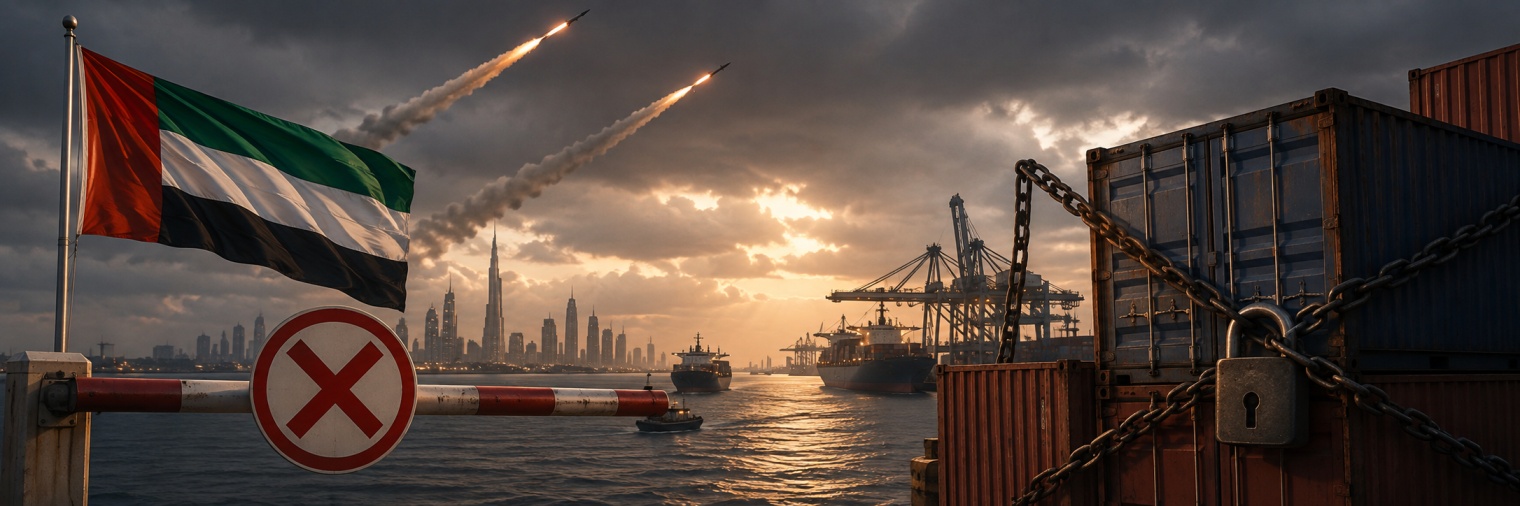
The UAE has cut off Iran’s most valuable commercial lifeline. On Wednesday, the UAE’s Ministry of Foreign Affairs suspended all trade, commercial exchanges and financial transactions with Iran until further notice, hours after its defence ministry said it had detected two ballistic missiles fired from Iranian territory. Tehran denies launching them.
The Foreign Ministry cited “escalations that undermine peace and security in the region.” Afra Al Hameli, director of the ministry’s strategic communications department, announced the decision on X, adding that the UAE remains committed to dialogue, cooperation and regional integration.
The defence ministry gave a separate account: one missile fell outside Emirati territorial waters, the other landed inside them. Officials assessed both as targeting maritime traffic. No casualties or damage have been reported.
The alert came days after Abu Dhabi accused Iran of striking two vessels belonging to state-owned oil company ADNOC in the Strait of Hormuz — an attack Iran has also not claimed.
Tehran’s Response
Iran’s Foreign Ministry rejected the accusation within hours. Spokesman Esmail Baghaei called it baseless and harmful to regional trust, saying it ran contrary to the principle of good-neighbourliness. He raised the possibility of a “false flag operation” and pointed instead to what he described as ongoing US and Israeli actions in the region.
What the Suspension Means
Dubai has quietly become Iran’s largest supplier of imported goods. Retired US general and former assistant secretary of state Mark Kimmitt said Dubai supplies roughly a third of Iranian imports — more than China or Turkey combined — calling the Emirati embargo “even more significant” than Washington’s own sanctions.
Dubai’s status as a global financial hub has long given Tehran a discreet workaround for international sanctions. Bilateral trade has ranged between $16 billion and $28 billion in recent years, and Emirati exports to Iran climbed from about $5.2 billion in 2018 to more than $20 billion recently. Thousands of Iranian firms operate out of the UAE, many through Dubai’s free zones and re-export channels.
Pressure had been building: Emirati authorities detained dozens of money changers linked to Iranian networks back in March, according to Iran International.
A War That Reshaped Gulf Trade
The conflict began on February 28, when the US and Israel struck Iran. Iran retaliated across the Gulf, and the UAE absorbed the heaviest fire of any Gulf state — more than 530 ballistic missiles, dozens of cruise missiles and over 2,200 drones in the following weeks. Tuesday’s strike was the first targeting the UAE since May.
The UAE suspended direct cargo shipping with Iran in early March; trade resumed only in late June through Dubai’s Jebel Ali Port. That reopening has now closed again.
The Wider Squeeze
The timing is significant: a 60-day window for US-Iran talks expired Monday without agreement, and Washington continues to blockade Iranian ports by sea as President Trump signals a shift toward economic rather than military pressure.
Shipping through the Strait of Hormuz has collapsed to between 8 and 15 vessels a day, down from roughly 130 before the war. The International Maritime Organization has logged 64 violent incidents involving commercial vessels since late February, killing 17 seafarers. Brent crude climbed toward $90 a barrel last week — about 24% above pre-war levels.
What Happens Next
Kimmitt does not expect other Gulf states to follow Abu Dhabi’s lead immediately, predicting a wait-and-see approach across the region — though he warned Tehran could interpret the embargo as a near-warlike act.
The UAE looks better positioned to absorb the shock: non-oil foreign trade reached AED 1.937 trillion in the first half of 2026, up 13.1% year-on-year, according to The National. Iran has no comparable cushion — its importers, exchange houses and banks all lean heavily on Dubai.
The Emirati statement listed no exemptions for food or medicine and set no review date. For now, the suspension stands open-ended — and that silence may prove its sharpest edge.