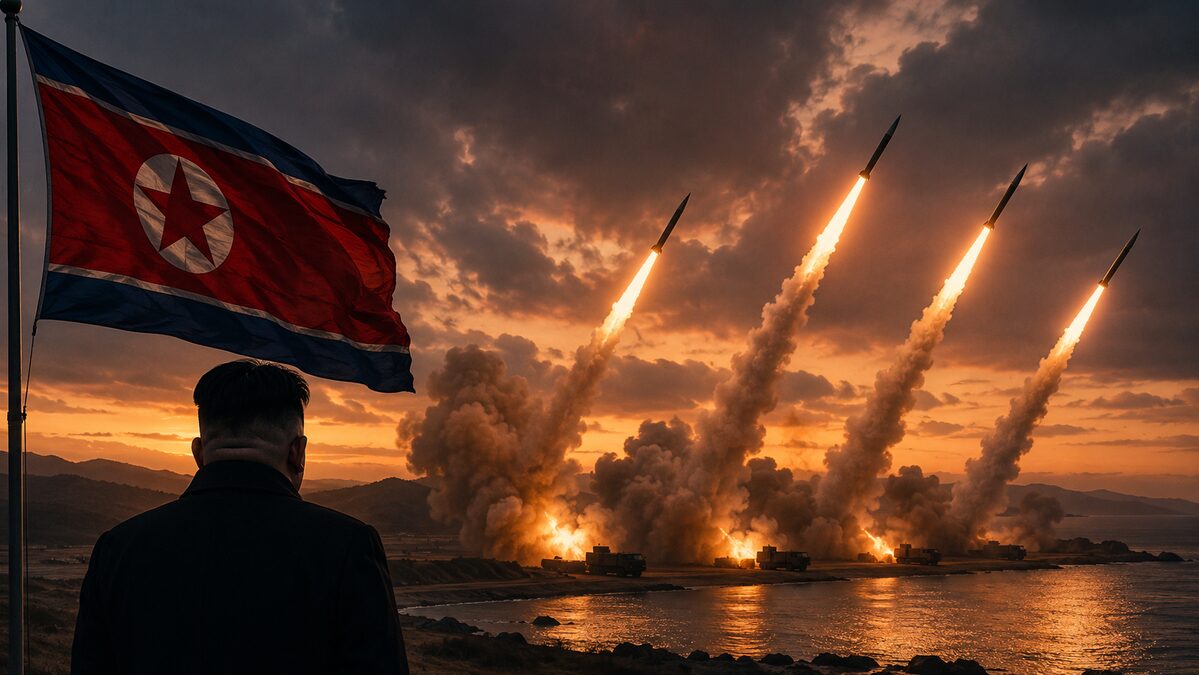
North Korea fired approximately 10 short-range ballistic missiles toward the sea on Thursday evening, in a launch that landed squarely in the middle of Washington’s warmest overture to Pyongyang in seven years.
The missiles were launched from the Pyongyang area at around 5 p.m. local time, South Korea’s Joint Chiefs of Staff confirmed. Each weapon flew roughly 300km before falling into waters east of the Korean peninsula. The distance covered was not the point — the timing was.
Seoul and Tokyo Respond
Seoul reacted within hours. President Lee Jae Myung’s office convened an emergency security meeting with defence ministry and military officials, calling the launch “a grave act that violates UN Security Council resolutions.” The military was ordered to maintain full readiness while joint exercises with the United States continued.
Japan also tracked the weapons. The prime minister’s office reported a suspected launch, though the coast guard later confirmed the projectiles fell outside Japan’s exclusive economic zone, with no damage to ships or aircraft.
The launch carried a technical signal as well. Defence Minister Ahn Gyu-back told lawmakers the weapons were likely 600mm multiple rocket launchers — a system foreign analysts refer to as the KN-25, which Pyongyang has said is capable of delivering tactical nuclear warheads. Ahn also estimated North Korea’s nuclear stockpile at 80–120 warheads, a figure notably higher than the 57 cited by President Trump earlier this week.
Why the Timing Stung Washington
On August 16, Trump ordered the Pentagon to substantially scale back the Ulchi Freedom Shield exercise, calling the joint drills costly and describing them as sending a signal that was “totally inappropriate and hostile” toward the North. He cited his “very good” relationship with Kim Jong Un and also criticized Seoul for declining to join the American campaign against Iran.
The allies complied, halving the exercise’s duration — it ran from August 17–21 instead of the originally scheduled conclusion on August 27, according to Seoul’s Joint Chiefs.
Trump then went further, telling reporters on Monday that Kim had responded to his request for a conversation, and saying on Wednesday that he expected to meet the North Korean leader later this year.
Pyongyang’s response was cold. Kim Yo Jong, the North Korean leader’s sister, said through state media that she was “completely unaware” of any such contact. While acknowledging that relations between the two leaders remained “excellent,” she insisted that American “hostile policy” had not changed — and that trimming the drills did nothing to alter their fundamentally provocative nature.
The missile launch followed a day later.
Reading the Message
Yang Moo-jin, a professor at the University of North Korean Studies in Seoul, said the launch proved Kim Yo Jong’s warning was “not mere rhetoric.” He suggested it carried multiple messages simultaneously: opposition to the drills, irritation at foreign speculation over the North’s arsenal, and a warning against outside commentary on Pyongyang’s security affairs. “It is a message that matters concerning North Korea’s security are for North Korea to decide,” Yang said, adding that the North may also have been testing upgraded systems.
Is This Standard Practice?
Largely, yes. North Korea has long characterized joint US-South Korea drills as invasion rehearsals and typically responds with weapons tests as a matter of routine.
Andrew Yeo, a senior fellow at the Brookings Institution, described such tests as “not unusual,” pointing to a consistent two-decade pattern of launches timed around joint exercises, with a performative element built in.
The historical record backs this up. North Korea fired roughly 10 ballistic missiles from Sunan during Freedom Shield in March 2026, and fired several within hours of that exercise beginning in March 2025. One analysis counted more than 90 launches across 2022 alone, including intercontinental-range types, with similar spikes recorded in 2017 and 2019.
This month follows the same pattern — Pyongyang fired ballistic missiles on August 6 and 12, before Ulchi Freedom Shield had even begun. A North Korean missile launch coinciding with allied military exercises is, by now, closer to ritual than rupture.
What surprised observers wasn’t the volley itself, but its diplomatic backdrop.
Hong Min of the Korea Institute for National Unification offered a note of caution to Reuters, saying such tests usually stem from an existing weapons programme — though he added that the choice of timing remains political.
Regional Reactions
Regional powers moved quickly to respond. Russian foreign ministry spokeswoman Maria Zakharova said Moscow could “only welcome” the American drawdown. Chinese Foreign Minister Wang Yi, visiting Seoul this week, urged South Korea not to choose between Beijing and Washington, while also calling on the United States to abandon its “hostile policy” toward the North.
What’s Next
Seoul now faces a complicated autumn. This year’s exercise was meant to help assess South Korea’s wartime command capacity — a factor underpinning a planned transfer of wartime operational control, analysts writing in The Diplomat note. A shortened drill complicates that assessment.
Trump may still get his summit. Reports point to a possible meeting on the sidelines of the APEC summit in Shenzhen this November. For now, though, Pyongyang is setting the terms.