
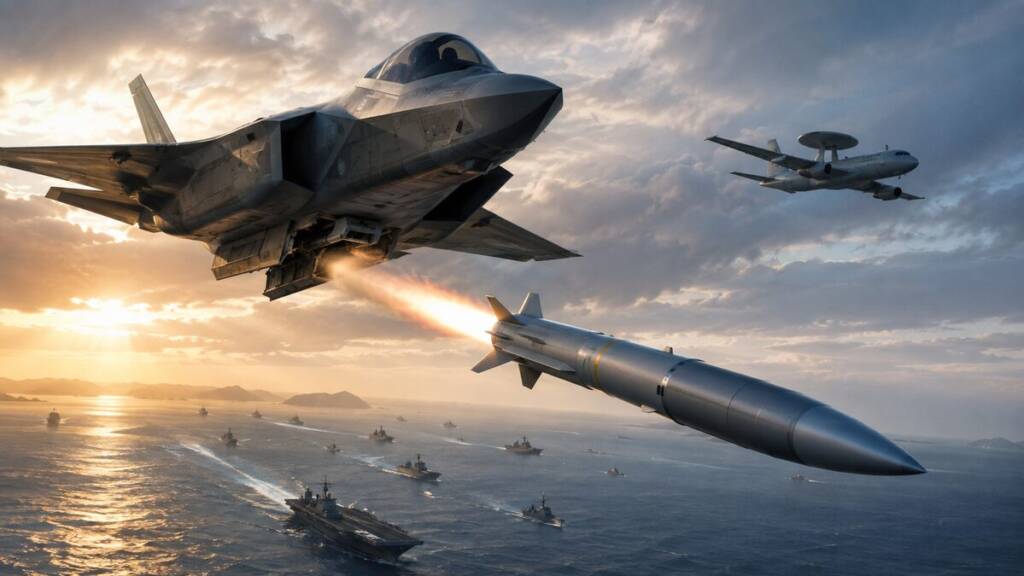
The United States Air Force wants a missile that can destroy an enemy aircraft 1,000 nautical miles away. On Tuesday, it began telling defence contractors how to build it.
The service opened a classified two-day industry event at Eglin Air Force Base in Florida on 25 and 26 August. The subject is a programme called the Air Force Long Range Weapon, or AFLRW. According to the contracting notice posted on 24 June by the Air Force Life Cycle Management Center’s Armament Directorate, the service wants two versions: one air-to-air, one air-to-surface. Both must fly at least 1,000 nautical miles, roughly 1,850km. The air-to-air variant comes first for initial operational capability.
That range is the story. Today’s AIM-120 AMRAAM, the benchmark Western air-to-air weapon for three decades, reaches about 100 miles. The AFLRW would therefore travel roughly ten times further.
Why the Air Force Is Thinking in Four Figures
Geography drives the requirement. From American bases on Okinawa to Taiwan is about 390 nautical miles. From Andersen Air Force Base on Guam, it is closer to 1,500.
Nobody builds a 1,000-mile missile to win a dogfight. Instead, planners want to kill the aircraft that hold an air campaign together: early warning platforms, aerial tankers and surveillance jets. Those aircraft normally orbit far behind the fighting. A weapon of this reach would put them at risk anyway.
According to reports, the requirement flows directly from China-focused near-peer planning scenarios. The notice itself refers to Defense Planning Scenario 2.1 and 7.1 environments. Both remain classified.
Notably, the Air Force did not say which aircraft would carry the weapon. It also did not publish a cost figure or a fielding date — a real constraint, since a missile this large may not fit inside the weapons bay of an F-35 or F-22, and heavy fighters or bombers such as the B-21 have been floated as more likely candidates.
China Got There First
Beijing has already fielded the concept. Its PL-17 — sometimes referred to during development by the placeholder “PL-XX” or the internal name “Project 180” — measures about six metres and is estimated to reach 300–500km, depending on the source. It has been described as an “AWACS killer” built to hunt exactly those support aircraft.
Washington is answering on several fronts. The Navy recently unveiled the AIM-424 Malice, a Raytheon-built air-to-air missile disclosed publicly at the Tailhook Symposium on 22 August. Its officially stated range is “in excess of 250 nautical miles” — a substantial jump over the AMRAAM, but still a quarter of AFLRW’s 1,000nm threshold and closer in class to weapons like the AIM-174B Gunslinger. The AIM-260 JATM is also in development, at a shorter range still. The AFLRW sits far beyond all three.
So yes, a race is under way. However, it is a race for reach rather than for numbers. Each side is trying to push the other’s support aircraft further from the fight.
No Treaty Covers Any of This
Here is the awkward part for arms control. There is no agreement to break.
The 1987 Intermediate-Range Nuclear Forces (INF) Treaty banned only ground-launched ballistic and cruise missiles with ranges between 500km and 5,500km. It never restricted air- or sea-launched weapons. The AFLRW is air-launched. It would therefore have been legal even at the treaty’s height.
The wider framework has since collapsed anyway. New START expired on 5 February 2026. UN Secretary-General António Guterres called the lapse a “grave moment” for international peace and security. For the first time in more than half a century, no binding limits apply to American and Russian strategic nuclear arsenals.
Was China the Reason the Treaty Died?
Partly, but the record is more tangled than the question suggests.
Officially, United States blamed Moscow. Then United States Secretary of State Mike Pompeo said Russia was “solely responsible” for the INF treaty’s demise, pointing to its 9M729 cruise missile.
Yet China appeared in the same argument from the start. A February 2019 White House fact sheet noted that China and Iran are not parties to the treaty and each hold more than 1,000 missiles in the banned range band. Analysts at the Carnegie Endowment for International Peace wrote at the time that US officials cited China’s growing military power as a major reason for leaving.
One distinction matters. The INF was open-ended, so the United States withdrew rather than declined to renew. New START, by contrast, could only be extended once under its own terms — which happened in February 2021, just as its original ten-year term was expiring. It was reported in January 2026 that President Donald Trump wanted China included in any successor agreement. Beijing has consistently refused, for now, while its arsenal remains smaller.
The Pentagon’s latest China Military Power Report put that arsenal in the “low 600s” through 2024, on track to exceed 1,000 warheads by 2030.
What Happens Next
The Air Force plans one-on-one talks with vendors through October and November. The Air Dominance Division, Air Combat Command and Air Force Global Strike Command will all take part.
Two hard problems remain. First, a missile this large may not fit inside the weapons bays of an F-35 or F-22. Second, finding a moving target 1,000 miles away is harder than reaching it — a task that depends on the kind of space-enabled sensor and data-sharing network sometimes called a “kill web,” which does not yet fully exist.
Beijing has already signalled its view of American missiles in the region. Its foreign ministry has repeatedly warned that such deployments fuel “the risk of a regional arms race.”