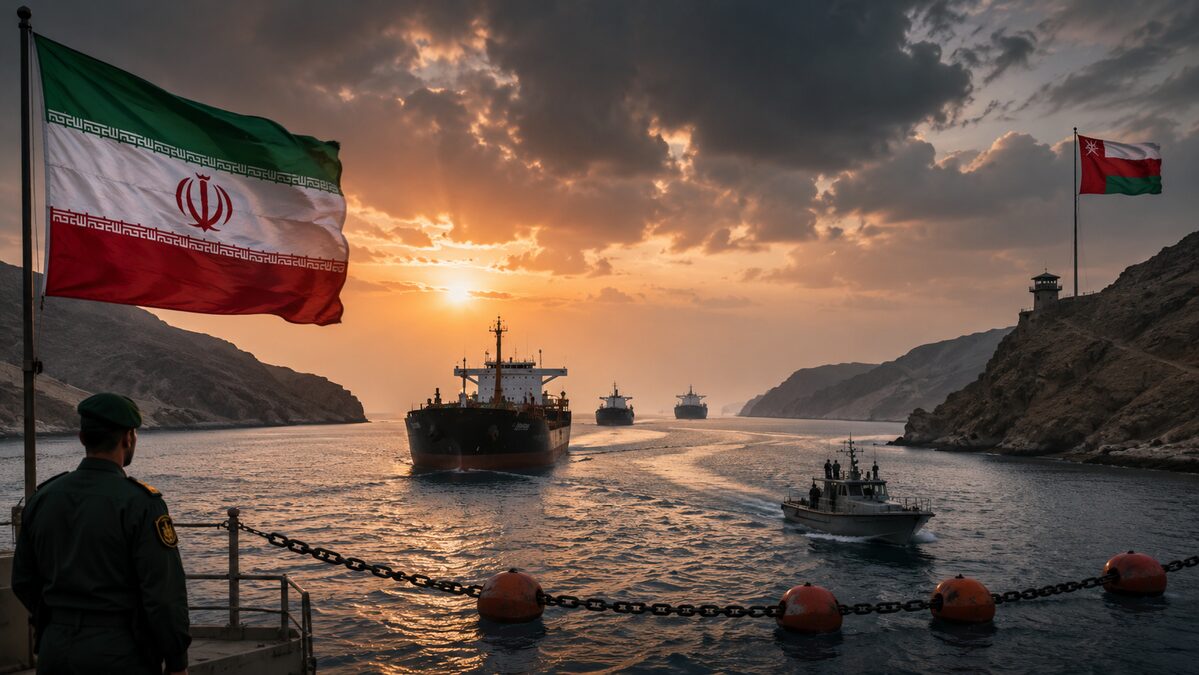
Iran’s Revolutionary Guards announced a deal with Oman on Wednesday covering both the waters of the Strait of Hormuz and the revenue from it. The two neighbours have reportedly divided up the strait and agreed on how to split its earnings. But there’s a catch: the waterway remains closed.
Brigadier General Hossein Mohebbi, the Guards’ spokesman, made the announcement on August 26 through the state-run Sepah News agency, saying the talks — which he put at about a month old — had produced results acceptable to both sides. He also accused Washington of obstructing progress toward a final agreement.
What the Hormuz Deal Would Actually Change
Iran’s Deputy Foreign Minister Kazem Gharibabadi outlined the plan on state television. Ships heading into the Gulf would travel through Iranian waters, while outbound vessels would use a separate route running partly through Iranian and partly through Omani waters. Military vessels would be banned entirely. Both routes would be temporary, with Tehran and Muscat given 30 to 60 days to negotiate a permanent arrangement.
A joint statement from the two countries’ foreign ministries on Tuesday was far more modest — describing a phased interim framework and a joint mine-clearing effort, with no mention of fees. Oman’s Foreign Minister Badr Albusaidi said only that he hoped to announce the corridor soon.
Tehran’s Own Officials Are Less Certain about Hormuz
The announcement quickly ran into pushback. A senior Iranian source told Reuters that Iran and Oman had not finalized an agreement and were still negotiating the details. Foreign Minister Abbas Araghchi hasn’t confirmed the Guards’ account, and Oman’s foreign ministry has stayed silent. Muscat has never even publicly said it wants a role in policing the strait — so for now, this is a claim, not a signed agreement.
Mohebbi made clear that reopening depends on Washington, not Muscat. Iran wants the US naval blockade on its ports lifted, oil sanctions dropped, frozen assets released, and compensation paid — demands rooted in a June memorandum of understanding that has since fallen apart, with both sides blaming each other.
Washington Isn’t Budging
The US hasn’t directly addressed the revenue-sharing claim, but its stance on tolls is unchanged: Secretary of State Marco Rubio has flatly rejected the idea of any country charging fees in international waterways. President Trump maintains the strait is already “open and operating” and that mines have been cleared — a claim Gharibabadi dismissed as market reassurance rather than fact. Trump has also threatened military action against Oman if it interferes with US plans. Meanwhile, Washington is preparing new sanctions targeting Iran’s trading partners, undercutting the commercial basis of any Iran-Oman arrangement.
Neighbours Push for De-escalation
Qatar has taken the lead diplomatically — Prime Minister Sheikh Mohammed bin Abdulrahman Al Thani met with Araghchi in Tehran on Thursday, pushing to restore the strait to its pre-February 28 status. Other Gulf states are more cautious: the UAE and others have publicly opposed Iranian transit fees, though some officials have privately suggested they could accept a fee as long as Iran doesn’t control the routes. Saudi Arabia has organized a multi-country escort alliance for shipping.
Ports outside the strait are benefiting — Oman’s Sohar port has seen ship traffic rise roughly 40% since the war began. Inflation is climbing across the Gulf, and Oxford Economics has raised its 2026 forecasts for all six GCC economies.
The Toll So Far
The numbers show why urgency is mounting. Before the war, roughly 20 million barrels of crude passed through Hormuz daily; by Monday that had fallen to just 5 million — a three-month low. Ship traffic has also thinned sharply: only five commodity vessels crossed on Tuesday, against a 10-day average of 15, according to Kpler data, down from about 130 daily before February 28.
Markets viewed the development with cautious optimism, and Brent crude dipped below $90 a barrel after Tuesday’s statement. Qatar is still counting its losses after the March strike on Ras Laffan cut about 17% of its gas export capacity.
Iran shows no signs of softening — it blacklisted 45 ships on Sunday over suspected ship-to-ship transfers, and Araghchi has written to the UN calling the latest US sanctions a form of collective punishment. The tankers, for now, keep waiting.