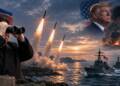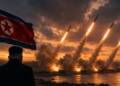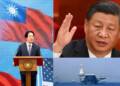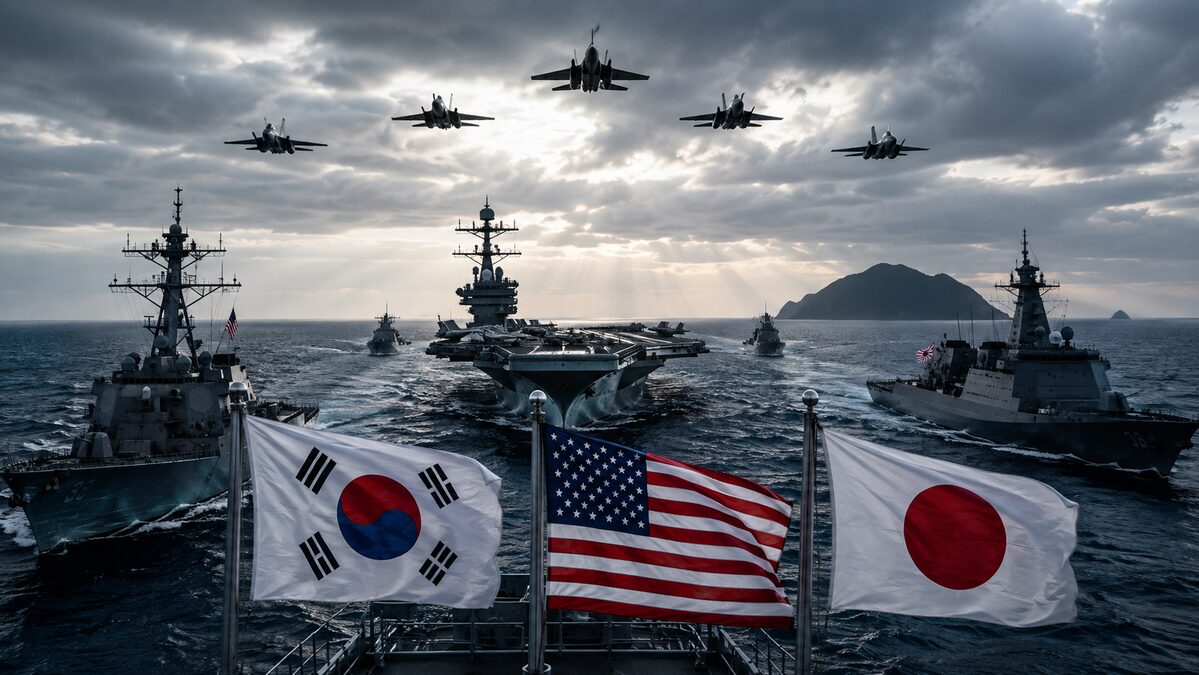
South Korea, Japan, and the United States will hold the Freedom Edge exercise from September 7 to 11, Seoul’s Joint Chiefs of Staff announced Friday. Warships and aircraft from all three countries will train in international waters east and south of Jeju Island, officially rehearsing a joint response to North Korea’s nuclear and missile threats. The timing, though, is striking: just last week, Trump halved a separate drill with South Korea in an apparent bid to coax Pyongyang back to the table.
What the Exercise Will Involve
The Joint Chiefs of Staff described Freedom Edge as “a defensive drill conducted annually by the three countries,” covering maritime missile defense, air and air-defense operations, anti-submarine warfare, and cyber defense.
US Forces Japan went further, saying this round will “significantly expand trilateral interoperability across multiple domains” — including real-time data sharing among all three militaries, closing a long-standing gap in which Seoul and Tokyo each connect to US radar systems but not directly to each other.
A Drawdown, Then a Sudden Turn
Rewind two weeks. On Trump’s orders, the Pentagon cut Ulchi Freedom Shield from 11 days to five; the exercise opened August 17 and ended six days early. Trump cited cost, along with Seoul’s refusal to help in the Iran war, writing on Truth Social that the drills sent a signal that was “totally inappropriate and hostile.”
A second cut followed. On August 24, Seoul disclosed that Washington had canceled Ssangyong, the biennial amphibious landing drill due next month. South Korean Marine Corps spokesman Han Seung-jeon said the US Marine Corps had given formal notice back in June that Middle East commitments would limit available forces — a significant loss, since Ssangyong normally puts more than 10,000 marines on a beach.
Two drills scaled back, then a reversal: on Friday, the allies confirmed Freedom Edge would proceed at full scale.
Did Pyongyang’s Snub Change the Calculation?
The sequence invites that reading. On August 19, Kim Yo Jong, sister of leader Kim Jong Un, denied any communication between her brother and Trump, saying the two leaders still got along but that US policy hadn’t softened. A day later, North Korea fired roughly 10 short-range ballistic missiles.
The rebuff hardened further on August 27, when North Korea’s foreign ministry accused Washington of “a series of hostile moves” — including a possible sale of air-to-air missiles to Seoul — and vowed a powerful response. Seoul announced the trilateral drill the very next morning.
Why the Exercise Also Points at China
The geography matters as much as the press release. The waters south of Jeju open onto the East China Sea and sit just north of Taiwan, along a corridor Chinese warships bound for the Pacific must pass close to.
Analysts have made this point before. Cho Han-bum of the Korea Institute for National Unification told the South China Morning Post in 2024 that the area checks North Korea and China simultaneously, while Yang Uk of the Asan Institute for Policy Studies called such drills “inconvenient” for Beijing, and Andrew Yeo of the Brookings Institution said China was certainly watching.
Pyongyang says much the same thing, more bluntly — arguing the drills reflect a US intention to lay siege to China and squeeze Russia, and branding the trilateral format an Asian version of NATO.
Not a First, and Not a Revival
This isn’t a one-off. Freedom Edge is now in its fourth round: the three leaders agreed to multi-domain drills at Camp David in August 2023, the first exercise ran in June 2024, a second followed that November, and a third took place off Jeju in September 2025.
The format is young but has become a regular fixture, settling into an early-autumn slot. More tellingly, it survived a drawdown that Ssangyong did not.
What to Watch Next
Several more drills sit on the calendar between September and November, including Iron Mace — a tabletop exercise on nuclear and conventional integration — alongside the Freedom Flag and Buddy Squadron air drills. Any could still be trimmed if talks with Pyongyang revive.
North Korea, meanwhile, tends to answer large exercises with weapons tests of its own. Trump still says he wants a summit this year — and Freedom Edge may reveal which signal Washington is actually sending.