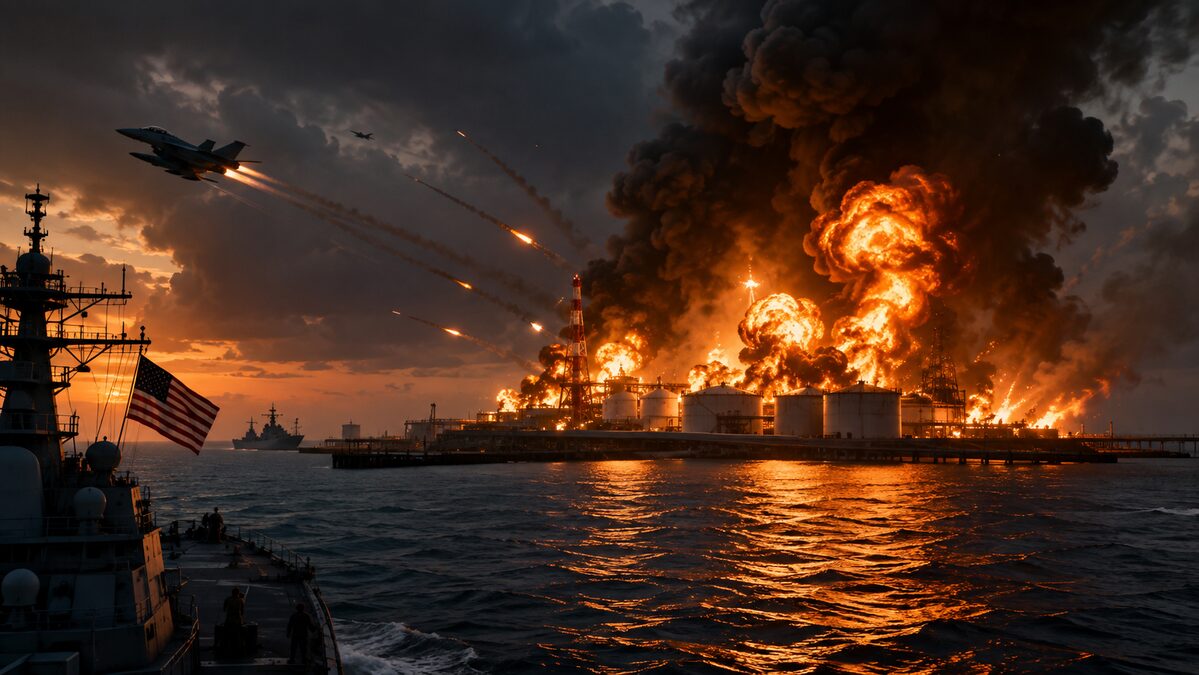
United States forces bombed Iranian territory on Sunday for the first time in more than a month, and Iran struck back at American bases in Jordan and the United Arab Emirates within hours. President Donald Trump then posted a video clip showing Iran’s largest oil terminal in flames.
Trump wrote a single line on his Truth Social platform: “Kharg Island being blown to smithereens!!! President DJT.” He gave no further detail. Experts who ran the clip through detection software concluded that artificial intelligence had most likely produced the on-screen explosions.
Kharg Island itself stood untouched, with no independent evidence pointing to any attack there. The White House and the Pentagon did not answer requests for comment, and Iranian media said nothing about the post.
The Strike That Broke the Lull
Trouble began on Sunday evening at the mouth of the Strait of Hormuz, where American forces destroyed two Iranian rocket launchers on Larak Island. The strike ended a quiet spell that had held since late July.
Navy Captain Tim Hawkins, a US Central Command spokesperson, set out Washington’s case: American forces had watched Revolutionary Guard units preparing rockets that carried sea mines. CENTCOM described its response as “limited, precise action.”
Iran’s Islamic Revolutionary Guard Corps confirmed the attack and reported deaths among its soldiers. Guard spokesperson Hossein Mohebbi called the American decision a “grave blunder” and promised consequences in the economic and military arenas. Neither government has published a verified casualty figure.
The two sides also dispute the framing. The Guard called the raid an act of aggression; CENTCOM rejected that description outright and said Iran had created the threat.
Tehran Strikes Back Before Dawn
The Guard answered before sunrise on Monday, firing ballistic missiles at the King Hussein and Al Azraq air bases in Jordan. Iranian state broadcaster IRIB claimed heavy damage at both sites.
Jordan’s armed forces rejected that account. The army said its defences destroyed eight missiles at dawn after they breached Jordanian airspace. A US source told Fox News that interceptors stopped nearly all of them.
Iran’s regular army opened a second front that morning, saying drones had struck US helicopters and troops at Al Minhad Air Base, south of Dubai. The Emirati defence ministry denied any attack there and called the reports false, saying its forces had dealt with a single Iranian drone over territorial waters.
Oil Climbs Back Above $90
Traders reacted within minutes. Brent crude rose about 2.7 per cent to roughly $90.49 a barrel in early Asian trading, while West Texas Intermediate gained about 2.5 per cent to $85.46.
Both benchmarks had fallen more than 4 per cent over the previous week, as investors had started treating the confrontation as a sanctions fight rather than a supply threat.
The Guard’s navy revived the older fear on Monday, saying a supertanker had struck two sea mines, caught fire and stopped after taking an unauthorised route south of the strait. Independent sources have not confirmed that account, and CENTCOM said last week that it had cleared the strait’s international shipping lanes of mines.
Sanctions Arriving Every Week
Money, not missiles, had become Washington’s main instrument during August. Treasury Secretary Scott Bessent told Reuters that fresh secondary sanctions would land almost weekly. “We’re starting with the banks,” Bessent said, warning that an offending institution could lose access to the dollar system entirely. Bessent also plans to press G20 finance ministers to cut their economic ties with Tehran.
The Treasury moved against the UAE branches of Egypt’s Banque Misr on Friday, accusing the lender of serving Iran’s shadow banking network.
Six Months of War
The war began on 28 February, when US and Israeli aircraft attacked Iranian targets. Iran then closed the Strait of Hormuz, through which roughly 20 per cent of the world’s seaborne oil once moved.
Kharg carries particular weight in this fight: the terminal handled about 90 per cent of Iran’s oil exports before the war, according to Reuters. Trump has threatened the island before, but no attack has followed.
Diplomacy has stalled meanwhile. Iran and Oman agreed a revenue-sharing arrangement over the waterway last week, though Tehran stressed that the deal guarantees no immediate reopening.
President Masoud Pezeshkian struck a defiant note on Monday. Iranian state media carried his remarks: “We will never remain silent in the face of any aggression,” Pezeshkian said, adding that Iran did not want war.