
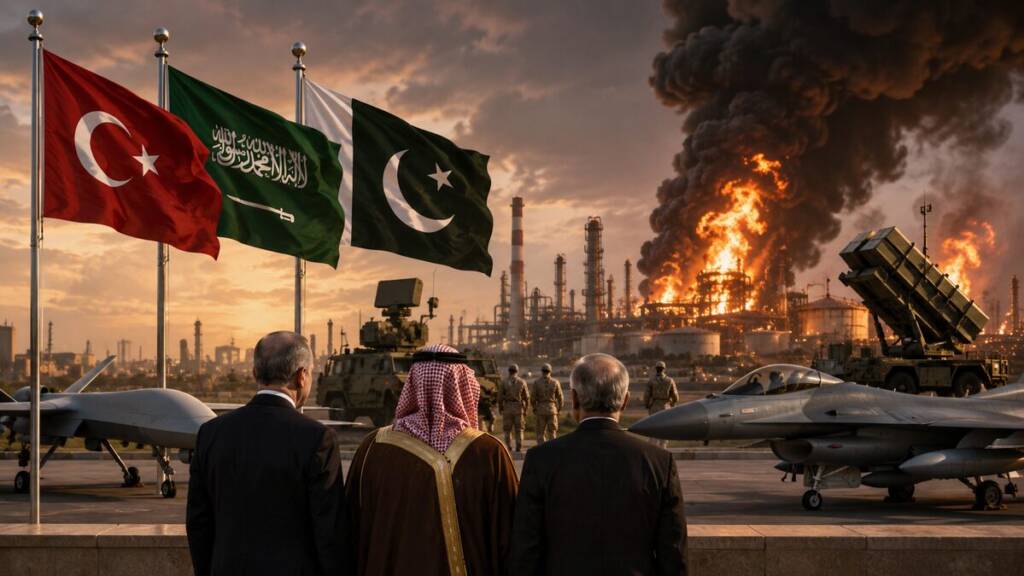
Turkey, Saudi Arabia and Pakistan will open their first defence pact talks on Monday, with foreign ministers, defence ministers and chiefs of staff all scheduled to attend.
The pact makes a NATO-style promise: an armed attack on any one signatory counts as an attack on all three. Turkey’s foreign ministry says the agenda covers international security, defence capabilities and joint weapons production.
One awkward question shadows the talks. Iran-aligned Houthi fighters have struck Saudi oil sites repeatedly since the ink dried, yet neither Ankara nor Islamabad has fired a shot in the kingdom’s defence.
A Clause Nobody Has Tested
Turkish President Recep Tayyip Erdoğan signed the agreement in Mecca on 7 August, alongside Saudi Crown Prince Mohammed bin Salman and Pakistani Prime Minister Shehbaz Sharif.
Two days later, the Houthis hit Saudi Aramco’s Jazan refinery with a drone, then claimed a third strike on the same plant on 18 August — having already targeted Aramco sites at Jazan and Yanbu in late July.
Jazan refines about 400,000 barrels a day. The Houthis also declared a Red Sea blockade on Saudi shipping in July. Aramco chief executive Amin Nasser said the strikes interrupted some output but told reporters they caused no material operational or financial damage.
Who Actually Defended the Kingdom
The kingdom’s ordeal began on 28 February, when American and Israeli forces struck Iran. Missiles and drones then rained on Saudi territory; Riyadh blamed Tehran, which denied responsibility.
Drones targeted Ras Tanura, Saudi Arabia’s largest refinery, on 2 March. Aramco shut the plant and restarted it on 13 March. Projectiles later struck Prince Sultan Air Base and the U.S. embassy in Riyadh, while Saudi forces intercepted drones heading for the Shaybah oilfield. A drone strike on Al-Kharj killed an Indian and a Bangladeshi worker.
Greek-operated Patriot batteries destroyed two Iranian ballistic missiles aimed at Saudi refineries on 19 March — a strike Greek Defence Minister Nikos Dendias confirmed.
Saudi crews, American units and Greek gunners did the shooting. Pakistani and Turkish weapons stayed out of the fight entirely.
Islamabad Reached for the Telephone
Dar told Pakistan’s parliament in March that he had raised the Saudi pact with Tehran, prompting Iran to seek assurances about Saudi territory. Asif ruled out any Pakistani role in a military campaign against Iran; analysts described the posture as alignment without entanglement.
Pakistan did eventually deploy, moving 13,000 troops and fighter jets to Saudi Arabia in April — but only after the ceasefire, not during the attacks. Ankara held back further still. Erdoğan stressed Turkish neutrality throughout, and Turkey denied the United States and Israel use of its airspace.
A MetroPoll survey in March found 68.1 per cent of Turks favoured neutrality, against just 2.1 per cent who backed alignment with Washington.
What Istanbul May Settle
The committee will examine interoperability, joint production, research and counter-terrorism coordination — each item demanding money, basing rights and command arrangements. The three militaries’ arsenals differ sharply: Turkey flies NATO-standard equipment, Pakistan operates Chinese and American aircraft, and Saudi Arabia depends largely on American systems.
Turkey says the pact welcomes new members, and officials have floated Egypt as a possible candidate.
Ankara and Islamabad insist the agreement targets nobody. Pakistan’s foreign office calls it purely defensive, and Turkey says the pact sits beside its NATO membership rather than replacing it. Riyadh, meanwhile, has hardened its own line, expelling Iranian defence officials in March and warning Tehran of consequences.
How the Alliance Came Together
Saudi Arabia and Pakistan signed a bilateral mutual defence pact in September 2025; Turkey joined the arrangement this month. Each partner brings something different: Saudi Arabia supplies money and oil, Pakistan supplies nuclear weapons and a large army, and Turkey supplies drones and a defence industry.
Critics see a gap between the promise and the practice. Riyadh will judge the pact by its next refinery fire.