
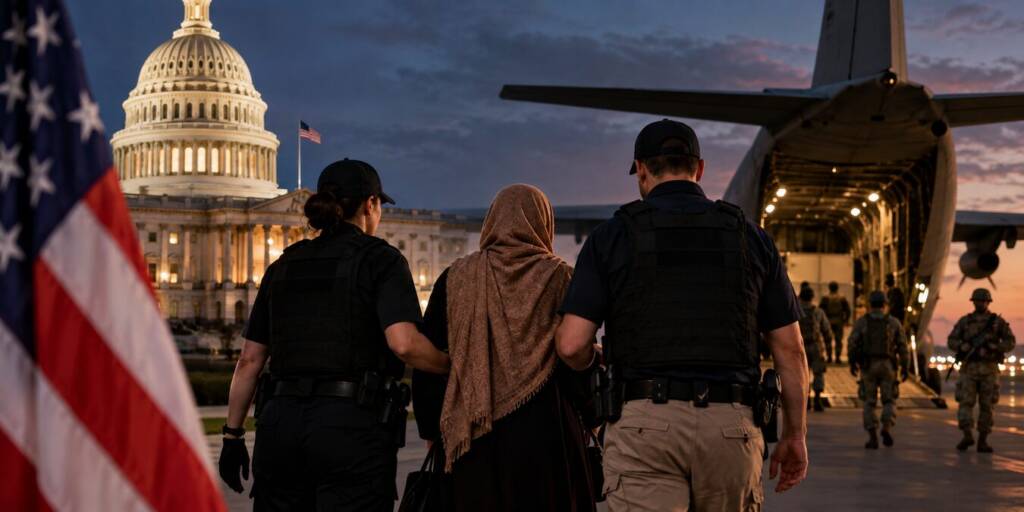
Nazira Haji Zada never faced a criminal charge, and never saw the evidence against her. Her removal gives the Alien Terrorist Removal Court its first result since 1996.
The United States has deported a 47-year-old Afghan woman accused of helping to conceal an Islamic State-inspired shooting plot, closing the first case ever brought before a court that Congress created in 1996 and that no attorney general touched for 30 years.
The Justice Department announced on Friday that Nazira Haji Zada had dropped her challenge and accepted removal. Federal agents arrested her at her Fort Worth home in Texas in July and took her before the Alien Terrorist Removal Court.
Chief Judge Joan Ericksen signed the removal order on 20 August, and the court kept every filing sealed until Haji Zada reached Afghanistan.
Haji Zada held a green card, and prosecutors never charged her with any crime. Her son and son-in-law both pleaded guilty to terrorism offences in 2025.
Both Sides Claim the Outcome
Attorney General Todd Blanche called the result “a win for national security and the rule of law”, and said the case showed the department would “use every tool at its disposal to protect our country”. Homeland Security Secretary Markwayne Mullin said those who plot terrorism “have no place in our country”.
Haji Zada’s lawyers rejected that framing. Matthew Farley, the public defender who represented her, said his client’s “choice to consent to removal should not be seen as an endorsement of this court’s legitimacy”.
“Dragging lawful permanent residents into court but refusing to show them or their attorneys the evidence that will be used against them is a plain violation of due process,” Farley said. He predicted that a judge would strike the court down “as soon as a judge is asked to address the issue”.
What the Court is, and Why Congress Built it
Lawmakers wrote the tribunal into the Antiterrorism and Effective Death Penalty Act, which President Bill Clinton signed on 24 April 1996. Congress passed the law after the 1993 World Trade Center bombing and the 1995 Oklahoma City bombing, wanting a venue where the government could deport suspected terrorists without exposing intelligence sources in an ordinary immigration hearing.
The statute lets the Chief Justice of the United States designate five federal district judges, each from a different judicial circuit, for staggered five-year terms. Chief Justice John Roberts picked the current five. The attorney general or the deputy attorney general must sign off on any application, which the government files under seal.
That design carries one obvious cost: the government may rest its case on classified material the person facing deportation never reads.
The trade-off explains the silence. Legal scholars say earlier administrations steered clear rather than risk a ruling that the mechanism breaches due process. The court sat unused through the Clinton years, the 11 September attacks, the wars in Afghanistan and Iraq, the rise of Islamic State, Trump’s first term and Joe Biden’s presidency.
A Judge’s Aside Woke it Up
The revival traces back to a remark from the bench. Hearing a challenge to the administration’s use of the 1798 Alien Enemies Act against Venezuelan migrants, US District Judge James Boasberg pointed the government towards the forgotten tribunal. “Congress has an answer for us, doesn’t it?” he said.
On 15 July the Justice Department filed the first petition in the court’s history, a single page that withheld the target’s name. Ericksen did not wave it through. She wrote that she had “questions about the nexus” between the respondent’s conduct and the law the government invoked, and ordered prosecutors to try again. She convened the court’s first hearing on 30 July.
An FBI memo dated 15 July said investigators had “developed information” that Haji Zada supported Islamic State and had her children pledge loyalty to the group.
The Plot Behind the Case
Her son, Abdullah Haji Zada, and her son-in-law, Nasir Ahmad Tawhedi, bought two AK-47 rifles and 500 rounds of ammunition from an undercover FBI employee in rural Oklahoma on 7 October 2024. They planned to open fire on crowds on Election Day, 5 November, and told investigators they expected to die as martyrs.
Judge Scott Palk handed Abdullah Haji Zada, then 19, the maximum 15 years in November 2025. Tawhedi pleaded guilty in June 2025 and faces up to 35 years, but a Bureau of Prisons psychologist found him mentally incompetent in February, so the judge cannot sentence him yet.