
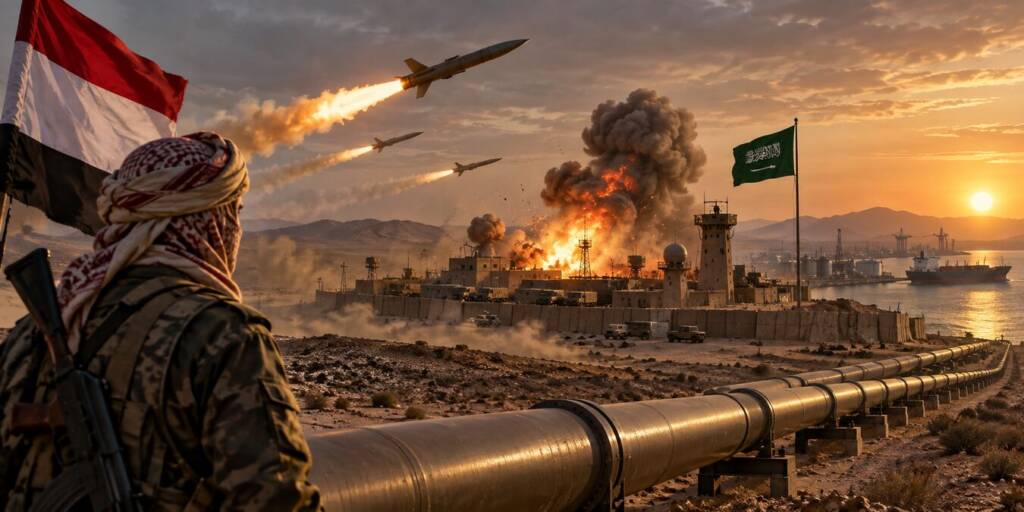
Riyadh’s only route around the Strait of Hormuz now lies idle. Ukrainian drones have gutted Russia’s refineries. The world has run out of spare fuel, and Iran knows it.
Yemen’s Houthi fighters said on Sunday that they had struck a Saudi military base at Sharurah with ballistic missiles and drones, driving a widening war deeper into the kingdom, days after drones from Iraq forced Saudi Arabia to shut the pipeline carrying most of its crude to market. Together, the two attacks hand Iran the tightest grip on global energy supply it has held in this war, and the strongest hand it has yet played against the United States.
The Houthi military spokesperson, Yahya Saree, wrote on X that the operation hit weapons depots and command centres “managing the aggression against our nation and people”.
Saudi Civil Defence reported a projectile falling at al-Tawwal in Jazan province, injuring two people and damaging a mosque and several buildings. Saree threatened larger strikes deeper inside the kingdom if Riyadh’s air campaign continued. The Houthis said Saudi aircraft flew 129 raids on areas they control in 48 hours.
The pipeline that kept the world supplied
Saudi Arabia shut the East-West Pipeline on September 11 after drones from Iraq’s Maysan province set pump stations alight in the Riyadh and Madinah regions. The energy ministry called the closure a precaution. The foreign ministry withheld retaliation at Baghdad’s request but reserved the right to “take all measures necessary”.
That 1,200km line, running from the Abqaiq fields to the Red Sea port of Yanbu, had been moving 4 million to 5 million barrels a day — about 4 to 5 per cent of world supply — since Iran’s blockade closed the Strait of Hormuz in March. Riyadh has no ready substitute. It can route some barrels through Egypt’s Suez Canal and Sumed pipeline, but it cannot send eastern crude to Yanbu while the line sits idle.
The US president, Donald Trump, pointed at Tehran. “I think they are, probably they are,” he told reporters in Dublin on September 12. No group has claimed the attack, and the Islamic Resistance in Iraq, the umbrella for Iran-aligned militias, has denied involvement. The security analyst Wolfgang Pusztai said the order most likely came from Tehran, and that it sharpened Iran’s blockade by denying Riyadh any bypass.
A market with nothing left in reserve
Brent crude traded near $106 a barrel on Monday, up about 2 per cent, after Oman postponed a meeting between Gulf states and Iran on Hormuz shipping, Trading Economics data showed. Brent had fetched roughly $72 before the war began on February 28.
The International Energy Agency put Saudi crude supply at its lowest level in more than three decades. Ben Cahill of the Atlantic Council called the closure “a real blow” and said the buffers that had carried the market through six months of war had worn away.
Ukraine’s drones close the other door
Iran’s leverage rests partly on a front it does not control. Ukraine has flown more than 60 strikes against at least 24 Russian refineries, the Caspian Policy Centre estimates, and Moscow has extended its diesel export ban to the end of September. The IEA said on September 11 that the attacks were degrading Russia’s refining system, with damaged units needing six to eight months to replace.
Trump urged Kyiv on Sunday to stop hitting Russian diesel. The Ukrainian president, Volodymyr Zelenskyy, refused. “If they cause us blackouts, we will try to respond to them in kind,” he said.
Two of the world’s largest fuel exporters therefore cannot ship at scale at the same moment. Tehran sits at the junction, and that arithmetic explains why it feels no urgency to reopen anything.
The bill lands in America
US diesel passed $6 a gallon this month for the first time, with AAA putting Friday’s average at $6.06 — 64 per cent above a year ago. Petrol averaged $4.30, against about $3 before the war. Consumer prices rose 0.4 per cent in August, and the Bureau of Labor Statistics attributed more than a third of that energy rise.
Those figures reach voters seven weeks before the midterm elections. Trump has predicted the war will end “probably right after the midterms”, and that oil prices will then fall. Tehran’s terms have not moved: Hormuz stays shut until Washington meets the conditions of the June memorandum.
The ground war beneath it
The Houthis spent last week seizing the rest of Yemen’s Red Sea coast, taking Mokha port and Mayun Island and completing their hold on the Bab el-Mandeb strait. They have declared a blockade of Saudi Red Sea ports while telling other shipping it may pass. The UN migration agency counted 76,000 people displaced since July — a figure that quadrupled in a week — and both sides put the death toll above 500.
The Saudi crown prince, Mohammed bin Salman, twice asked Trump to strike the Houthis last week. Trump declined. “The Houthis called us and they don’t want to fight with us,” he said in Dublin. “There’s just one country that they’re not too happy with.”