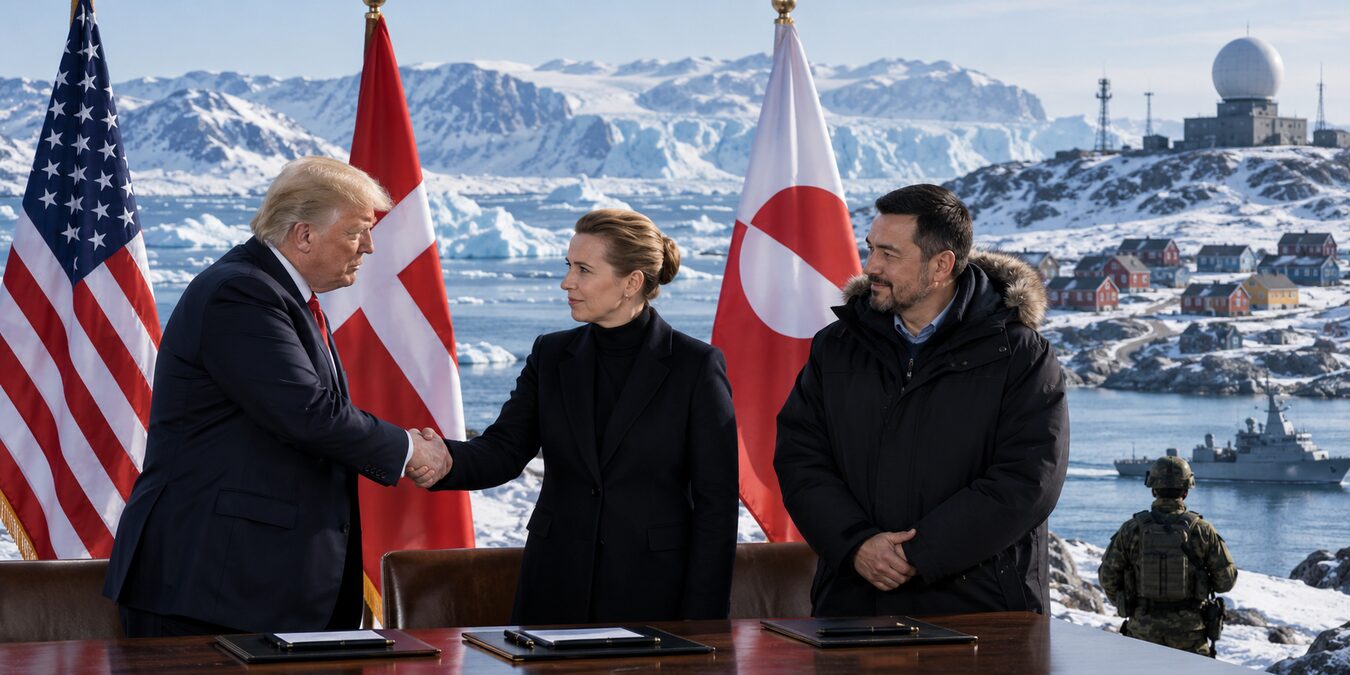
The US president, Donald Trump, says a pact with Denmark and Greenland hands America “permanent control” over the island’s security. He announced it on Friday, after months of threatening to take the island by force. Yet Copenhagen insists Greenland stays within the Danish kingdom, and two parliaments must still approve the pact.
The Danish prime minister, Mette Frederiksen’s, office said all three governments would sign it next week. The signing will take place in New York, during the UN General Assembly.
What is in the Greenland deal
Trump announced the pact on his Truth Social platform. He wrote: “This is an ‘Infinite Life’ Agreement, there is no end!” He also said the deal would cost America nothing. No US advtersary may have a base or make “sensitive investments” there without written US approval, he added. He promised to begin “immediately” building a bigger US military presence on the island.
A State Department official said the pact bans any non-Nato military base on Greenland. The US secretary of state, Marco Rubio, said the deal “permanently and completely addresses” Washington’s security concerns.
A senior US official outlined further terms. The pact has no expiry date and would hold even if Greenland becomes independent, the official said. Washington could also build new bases after consulting Copenhagen and Nuuk, without their approval, the official added. Only America and its allies could make sensitive investments in ports, undersea cables or minerals, the official said. Denmark and Greenland have not publicly confirmed these terms.
Frederiksen welcomed the deal but stressed sovereignty. She said the pact “recognises the sovereignty and territorial integrity” of the Danish kingdom, and added that it respects the Greenlandic people’s right to self-determination. Greenland’s prime minister, Jens-Frederik Nielsen, said the agreement was “to the benefit of us all”.
Why Trump wanted Greenland
Trump has long argued that America needs Greenland to hold off Russia and China. Greenland sits between North America and Europe, with more than two-thirds of it inside the Arctic Circle. The US runs Pituffik Space Base there, which watches for incoming missiles. A 1951 defence treaty already gives US forces wide access to the island.
Alan Fisher said Trump saw Greenland as key to his Golden Dome missile shield. Fisher also noted that Friday’s public statements made no mention of rare earth minerals, a frequent Trump theme. Domestic politics matters too — the deal lets Trump claim a foreign policy win before November’s midterm elections.
From threats to talks
Since returning to the White House in January 2025, Trump has pressed Denmark to sell the island. For months, he refused to rule out military force against a Nato ally. In January, he threatened 10 per cent tariffs on eight European countries, including Britain, that opposed his plan. That same day, thousands marched in Nuuk in what officials called the island’s largest-ever protest. Days later, in Davos, Trump ruled out force and dropped the tariff threat, citing a “framework” he had reached with the Nato secretary-general, Mark Rutte.
Yet at a Nato summit in Ankara in July, he still called Greenland “a big problem for us”. Behind the scenes, officials from all three governments had been negotiating quietly since February. Earlier this month, the EU pledged €200 million to Greenland to ease anxiety over Trump’s threats.
What changes now
Mikkel Olesen, a senior researcher at the Danish Institute for International Studies, said much remained unknown. But he said the deal “has the potential to end the crisis” without any loss of sovereignty. He added that Danes and Greenlanders had no wish to see Russian or Chinese bases there either.
The harder test lies elsewhere. Every party in Greenland’s parliament backs eventual independence. A pact that outlasts independence could therefore touch a nerve in Nuuk. So could any US right to build bases without local approval. The parliamentary votes, not next week’s signing, will decide the pact’s fate.
The wider damage may linger. Imran Bayoumi, an associate director at the Atlantic Council, said the episode had badly hurt America’s image in Europe. Repairing it would take “a lot of work”, he said.