
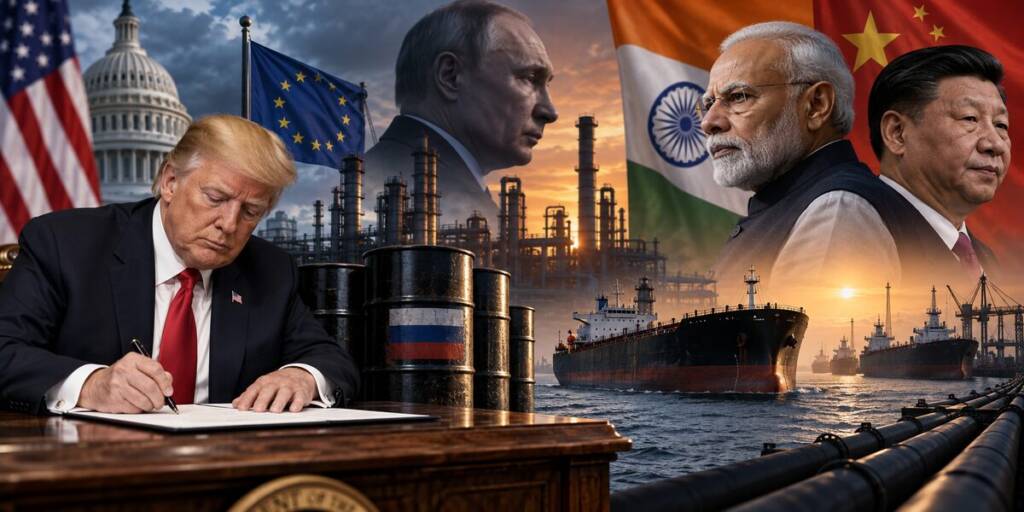
The US president, Donald Trump, signed a Russia sanctions bill into law on Friday, the White House said. It lets Washington impose tariffs of up to 100 per cent on the top buyers of Russian energy.
India and China sit squarely in the firing line. The bill’s sponsors rank both among the five largest buyers of Russian crude.
The law also leaves Europe largely untouched, while US imports from Russia rose by a quarter last year. For New Delhi, it could prove the tipping point in an already strained partnership.
What the new sanction law does
The law’s official name, the Lindsey O Graham Sanctioning Russia and Iran Act, honours the late senator from South Carolina. It targets the Russian president, Vladimir Putin, senior officials, banks and the “shadow fleet” of tankers that dodge sanctions.
It also raises duties on Russian goods and extends Iran sanctions for five more years. Within 30 days, the law requires duties on the five biggest buyers of Russian crude or gas. The president picks targets, sets rates of up to 100 per cent, and can waive sanctions.
The Senate backed it 86 to 11 in August, and the House 262 to 159 on Wednesday. The Democratic senator Richard Blumenthal delivered a warning: “China and India, you better buy your oil and gas somewhere else.”
What India and China already pay, without new sanctions
In August 2025, Trump raised duties on most Indian goods to 50 per cent, partly over Russian oil. He dropped the 25 per cent oil penalty in February, saying India had agreed to stop buying Russian crude.
On February 20, the US Supreme Court struck down Trump’s emergency tariffs. Since July 24, most Indian goods have faced an extra 10 per cent under a new forced-labour trade action.
Chinese goods face 12.5 per cent under the same action. That comes on top of older US duties of 7.5 to 100 per cent on many Chinese products. Any new Russia-linked tariff would stack on top of these charges.
Why Europe largely escapes new sanctions
EU countries bought $30.74 billion of Russian goods in 2025, mostly fuel. Yet the law largely spares them.
First, it ranks individual countries, not the EU as a bloc. Second, a gas clause exempts any country buying under 15 per cent of Russia’s gas exports. That country must also show “significant steps” to cut such imports.
Supporters of the bill say the clause frees France, Belgium, Hungary and Japan from gas-related duties. Blumenthal told fellow senators in floor debate that the law protects Nato allies.
Cato Institute analysts see gaps: no exemption covers crude, so Hungary and Slovakia remain at risk. They add that the sponsors’ list omits Turkey, which independent trackers rank third among crude buyers. India’s exposure lies in crude, so it gets no escape hatch either.
The hypocrisy charge
American imports of Russian goods jumped 25.6 per cent, to $3.8 billion, in 2025, official US data show. The new law even spares US-Russian civil nuclear deals and some Russian uranium shipments for American reactors.
In August 2025, India’s Ministry of External Affairs called the targeting of India “unjustified and unreasonable”. It pointed to continuing US purchases of Russian uranium, palladium, fertilisers and chemicals.
When a reporter asked about those imports, Trump replied: “I don’t know anything about it.”
The law’s calendar adds a twist. The US-Israeli war on Iran, which began in late February, choked Gulf shipping. From March to mid-June, a US Treasury waiver let Indian refiners buy Russian cargoes already at sea.
India’s purchases of Russian crude roughly doubled in March, to about 2 million barrels a day. They hit a record 2.8 million barrels a day in July. Those waiver months fall inside the law’s 12-month look-back window. Washington may now penalise India for barrels its own Treasury waved through.
A tipping point for India-US ties?
The law hits a relationship that a year of tariff fights has already bruised. Michael Kugelman, a senior fellow at the Atlantic Council, said the new law “may be the biggest blow yet”. He warned it could deepen mistrust in Delhi just as negotiators close in on a trade deal. He added that a delayed or light-touch rollout could contain the damage.
India’s foreign ministry said on Friday it had raised the issue with Washington at high levels. It said India had outlined risks “for not just the bilateral relationship but also the international energy market”. Indian refiners have already lined up Russian barrels for September and October. New Delhi has also struck trade deals with Britain and the European Union. If Trump pulls the trigger, the law could turn a year of friction into a lasting rupture.