
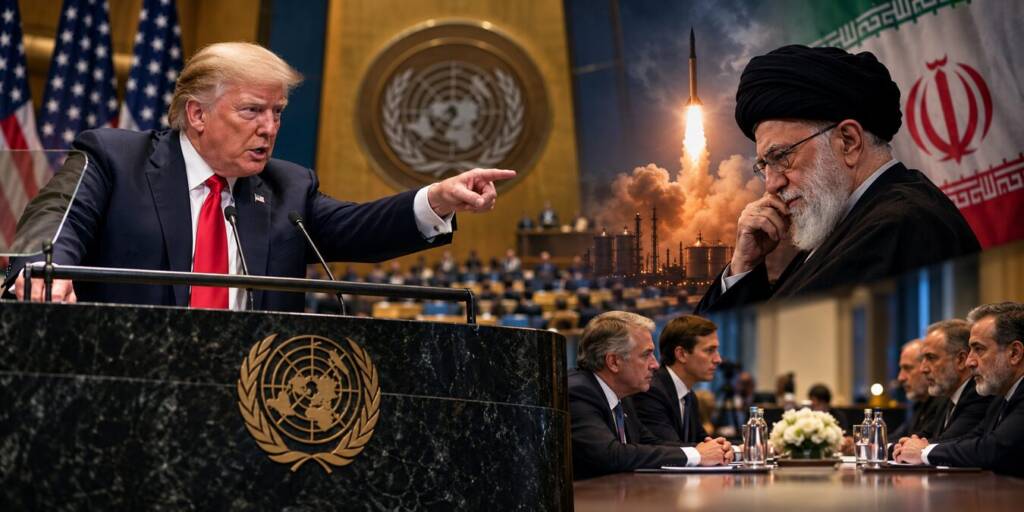
US President Donald Trump gave Iran a stark choice between a deal and destruction on Tuesday, 22 September, telling the 81st UN General Assembly that he could “annihilate the Islamic Republic” quickly if no agreement is reached to end the war. Hours later, his envoys met Iranian officials on the sidelines of the gathering.
Addressing nearly 130 heads of state, Trump defended US military action in Iran and Venezuela, rejected global controls on artificial intelligence, and later signed a security pact covering Greenland.
Iran: Threats and a Quiet Meeting
With the US war with Iran nearing its seventh month, Trump told delegates he faces a defining decision: let Iran rebuild through a negotiated deal, or launch a swift attack. He described the Iranian government as “weak and desperate.”
Trump predicted no agreement would come before the US midterm elections. “I believe we’ll make a deal, right after the election,” he said, claiming Tehran was waiting to see the results — despite not being a candidate himself.
Later, Trump told reporters that envoy Steve Witkoff and his son-in-law Jared Kushner had met with the Iranians. Secretary of State Marco Rubio said Trump remains open to meeting Iran’s President Masoud Pezeshkian in New York. Trump also held talks with Gulf leaders and Jordan on the war’s next steps. Members of the Iranian and Cuban delegations walked out at points during his speech.
Backing AI, Rejecting Global Rules
Trump said the US “totally rejects any attempt to construct a globalist scheme to control artificial intelligence,” adding that US documents would now refer to the technology as “superintelligence.”
PolitiFact noted that industry experts do not consider current AI systems superintelligent, and that the loudest safety warnings today are coming from AI industry leaders themselves. Trump also claimed a wide lead over China on the technology. By contrast, UK Prime Minister Andy Burnham told the Assembly that Britain would lead efforts on global AI standards.
Greenland: Bases, Not a Purchase
After his speech, Trump signed an Arctic security agreement with the leaders of Denmark and Greenland. The deal keeps Greenland under Danish control while expanding the US military presence, allowing new American defence areas at Narsarsuaq and Mestersvig and upgrades at Pituffik Space Base. In his address, Trump pledged to build two major military bases on the island.
Danish Prime Minister Mette Frederiksen called it a “deal that can last forever,” while Greenland’s Prime Minister Jens-Frederik Nielsen described it as a win for all three sides. Trump declined to say whether he had dropped his broader ambition to acquire the territory.
Claims Under Scrutiny
PolitiFact fact-checked several of Trump’s claims. Strikes on cartel boats destroyed 97 per cent of the drugs arriving by sea, he asserted, but fact-checkers rated the claim false. His claim that the US and Venezuela together hold more than 60 per cent of the world’s oil also faced scrutiny. PolitiFact put their combined share of proven reserves at 21.9 per cent. Trump’s dismissal of concerns that US munitions stocks are running low was rated misleading, with PolitiFact citing reports of shrinking stockpiles.
A World on Edge
The war continues to rattle energy markets, with Brent crude hovering near $100 a barrel, up from about $70 before the conflict began. Iran-backed Houthi fighters in Yemen have recently widened their attacks on Saudi Arabia.
Qatar’s Foreign Ministry spokesman Majed al-Ansari said mediators are working to overcome a severe lack of trust between Washington and Tehran.
The White House framed the address as a message of renewed American strength, quoting Trump: “America is back, and our country is stronger today than ever before.”
Major US television networks suspended pool coverage of Trump after the White House barred CNN, Politico and MS NOW from the press pool.
Iranian President Masoud Pezeshkian addresses the Assembly today, 23 September. Trump is also set to host Chinese President Xi Jinping at the White House this week. The general debate runs until 28 September.
Last year, Trump used the same platform to question the very purpose of the UN. This year, his message to Tehran dominated the opening day.