
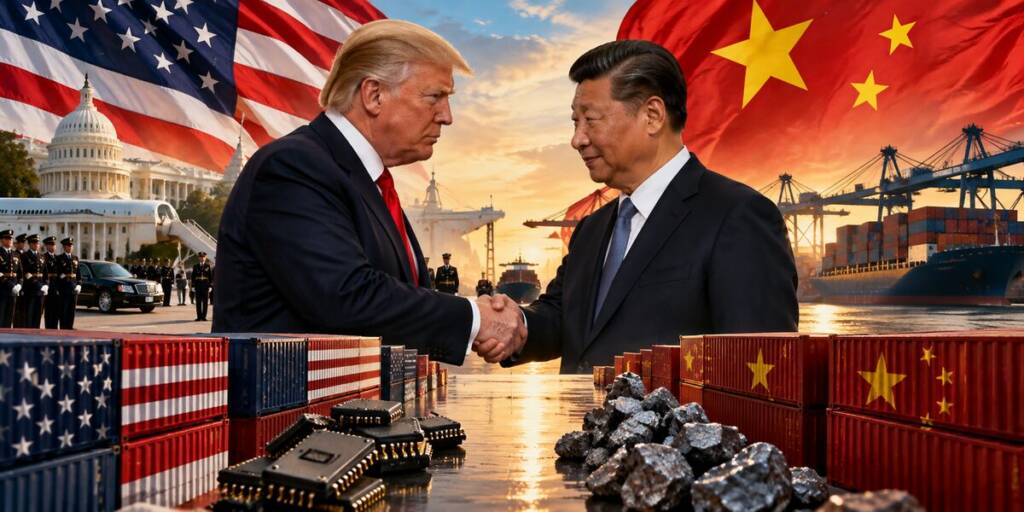
US President Donald Trump and Chinese President Xi Jinping have agreed to keep their trade truce alive, extending it during Xi’s state visit to Washington on September 24. US Treasury Secretary Scott Bessent said both sides would push the truce from November 10 to January 10, 2027 — a move analysts say also shields China from a sweeping new US law authorizing 100 percent tariffs. That leaves India, another major buyer of Russian oil, facing an awkward question: why does Beijing get a pass while New Delhi doesn’t?
What the Two Sides Agreed on Trade
Xi arrived September 23 for his first visit to Washington in more than a decade. Trump greeted him on the tarmac at Joint Base Andrews — the first time in 11 years a US president had extended that courtesy to a foreign leader.
The talks yielded consensus on several economic fronts. Negotiators agreed to establish a channel for discussing serious artificial intelligence safety incidents, while US Trade Representative Jamieson Greer outlined a “Board of Trade” process to select goods for reciprocal tariff cuts.
Bessent said China had honored its pledge to purchase 25 million tonnes of US soybeans, though Beijing remains roughly $17 billion behind on other agricultural commitments. Beijing itself has not officially confirmed the truce extension.
Indian MP Shashi Tharoor noted that Washington secured commitments on farm exports and steady critical mineral supplies, while Beijing won tariff relief and a pause on broader US export controls. Both sides also agreed to keep military talks open to guard against miscalculation.
China’s leverage in these negotiations is considerable: the country posted a $1.2 trillion global trade surplus last year, and its dominance over rare earth supplies gives Beijing significant sway over Washington.
Why China Escapes the 100 Percent Threat on Trade
Trump signed the Sanctioning Russia and Iran Act into law on September 18, granting himself authority to impose tariffs of up to 100 percent on major buyers of Russian energy — a category that includes both China and India. Crucially, though, the tariffs aren’t automatic; Trump retains full discretion over which countries to target, what rates to impose, and whether to grant waivers.
The Conference Board, a US research group, has judged it unlikely Washington will wield this power against China, citing the administration’s evident interest in preserving the truce. That truce emerged from a 2025 tariff war in which mutual duties exceeded 100 percent; even now, US tariffs on Chinese goods average more than 36 percent, according to Congressional Research Service estimates.
Will India Face Tariffs?
India has no comparable truce to fall back on. In February, Washington and New Delhi struck an interim trade framework under which Trump dropped a 25 percent penalty on Indian goods, citing India’s commitment to halt Russian oil purchases. A subsequent US Supreme Court ruling voided those reciprocal tariffs, and Washington replaced them with a flat 10 percent levy on certain products from all countries.
India’s actual oil purchases, however, tell a different story. The country imported 2.08 million barrels a day of Russian oil in August, according to Kpler data — accounting for 45 percent of its total oil imports. That figure keeps India squarely within the new law’s crosshairs.
India’s Ministry of External Affairs has said it remains committed to energy security for its 1.4 billion citizens and will take all necessary measures to protect its trade interests. Commerce Minister Piyush Goyal has similarly signaled that India will sign a fuller trade deal only on terms favorable to its exporters.
The risk to India is real, if not yet certain. Trump has broad discretion and has targeted India with tariffs before. Tharoor warned that tariff relief extended to China could backfire on Indian exporters if Washington decides to press New Delhi harder instead.
Is India Losing Its China Value?
Washington has long viewed New Delhi partly through the lens of its rivalry with Beijing — a dynamic that gave rise to the Quad grouping of the US, India, Japan and Australia. Trump’s evident warmth toward Xi now tests that underlying logic. Trump has referred to the US-China relationship as a “G2,” a label that has unsettled New Delhi, while Beijing’s readout from the May summit spoke of building “strategic stability” between the two powers.
Still, some analysts see limits to the thaw. The National University of Singapore’s Institute of South Asian Studies pointed in May to deep mutual mistrust between Washington and Beijing, arguing the prospects for a genuine G2 remain limited. Former US Deputy Secretary of State Kurt Campbell characterized this week’s summit as more about projecting strength than striking hard bargains.
India, meanwhile, offers Washington value that extends beyond serving as a counterweight to China — namely, a large consumer market and an alternative manufacturing base. Tharoor argued that warmer US-China ties don’t eliminate companies’ underlying incentives to diversify their supply chains, a dynamic that could bolster India’s pitch as a “China plus one” destination. The challenge for India now is demonstrating that value on its own terms, independent of the China question.
Trump and Xi are slated to meet again in China in November and in Florida in December. Bessent conceded he remains unsure whether a broader deal will follow.
For now, the truce buys both powers time. For India, the clock is already running: the sanctions law takes effect within 30 days of signing.