
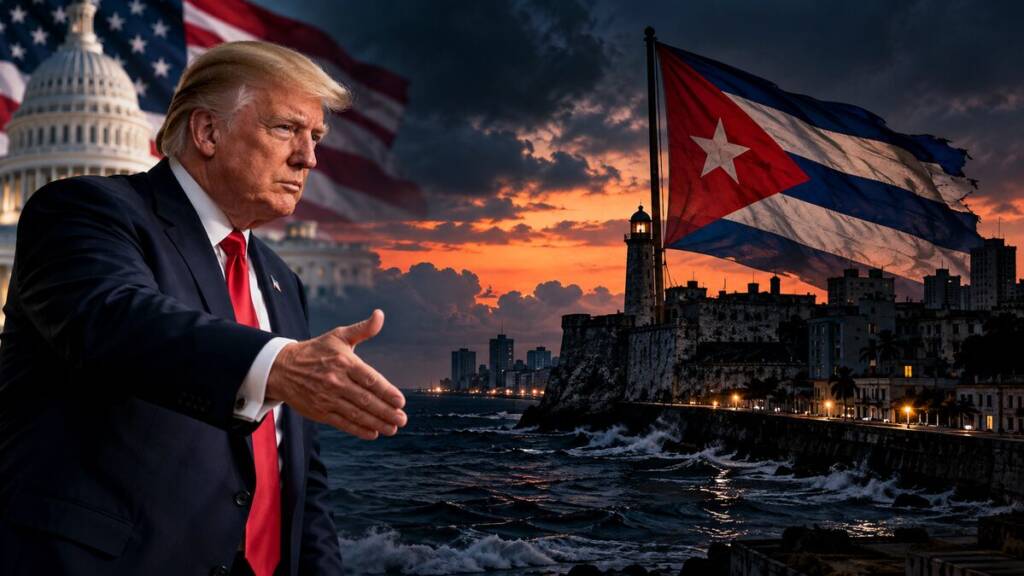
US President Donald Trump predicted on Saturday that the US and Cuba will strike a deal. He added that he does not expect to need military force. “I would say that Cuba and us will make a deal,” Trump told reporters at the White House. He spoke before leaving for Tennessee. He said his government wants to help Cuba and open the island to Americans.
Hours later, Cuba replied from New York. Foreign Minister Bruno Rodriguez told the UN General Assembly that Havana remains ready for dialogue with Washington. He insisted that any talks must rest on equal footing and carry no preconditions. He also called the US oil blockade “an act of collective punishment”.
The Heart of the Dispute
The US imposed a trade embargo on Cuba after Fidel Castro’s communist revolution in 1959. Successive US governments have kept it in place for more than six decades.
This year, Washington tightened the squeeze. In January, Trump threatened tariffs on any country that sells or supplies oil to Cuba. Mexico had ranked among Cuba’s top oil suppliers in 2025. By late January, Cuba reportedly held enough oil for only 15–20 days. The pressure followed a US military operation in January that removed Venezuelan President Nicolás Maduro. Venezuela had long supplied Havana with oil.
Cuba has gone Dark
The blockade now shapes daily life. Cuba’s power grid collapsed again on 18 September, leaving millions without electricity. There have been at least six such failures since January. Mercedes Rodriguez, a 60-year-old Havana worker, described the strain: “There isn’t enough food, there’s no water, there’s no electricity.”
Cuban officials also blame the blockade for gaps in food and other basic supplies. Havana puts the embargo’s cost at $8.1bn for 2025, up 7 per cent on the previous year.
What Washington Wants
The Trump administration openly says it wants a change of government in Havana.
Secretary of State Marco Rubio said on 23 September that the US would talk to Havana about a political transition. He linked this to ending the embargo and the blockade. Rubio said Cuba now faces “a golden opportunity”.
Trump went further at the UN on Tuesday. He called Cuba a failed state and promised that freedom would reach the island. The Cuban delegation walked out.
What Cuba Wants
Cuba wants the pressure lifted. Havana has called for an end to the energy blockade. It also wants the decades-old embargo gone.
Yet the Cuban government rejects any talk of stepping aside. President Miguel Díaz-Canel has said the revolution will not abandon its principles of sovereignty and dignity.
On Saturday, Rodriguez also said Cuba welcomes trade and business with US companies, as with any other nation. That offer hints at economic common ground.
Mixed Signals on Talks
The two sides send conflicting messages. In April, Havana confirmed that it held talks with US assistant secretaries of state. A Cuban official described the exchange as respectful and free of threats.
But the mood soured later. On 7 September, Rodriguez said the two countries had no negotiations and no agenda. He added that both sides still kept channels open.
Trump’s Saturday remarks therefore mark a shift in tone. He offered no date, venue or terms for any agreement.
The World Takes Sides
Brazil, Mexico and Pakistan have criticised the US measures and called for an end to both the embargo and the blockade. Since 1992, the UN General Assembly has backed a yearly resolution urging Washington to lift the embargo.
Opinion in the US remains split. Some experts, former officials and Cuban religious groups warn that more pressure could deepen hunger and push up migration. Others, including a prominent Cuban exile, back cutting off the government’s revenue to force change.
What Comes Next
Rodriguez warned that any US military strike would cause vast destruction. “Let’s hope that this never happens,” he said.
Trump’s words appear to take that threat off the table for now. The core gap, however, remains wide. Washington wants a new government in Havana. Havana wants respect for the one it already has.
Any deal must bridge that divide. Until then, Cubans will keep waiting for the lights to return.