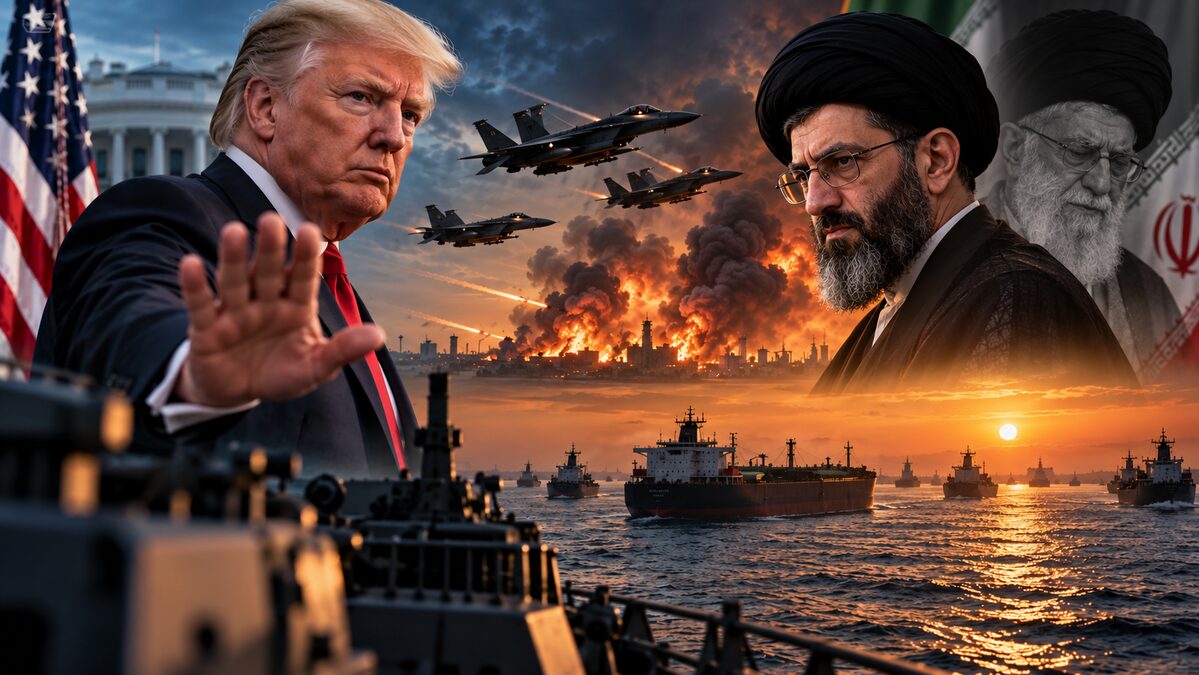
rumpUS President Donald Trump has rejected Iran’s offer of a seven-day ceasefire. He expects to resume bombing Iran after the US midterm elections in November. Iran hit back on Sunday. Tehran insisted that diplomacy offered the only way to resolve its conflict with the United States and Israel.
The decision stalls efforts to end a war that began on 28 February. It also raises the prospect of fresh US air strikes within weeks.
Trump Confirms the Rejection
Trump confirmed his decision on Saturday. “I’m rejecting their deal,” he told reporters at the White House. He argued that Iran wanted the strait reopened immediately because it was losing the war. Trump further claimed US forces held total control of the waterway. He also said 29 ships had sailed out the previous night.
Why Trump is Saying No
Trump doubts Tehran’s intentions. Privately, he questions whether Iran would meet his demands. He has told staff he sees a renewed bombing campaign as likely, US officials told the Journal. Washington also refuses to give up its strongest lever. The US told Tehran it would not lift the blockade.
The midterms also shape the timetable. Trump has repeatedly linked a deal to the November vote. Earlier this month, he said he expected the war to end after the elections. He insists Iran must abandon its nuclear ambitions or face further strikes. Iran calls enrichment a sovereign right.
Trump denies that politics drives his thinking. At the UN General Assembly this week, he said his only goal was ensuring “Iran will never have a nuclear weapon”.
What Iran Offered
Foreign Minister Abbas Araghchi unveiled the plan in New York last week. Qatari mediators passed it to the Americans. Under the plan, initial steps would take four or five days. The Strait of Hormuz would reopen on the sixth day. Nuclear talks would start on the seventh.
In return, Iran wants major concessions. Tehran asked Washington to lift its blockade of Iranian ports, ease oil sanctions and free some frozen assets. It also sought a ceasefire covering Lebanon. The plan closely mirrors a memorandum both sides reached in June, which later unravelled.
Iran Holds Firm on Talks
Araghchi responded on social media on Sunday. He said Iran’s conditions remain clear and any reopening of the strait depends on them. “Only a negotiated solution can get them out of this deadlock,” he wrote. He also challenged Trump’s account. Araghchi said mediators had not yet officially relayed any US rejection. Iran will decide its next step once mediators deliver Washington’s final position.
Blockade Bites into Iran’s Economy
Trump’s claim of Iranian desperation rests on economic data. The US blockade began on 13 April and cut Iran’s oil exports sharply.
The numbers show deep damage. Iranian crude loadings fell from about two million barrels a day in March to roughly 220,000–255,000 in August, according to Kpler and Vortexa. Iran’s statistics centre reported that GDP shrank 10.1 per cent year on year in the spring quarter.
Ordinary Iranians feel the squeeze most. Average inflation hit 69.9 per cent this month. The rial slid from about one million per dollar a year ago to over 2.2 million in early September. Unemployment rose to 9.1 per cent.
Tehran rejects the idea that pressure forced its hand. Araghchi framed the stalemate as Washington’s problem, not Iran’s.
The Wider Picture
The strait remains at the centre of the crisis. Before the war, around 20 per cent of the world’s oil and gas passed through it. Iranian attacks on vessels have cut shipping there drastically, despite Trump’s claims of US control.
The conflict continues to spread across the region. On Saturday, Saudi-led coalition forces intercepted two Houthi drones heading for Riyadh. They also downed two ballistic missiles aimed at Khamis Mushait.
Talks have collapsed before. Negotiations between Tehran and Washington have broken down numerous times during the seven-month war. For now, both sides await the mediators’ next move. Voters head to the polls on 3 November, and the Journal’s sources suggest the bombs may follow soon after.