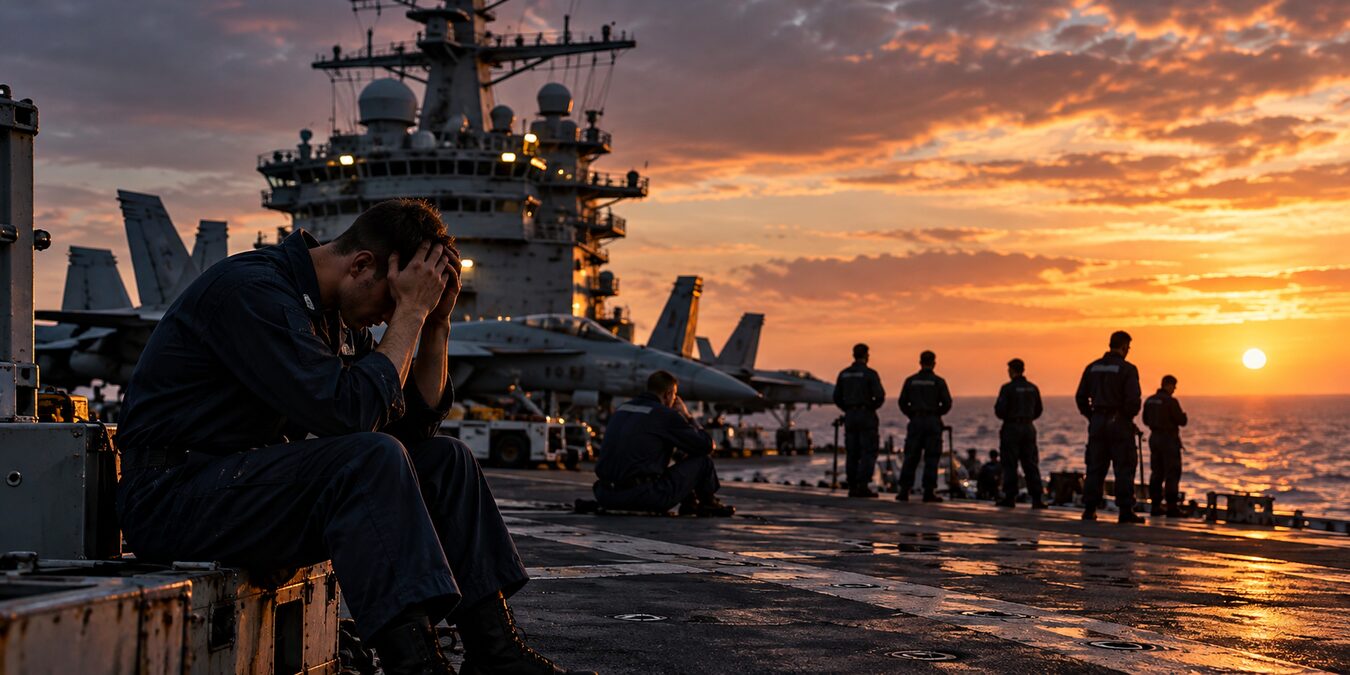
Eight US sailors serving with the USS Abraham Lincoln carrier strike group attempted suicide during a deployment that became the longest without a port call in modern Navy history. Acting Navy Secretary Hung Cao disclosed the figure in a September 22 letter to Senator Kirsten Gillibrand, who sits on the Senate Armed Services Committee. No sailor died by suicide, Cao wrote. The count spans the carrier’s crew, its air wing, embarked squadrons, escorting destroyers, and strike group staff — not the Lincoln alone.
An official said two sailors jumped overboard while the ship operated in the Middle East. The official provided no details about the other six attempts. A Navy spokesperson had earlier said there was no observed rise in suicidal thoughts or attempts aboard. By comparison, the Navy recorded 356 suicide attempts fleet-wide among roughly 337,000 active-duty sailors in 2024 — the most recent year with published data — putting the strike group’s rate roughly in line with the broader force, though the comparison is inexact.
A Deployment That Kept Extending
The Lincoln left San Diego in November for what was planned as a seven-month Indo-Pacific tour. War broke out with Iran on February 28, and the mission kept extending well past its original scope — one father told reporters the family’s expectations shifted once the Navy redirected the carrier toward Iran in January. Reports put the total length at 266 to 286 days without a port call; Representative Sara Jacobs says it’s the longest such stretch for any carrier in modern history. The Japan-based USS George Washington finally relieved the Lincoln in August.
Strain Aboard
The Navy hasn’t attributed a cause to any of the eight attempts, and mental health experts caution against single explanations. But crew accounts point to a rough deployment: one Lincoln sailor described sinking morale, frequent talk of shipmates’ suicidal thoughts, toilets and water fountains that often didn’t work, and hot water that regularly ran out. Before the recall, the sailor said the crew woke each day anxious for word on when they’d finally head home. Families separately described exhaustion and declining mental health among relatives aboard. Hegseth rejected the idea that the carrier was under-resourced and praised the crew.
A nuclear carrier can stay at sea for years without refueling — but people, not fuel, set the real limit. The Navy’s own planning framework calls for a roughly seven-month deployment within a 36-month cycle that also builds in maintenance, training, and rest. Long deployments eat into that recovery time, and the Lincoln isn’t an outlier: the USS Gerald R. Ford spent 326 days away, and the USS Fort Lauderdale returned in July after 334.
A Punishment That’s Drawn Criticism
One case has become a flashpoint. A sailor jumped from the Lincoln in August, an incident his wife described as a suicide attempt. According to leaked documents, the Navy charged him with malingering and unauthorised absence, putting roughly half his pay at risk. Jacobs, who represents the Lincoln’s home port of San Diego, said no one should face punishment for seeking the mental health care they need.
Gillibrand continues to press the Pentagon on shipboard living conditions and medical resources. Mental health professionals also note that homecoming brings its own adjustment challenges — a period the Lincoln’s families and crew are now entering.