
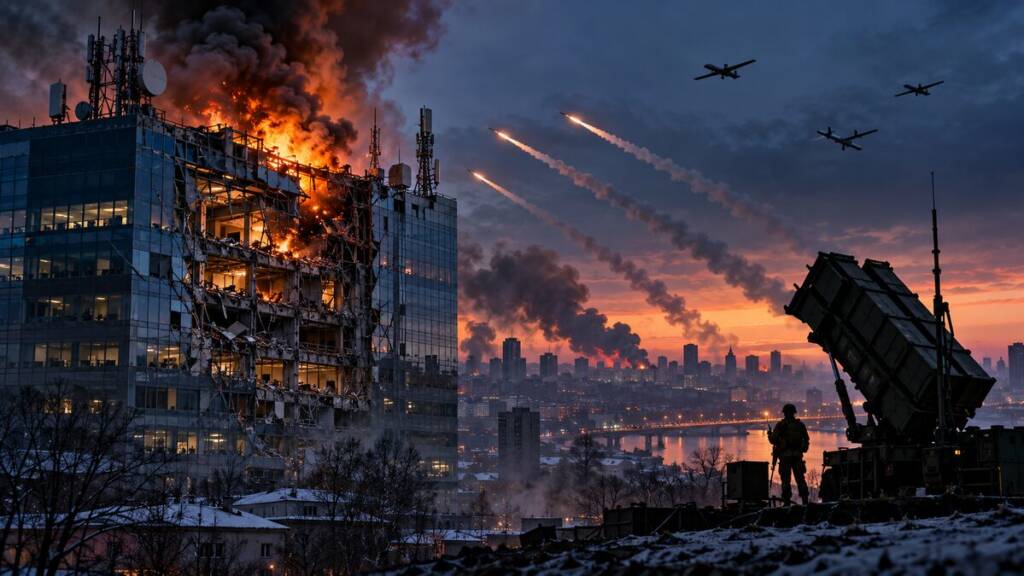
Russia struck the Kyiv headquarters of Kyivstar, Ukraine’s largest mobile operator, on Sunday, September 27. Kyivstar told Interfax-Ukraine that the strike hit its head office but caused no casualties.
Russia’s defence ministry said its forces also hit a data centre belonging to Vodafone Ukraine, the country’s second-largest mobile network, on the same day. President Volodymyr Zelensky said Russia struck a data centre in Kyiv twice on Sunday morning.
A week-long assault on Ukraine’s networks
Russian strikes on internet providers’ data centres over the past week have cut service to about 100,000 households in Kyiv and the surrounding region. Ukraine’s Foreign Minister Andrii Sybiha accused Moscow of trying to disrupt the flow of information. “Rapid alerts about missile and drone threats are essential – they save lives,” he wrote on X.
Why Moscow may hit Ukraine harder
Three pressures are pushing Russia towards heavier strikes on Ukraine’s power grid this winter.
The first is Ukraine’s own long-range campaign. Ukrainian drones have struck Russian refineries at least 70 times this year, and the International Energy Agency counted a successful hit roughly every three days from January to August. On September 20, one attack forced the Moscow refinery to halt crude processing. Moscow has promised retaliation. On August 31, Russia’s defence ministry said its forces had begun preparing “massive strikes” on Ukrainian energy facilities in response to attacks on Russian fuel and energy sites. Citing Ukrainian intelligence, Zelensky said Russia plans to spend $12 billion on jet-powered and other attack drones next year.
The second is the weather. Ukraine’s cold season runs from late October until March. The country’s energy ministry counts nearly 6,000 Russian attacks on the energy system since 2022, and the Centre for Eastern Studies (OSW) called last winter Ukraine’s hardest since the war began. After meeting US President Donald Trump at the UN on September 22, Zelensky warned: “If it will be winter in war, it will be not simple.”
The third is a shortage of air defence. Ukraine relies on Patriots as its only reliable shield against Russian ballistic missiles, and reports in August said it had “pretty much run out” of interceptors. On August 2, Zelensky said Ukraine had received only a third as many interceptors as a year earlier. Fewer interceptors mean more Russian missiles can reach power stations and substations.
The American stake
The US war with Iran has also drained America’s own Patriot stockpile. CSIS estimates that US stocks of advanced Patriot interceptors have fallen from over 2,300 to roughly 800.
That arithmetic shapes Trump’s approach. Since returning to office in 2025, he has ended large-scale US defence funding for Ukraine, and Kyiv now relies on European partners and paid purchases for key weapons. On September 18, the State Department approved a possible $2.7 billion sale of air defence equipment to Ukraine, and congressional records show Washington preparing to approve Germany’s transfer of 10 Patriot interceptors.
On September 25, Zelensky said Trump had given Ukraine permission to produce its own Patriot missiles. Poland’s Deputy Defence Minister Magdalena Sobkowiak-Czarnecka then offered to host the factory on “safe territory.” Warsaw also wants faster construction of a new US base for at least 5,000 American troops.
Trump also holds a new economic lever. He recently signed Senator Lindsey Graham’s sanctions bill into law, which lets him impose 100 per cent tariffs on the top five buyers of Russian oil and gas. At the UN, he vowed to use those powers if needed to end the war.
He is also pushing an energy truce. Zelensky says Kyiv will stop hitting Russian refineries if Moscow spares Ukraine’s grid. The Kremlin welcomed the idea but also raised sanctions and its seaborne exports.
Pain at the American pump
The refinery war also reaches American drivers. Trump has urged Kyiv to stop hitting Russian diesel plants, saying the strikes are “hurting the world.” US diesel topped $6 a gallon for the first time on September 10. Diesel powers trucks, trains and farm machinery. Experts dispute Trump’s link and point mainly to the Iran war.
A Wall Street connection
Sunday’s target also has an American connection. Kyivstar became the first Ukrainian company to list on a US stock exchange in August 2025, and its shares trade on the Nasdaq under the ticker KYIV. The operator has also signed a deal with Elon Musk’s Starlink for satellite links straight to mobile phones.
Kyivstar has faced attacks before. Two hacking groups with ties to the Russian government claimed a December 2023 cyberattack that knocked out its services. This time, the attack came from the air.
With frost only weeks away, Ukraine’s phones, heating and lights all remain in Moscow’s sights.