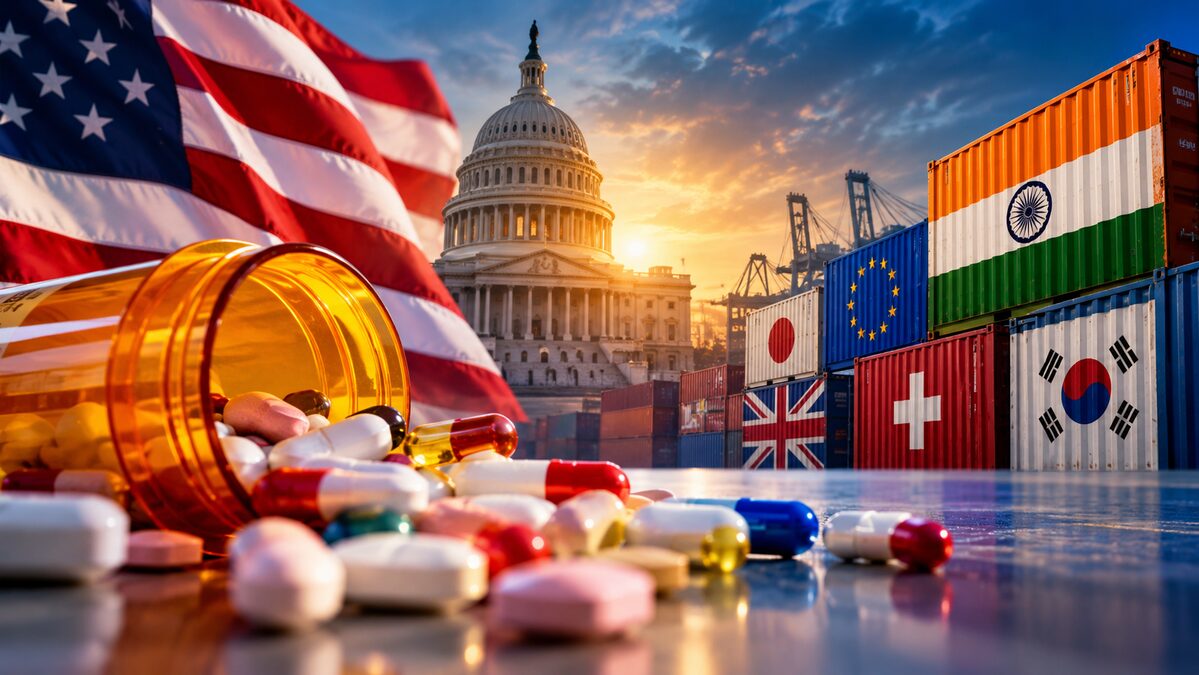
At 12.01am Eastern time on 29 September, America’s 100 per cent tariff on patented medicines widened its reach. Yet Washington had already slipped a quieter notice into the Federal Register six days earlier: a waiver on speciality drug tariffs for certain products from India and 19 other jurisdictions.
The list reads like a map of American friendship. It includes the European Union, Japan, Britain, Switzerland, South Korea, Vietnam, Bangladesh and Argentina. Neither China nor Canada makes the cut.
Welcome, then, to the new geopolitics of the medicine cabinet.
Why Washington Reached for the Tariff
The Commerce Department opened a Section 232 investigation into pharmaceutical imports on 1 April 2025. Section 232 lets a president restrict imports that threaten national security, and Commerce reached a stark conclusion: foreign plants produce about 53 per cent of the patented medicines Americans use, and roughly 85 per cent of patented active ingredients by volume, according to the administration.
President Donald Trump first brandished the threat in September 2025, promising a 100 per cent levy on branded drugs unless companies built American factories. Drugmakers then raced to strike individual pricing and investment deals with the administration.
Those negotiations bought the industry several months of breathing space. The formal blow landed on 2 April 2026, when Proclamation 11020 set a 100 per cent default rate on patented drugs and their ingredients. Partners with trade deals, such as the EU and Japan, faced a gentler 15 per cent. Companies that agreed onshoring plans with Commerce secured 20 per cent, rising to 100 per cent in 2030.
The message could hardly sound clearer: build here, or pay.
The logic carries some weight. The pandemic showed how brittle long medicine supply chains can become, and no government wants a distant port to hold its cancer drugs hostage during a crisis.
Yet a tariff remains a blunt tool for a delicate market. The industry lobby, PhRMA, warned that tariffs could affect investment in American drug-making.
India: Bruised, Not Broken
For India, the tariff saga has felt like a slow-motion stress test. The United States remains its largest pharmaceutical market by a distance: India shipped $9.46 billion of drugs there in 2025-26, about 30 per cent of its exports. That figure fell from $10.51 billion a year earlier. Pharmexcil chairman Namit Joshi reportedly lowered his 2030 industry forecast to $80-90 billion from $130 billion, blaming US tariff uncertainty and Middle East shipping disruption rather than weak demand.
Still, India’s exposure to the patented-drug tariff always looked modest. Indian firms mostly sell cheap generics, which Washington excluded from the Section 232 levy — by one estimate, India supplies nearly 40 per cent of the generics Americans take.
Markets still flinched. Indian pharmaceutical shares fell 2.6 per cent after Trump announced his branded-drug tariff in September 2025.
Europe, not India, carries the heavier stake in patented medicines. America buys most of its foreign medicines from India and European hubs such as Ireland, Switzerland and Germany, so for Europe’s research-heavy firms, the carve-out shields some of the costliest products they make.
What the Waiver Actually Covers
The Bureau of Industry and Security published its notice in the Federal Register on 23 September, defining the speciality products that qualify for a zero rate — in plain terms, Washington will charge no ad valorem duty on these goods.
An ad valorem tariff levies a fixed percentage of a product’s value. The list includes orphan drugs, nuclear medicines, plasma-derived therapies and fertility treatments. It also covers cell and gene therapies, antibody-drug conjugates, certain medical countermeasures and animal-health products. The zero rate extends to their ingredients too, and the notice also created a zero-duty heading for drugs that companies import solely for clinical trials and research.
Crucially, the exemption rewards diplomacy as much as medicine. A product qualifies if its home jurisdiction has a current or forthcoming trade and security framework with Washington. Alternatively, Commerce can grant relief when a drug meets an urgent American health need.
Companies must still prove that each product fits the American definitions, and Commerce reserves the right to modify those definitions later.
Why Now?
Three motives explain the timing. First, the broader tariff reached all remaining companies on 29 September. The notice gave operational teeth to exemptions the April proclamation had only sketched.
Second, America cannot conjure domestic capacity for niche therapies overnight. Roughly 30 million Americans live with a rare disease, according to the National Institutes of Health, and only about 500 of some 10,000 rare diseases have a treatment that the FDA has approved.
Behind every orphan drug sits a family that has often waited years for a diagnosis. For such families, a 100 per cent tariff would have felt like a second diagnosis, punishing the patients with the fewest options.
Third, the waiver rewards partners that have signed, or promised to sign, trade frameworks. India and the US unveiled a framework for an interim trade agreement on 6 February 2026, and Washington promised to remove tariffs on Indian generic pharmaceuticals once both sides conclude that agreement. As of 23 September, one tariff tracker could find no interim text that both sides had signed. The word “forthcoming” therefore does heavy lifting for New Delhi.
A Reprieve, Not a Rescue
Indian boardrooms should resist the urge to celebrate. The speciality list covers a thin slice of what Indian firms actually export. The policy now sorts Indian exports into three buckets: qualifying speciality drugs pay nothing, generics remain outside the levy, and other patented products face 100 per cent.
Admittedly, Indian firms in complex segments could still gain. Yet the industry’s real vulnerability lies elsewhere. In July, Trump announced a schedule for tariffs on foreign generic drugs: under that plan, generics pay nothing until August 2028, then 100 per cent, then 200 per cent a year later. Generics fill more than 90 per cent of American prescriptions, according to the FDA.
That statistic should worry American patients as much as Indian exporters. Here lies the central contradiction of Washington’s medicine policy: it wants cheaper drugs and domestic factories at the same time. Tariffs tend to push prices up, and American plants usually cost more to run. The speciality waiver quietly concedes that point — protectionism in medicine carries a human price that steel tariffs never do.
Washington spared the drugs where shortages would hurt most visibly. It will face the same dilemma with generics in 2028, on a far larger scale.
Deals, Not Drugs
The waiver on speciality drug tariffs tells a revealing story about modern trade. Medicines, once a humanitarian exception, have become bargaining chips. Washington extended relief to partners and withheld it from the rest.
For now, India sits on the right side of that ledger. Whether it stays there depends on deals, not drugs.
Washington has sweetened the pill, but it has not changed the prescription.