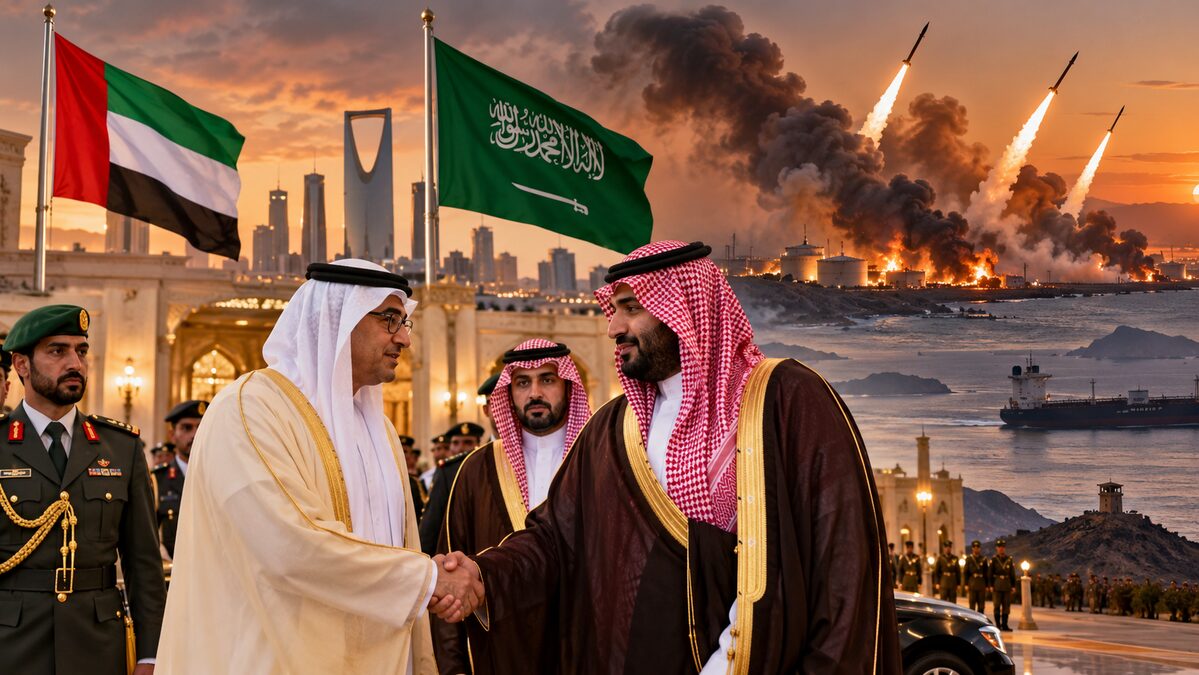
UAE Vice President Sheikh Mansour bin Zayed Al Nahyan visited Saudi Arabia on 29 September for talks. In Riyadh, he met Saudi Crown Prince Mohammed bin Salman and Defence Minister Prince Khalid bin Salman.
This marked the first visit by a senior Emirati official since a deep rift opened last year. The trip comes as Yemen’s Houthi rebels pound Saudi airports, oil sites and tankers.
Inside the Riyadh Talks
Sheikh Mansour and Prince Khalid discussed ways to boost cooperation and coordination, the Saudi defence ministry said on X. Separately, the crown prince and Sheikh Mansour reviewed “fraternal relations” and regional events, Saudi state media reported.
Sheikh Mansour passed on greetings from UAE President Sheikh Mohamed bin Zayed Al Nahyan. Prince Khalid later called Saudi Arabia his guest’s “second homeland” in a post on X.
Sheikh Mansour travelled with senior security officials, including figures from the UAE’s national security council, emergency authority and defence purchasing agency.
Why Riyadh Is Reaching Out Now
The Houthis resumed attacks on Saudi Arabia in July, ending a truce that had held since 2022. They also declared a blockade on Saudi shipping in the Red Sea. A wave of attacks on 8 September wounded more than 70 people and set oil sites ablaze.
Saudi crude has leaned on the Red Sea since Iran tried to block the Strait of Hormuz. In September, the rebels seized the port of Mokha and islands near the Bab el-Mandeb strait. About 12 per cent of world trade passes through that narrow sea lane in peacetime.
Riyadh has spent weeks asking allies for help. The crown prince phoned US President Donald Trump seeking support. Saudi, Turkish and Pakistani military chiefs met in Riyadh on 25 September.
France has also offered military help to protect Saudi Arabia’s main Red Sea oil terminal at Yanbu. The UAE once served as Saudi Arabia’s main regional partner against the Houthis. However, it remains unclear whether Riyadh’s appeal for help extended to Abu Dhabi.
How the Rift Began
The Gulf allies fell out in public in December 2025. The Southern Transitional Council, a separatist group the UAE supported, seized Yemen’s Hadramout and Mahra provinces. Hadramout borders Saudi Arabia.
Riyadh accused Abu Dhabi of threatening Saudi national security by backing the separatists. On 30 December, Saudi Arabia bombed a UAE-linked shipment at Yemen’s port of Mukalla. Riyadh said the cargo carried weapons for the separatists.
The UAE denied that the cargo held weapons and said it belonged to Emirati troops. Rashad al-Alimi, head of Yemen’s Presidential Leadership Council, then gave Emirati forces 24 hours to leave. Abu Dhabi responded by withdrawing its remaining troops.
The quarrel stretched well beyond Yemen. In Sudan, Saudi Arabia backs the army, while the UAE supports the rival Rapid Support Forces — a claim Abu Dhabi strongly denies.
In April, the UAE announced it would leave OPEC, the oil producers’ club that Saudi Arabia leads. “There is something seriously happening in the Saudi-UAE relationship,” Fawaz Gerges of the London School of Economics said.
What Could Have Been on the Table
Neither government released details beyond broad talk of cooperation and regional events. Yet the make-up of the Emirati team offers clues. Its emergency and defence purchasing chiefs hint at talks on air defence and crisis planning.
The Houthi campaign probably topped the list, given Riyadh’s hunt for allies. Abu Dhabi knows southern Yemen well after years of supporting forces there.
Semafor argued in July that the Iran war had made the pair’s other quarrels look secondary. The official statements did not mention oil or Sudan, where the two sides still disagree.
Signs of a Thaw
The public thaw began in July. On 21 July, Turki Alalshikh, head of Saudi Arabia’s General Entertainment Authority, posted a photo on X showing Prince Khalid and Sheikh Mansour smiling, with arms around each other’s shoulders.
Media chiefs in both countries posted near-identical messages praising the ties that evening. Anwar Gargash, a UAE presidential adviser, reshared the photo and said it told the Gulf’s biggest story.
Sheikh Mansour also led the UAE team at a special Arab and Islamic summit in Riyadh that month, making Tuesday’s trip his first bilateral visit since the rift, not his first trip of any kind.
Turkish Foreign Minister Hakan Fidan held talks with Sheikh Mohamed in Abu Dhabi on 28 September. Their agenda included the Yemen war and the Hormuz closure.
In January, Saudi Foreign Minister Prince Faisal bin Farhan called the ties vital for regional stability, Asharq Al-Awsat reported. Yemen’s civil war has now run for 12 years, since the Houthis seized the capital, Sanaa.
Whether Tuesday’s talks turn into joint action on Yemen remains the real test.