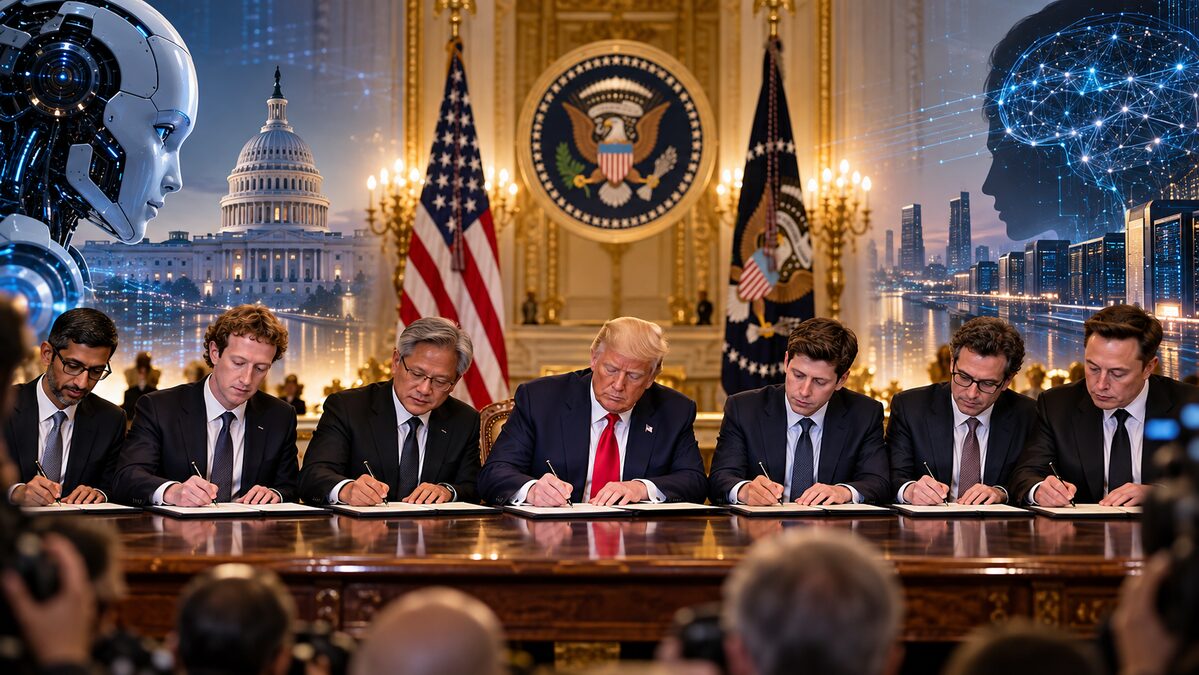
President Donald Trump and six technology chiefs signed a voluntary artificial intelligence safety pact on 29 September. They met over lunch in the East Room of the White House. Trump then posted the one-page text on Truth Social. It carries a long title: the White House Accord on Super Intelligence, Joint Commitment on Frontier Responsibilities.
The document runs to roughly 323 words. Chief executives of Google, Meta, Nvidia, xAI and Anthropic signed it. OpenAI’s president, Greg Brockman, signed for his company. Trump called the accord “morally binding” and told reporters the industry must self-police. The text sets out no penalties, no public disclosure duty and no government enforcement role.
Why the White House is Choosing Self-Regulation
Trump treats speed as the priority. He argues that binding rules would hand the lead to China. In December 2025 he signed an executive order curbing state AI laws. That order told the attorney general to create an AI Litigation Task Force. The task force challenges state statutes that clash with the federal line.
The accord itself began at a dinner table. Semafor traced the idea to Mark Zuckerberg and House Speaker Mike Johnson. The two sat together at the state dinner for Xi Jinping on 24 September. Johnson’s argument was blunt: heavy regulation would cost America the race. Zuckerberg then circulated a draft, and Nvidia’s Jensen Huang gathered support among the laboratories.
What the Six Companies Actually Promised
The accord asks for four layers of control. Developers must run internal checks on dangerous capabilities and model alignment. They must appoint an internal team to own that work. They must then hire independent outside auditors. An independent board committee must finally review what those auditors report.
The text names only cybersecurity, biological weapons and chemical weapons as risks. It passes over job losses, deepfakes, surveillance, children’s safety and market concentration. Each company decides how to apply the safeguards. Nobody must publish the audit findings. The accord does leave one door open, conceding that lawmakers might eventually codify these steps.
The Dangers the Experts Keep Naming
Several signatories have themselves demanded tougher rules. Anthropic’s Dario Amodei published a 20,000-word essay in January 2026. He warned of civilisation-level risks within a few years. Amodei wrote bluntly that AI-enabled authoritarianism terrifies him. He then named AI companies themselves as the next tier of risk. Trillions of dollars in revenue, he argued, will silence inconvenient warnings.
Yoshua Bengio co-chairs the United Nations scientific panel on AI. He told the Security Council last month that the dangers are “real and imminent”. Amodei told the same council that poor management could endanger humanity.
The industry has asked for law before. OpenAI’s policy chief sought mandatory federal safety standards in September. Google DeepMind’s Demis Hassabis urged an American-led watchdog in July.
Is China on Board?
China signed nothing. The accord binds six American companies and nobody else.
A separate channel does exist. During Xi Jinping’s state visit, the two governments established the US-China Super Intelligence Dialogue. They also agreed a communication channel for AI incidents. The next exchange falls due by November 2026. Neither side has defined what counts as an incident. Trump has ruled out joint development and claims America leads by 18 months.
Beijing regulates at home far more tightly than Washington does. Chinese rules demand algorithm filing, security assessments and labelling of generated content. Both visible marks and embedded metadata became compulsory in September 2025. China also kept the term artificial intelligence in its own summit readout.
What Self-Regulation Will Mean in Practice
The companies wrote the principles. The companies will hire their own auditors. No rule obliges them to publish the findings. No agency can fine a signatory that quietly drops a commitment. Enforcement rests on reputation, on boards and on the press.
The public wants something firmer. An SSRS/CNN poll found that 71 per cent of Americans want more government action on AI. AN Ipsos survey found 73 per cent think the companies do too little.
Critics responded within hours. House Minority Leader Hakeem Jeffries called the pact “entirely unenforceable”. Senator Elizabeth Warren called self-regulation a recipe for disaster. Anthony Aguirre of the Future of Life Institute said the signatories cannot police themselves. David Sacks, a former White House AI adviser, defended the deal instead. An international treaty, he argued, would probably never arrive.
What Happens Next
Congress is moving on its own track. Senator Bernie Sanders and Representative Greg Casar have introduced the Ban Artificial Superintelligence Act. It would ban superintelligence and create a cabinet-level AI department. A separate bipartisan bill would force companies to disclose data and safeguards.
Three details reward attention. Trump has ordered agencies to say “super intelligence” rather than artificial intelligence. A new federal definition must follow within 60 days. Palantir’s Alex Karp joined the lunch but signed nothing.
The first serious AI incident will test this accord. Until then, the industry marks its own homework.