
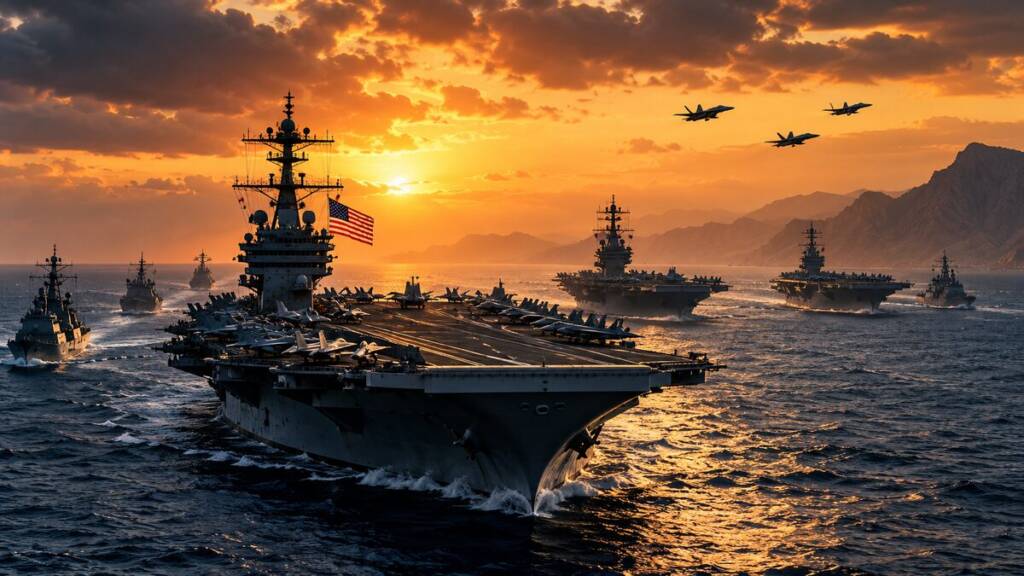
The Pentagon has ordered a third aircraft carrier strike group to the Middle East. It is adding 9,000 to 10,000 troops, according to US officials, and the ships, jets and Marines should arrive by late November. President Donald Trump has separately told aides that he expects to resume bombing Iran that same month.
The order follows the collapse of indirect talks in New York. It was reported on Thursday that the military is planning a possible surge of naval forces in the coming weeks, as Trump weighs renewed strikes.
What has Already Sailed
The USS Theodore Roosevelt left San Diego on Sunday. The Nimitz-class carrier leads Carrier Strike Group 9. It sails with the cruiser USS Chosin and destroyer squadrons. Carrier Air Wing 11 flies from its deck, including F-35C and F/A-18 Super Hornet jets.
The USS Makin Island amphibious ready group left a day later, carrying some 2,200 Marines of the 13th Marine Expeditionary Unit. The Roosevelt will need at least two to three weeks to reach the Arabian Sea.
The Current Deployment Picture
The USS George H.W. Bush and USS George Washington are already operating in the Arabian Sea. Roughly 18 other warships support them and enforce a blockade of Iran’s southern coast. The US already keeps more than 50,000 personnel in the region. The Navy has held a two-carrier presence there since the US and Israel launched the war on 28 February.
The Roosevelt will relieve the George Washington. The handover timing decides whether three carrier groups briefly operate together. That last happened in April, itself the first such deployment since 2003.
Why Washington Wants More Firepower
Carriers buy the president choices. They deliver strike aircraft, air defence and escort power without asking any ally for basing rights. Marines add raid, rescue and evacuation options.
One US official said that three carrier strike groups and two amphibious ready groups would ring Iran by late November, adding that “leaders will have many options for dealing with Iran.”
Central Command refuses to confirm the movements. It said in a statement: “we don’t discuss unit schedules for operational security reasons.” That silence matters, because the fleet pays a price. The naval analyst Ronald O’Rourke warns that holding three carriers in the region for long would strain the force significantly.
Have the Negotiations Failed?
They have stalled badly, though nobody has formally buried them.
Secretary of State Marco Rubio ordered Iran’s UN delegation to leave the country on Monday, after talks stalled. Foreign Minister Abbas Araghchi led that team. A US official said the Iranians had “overstayed their welcome”. The delegation boarded a flight to Doha at 1:20am on Tuesday. Tehran disputes the account. The delegation said on X that it left New York on Monday evening, following a schedule shared with the State Department on 17 September.
Qatari mediators had worked the gaps for days, but neither side would move. Trump had already rejected an Iranian offer to reopen the Strait of Hormuz and restart nuclear talks within seven days. That proposal also sought roughly $12 billion in frozen assets, sanctions relief and an end to the blockade of Iranian ports. A narrower deal may still exist. Araghchi has privately suggested that Tehran could restore inspectors’ access to bombed nuclear sites in exchange for sanctions relief.
Does this Mean Escalation is Certain?
No. Ships move for many reasons, including routine rotation.
One official said the Roosevelt sailed on Sunday without a final destination decided. Sending another carrier group and thousands of troops does not by itself prove that fresh American action is imminent. The political signals point the other way, however. Asked whether he would ramp up bombing after the midterms, Trump replied: “Possible.” He also threatened in his UN speech to “annihilate” the Iranian government. The midterm elections fall on 3 November.
Tehran is bracing. According to repoirts, Iran is preparing a broader response to any major new American attack, while still hoping to keep diplomacy alive. Markets read the same runes. Oil settled more than $4 a barrel higher on Thursday on news of the buildup.
What to Watch Next
Three things will tell you where this goes.
First, watch whether the George Washington sails home or stays. A sustained three-carrier posture signals intent, not rotation.
Second, watch Doha. Qatari mediators remain the only working channel between Washington and Tehran.
Third, watch the calendar. If the strikes resume, officials expect them after 3 November.