
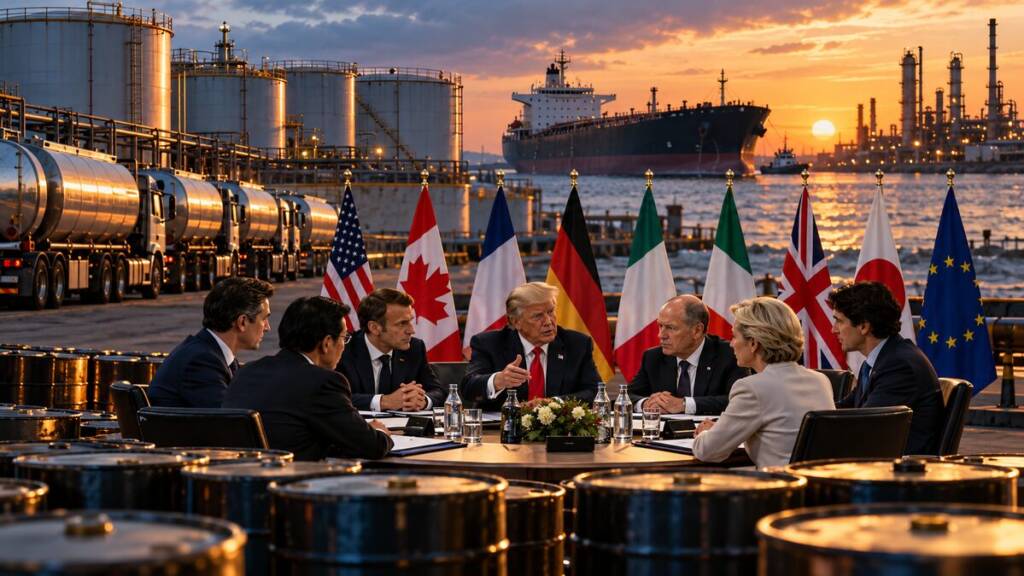
The Group of Seven agreed on Friday 2 October to open its emergency fuel reserves. Member states will release 100 million barrels of diesel and crude oil. The joint statement promises a coordinated release through the International Energy Agency. The flow begins immediately and runs for four months. G7 members and partners will front-load a substantial diesel release within 20 days.
The group also pledged to avoid energy export restrictions among themselves. That single line carries most of the diplomatic weight. Traders reacted within hours. US diesel futures slid 3.25% to $4.49 a gallon. European diesel futures fell by roughly $83 a tonne, down 5.75%.
France shaped the arithmetic. European countries would supply 50 million barrels of diesel. IEA members would add 50 million barrels of crude oil. That diesel figure equals about 17% of EU emergency diesel and gasoil stocks. It covers roughly 3% of the bloc’s annual consumption.
Why Washington Squeezed its Allies
Trump wanted European barrels because he did not want to stop American ones leaving. According to reports on 1 October, the administration had warned Berlin and Paris directly. Release emergency diesel, officials said, or face a US export ban. The targeting was deliberate. Germany and France hold roughly 35% of the EU’s strategic diesel reserves.
US officials also nursed a grievance. They believed both capitals had ducked earlier pledges to draw down emergency stocks. Energy Secretary Chris Wright pressed the case on television. He said that he felt “highly confident” Europe could ease prices.
Washington asked for 100 million barrels of diesel inside a 20-day window. European capitals then turned the threat into a bargain. They wanted the United States to rule out a unilateral ban first. Both sides eventually got their wish.
Why American Diesel Costs so Much
America is not short of diesel. It simply pays the world price for it. US refiners produce about 5.3 million barrels a day of distillates. Domestic demand absorbs roughly 3.6 million barrels. Exporters ship the surplus abroad.
That surplus now feeds a desperate global market. Net distillate exports have run near five-year highs since February. Pump prices followed. Diesel hit a record $6.53 a gallon on 22 September, nearly 77% above last year. Crude oil does not explain the jump. Oil trades roughly $28 a barrel below its June 2022 level.
Refining margins explain it instead. The Gulf Coast diesel crack spread passed $100 a barrel on 1 September. Inventories offer no cushion. Distillate stocks sit about 13% below the five-year seasonal average. The calendar now turns hostile. Refiners cut runs for autumn maintenance as harvest and heating demand climb.
Why Diesel is Climbing Everywhere
The world lost refineries, not oil wells. Crude still flows; the machines that turn it into fuel do not. Ukrainian drones did much of the damage. Analysts estimate that strikes have knocked about 40% of Russia’s refining capacity offline. Moscow responded by shutting the taps. Russia banned diesel exports outright on 8 July, removing roughly a tenth of seaborne supply.
The Iran war compounded it. Reduced transits through the Strait of Hormuz starved Gulf and Asian refineries of crude. China offered no relief. Export quotas and weak refinery runs kept its spare capacity bottled up. The arithmetic is brutal. S&P Global calculates that refineries worldwide processed 7.5 million fewer barrels a day than a year earlier.
The IEA counted the loss differently. Diesel exports from Russia, the Middle East and Asia fell 1.3 million barrels a day year on year. That equals about a fifth of global seaborne diesel trade. Winter heating demand now arrives on top.
The Midterm Calculation
Americans vote on 3 November. Diesel threatens Republicans twice over. The fuel moves lorries, tractors and construction plant. Its price therefore lifts the cost of food and almost everything else. Voters have noticed. Polls place the economy and cost of living at the top of the midterm agenda.
The numbers look grim for the White House. Fox News puts Trump’s approval at 39%, with petrol near $4.50 a gallon. Another survey went further. It found his standing the weakest of any president before a midterm since 1990. Voters also doubt his party on fuel specifically. Quinnipiac found they trust Democrats over Republicans on petrol prices by 40% to 27%. That explains the urgency. Emergency barrels can move pump prices within weeks.
New refineries cannot. They take years, and no president builds one before polling day.
Whether it Will Work
History counsels caution. The IEA coordinated a 400-million-barrel release in March, the largest ever, and prices still climbed. Members have delivered only about two-thirds of those barrels. This new tranche is a quarter of the size. Reserves also empty. Governments must eventually buy the fuel back, which supports prices later.
The deeper problem survives the release. Damaged refineries, not missing crude, created this shortage. The G7 knows it. Ministers will meet again through the IEA within days to weigh further diesel releases. Washington is preparing domestic measures too. An executive order would widen the use of tax-exempt red-dyed diesel. For now, traders have the answer they wanted. Whether voters feel it by 3 November is a separate question.