
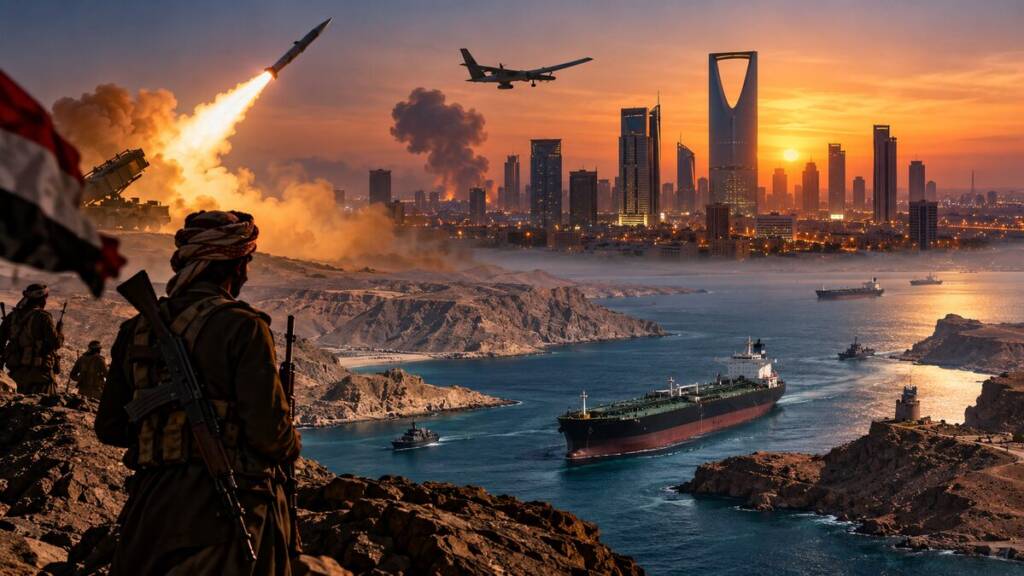
An explosion shook Riyadh at dawn on 19 September. The Saudi-led coalition said its defences had destroyed a Houthi ballistic missile bound for the capital. Later that morning, residents near the airport watched black smoke climb into the sky. It was the capital’s first air-raid alert since fighting flared in July. Two weeks on, the Saudi Houthi conflict has outgrown missile alerts and border skirmishes. Riyadh now plans a ground offensive in Yemen, with Yemeni troops in front and Saudi jets overhead. The reason lies far to the south-west, at a strait whose Arabic name means Gate of Tears.
The War Comes Home
For years, most Saudis followed the Yemen war from a distance. A truce from 2022 kept the border largely quiet. That calm ended this summer.
On 13 July, Saudi Arabia and its Yemeni allies struck Sanaa airport to stop an Iranian airliner landing. The Houthis answered with missiles, a naval blockade and, later, a ground offensive.
On 8 September, Houthi missiles and drones hit Abha, Khamis Mushait, Jizan and Najran. Saudi officials counted at least 73 wounded civilians. Nine days later, debris from a downed Houthi drone killed a Yemeni resident of the kingdom.
This Sunday, the Houthis claimed new strikes on Aramco sites in Riyadh and Khurais. Steven Cook of the Council on Foreign Relations says the attacks expose Saudi vulnerabilities. Riyadh, he notes, has found few answers to them.
How the Saudi Houthi Conflict Closed Riyadh’s Last Exit
The deeper threat is economic. When the Iran war began in February, tanker traffic through the Strait of Hormuz collapsed. Flows fell from about 20 million barrels a day to between six and nine million. Saudi Arabia had an insurance policy. Its 1,200-kilometre East-West pipeline carries crude from the eastern oilfields to Yanbu on the Red Sea. Riyadh pushed four to five million barrels a day through it.
Oil bound for Asia must then sail south through Bab el-Mandeb. The strait separates Yemen from the Horn of Africa. The Houthis saw the opening. In July, they declared a blockade on Saudi shipping. Within days, two tankers carrying 2.8 million barrels of Yanbu crude turned back before the strait. By August, Saudi oil supply had sunk to a three-decade low.
In September, Houthi fighters seized the port of Mokha and reached Perim Island, inside the strait itself. Almost at once, drones struck the pipeline, and Riyadh shut it for nearly two weeks. Saudi officials traced the launch to Iraq.
Yanbu itself now sits within range. A Greek Patriot battery shot down a missile and a drone over the port on 24 September. According to experts, Saudi losing Yanbu “would be a disaster for the world”. The blockade, however, has a single target. Houthi envoys told American diplomats they would spare every ship except Saudi ones. A detour through Suez exists, but it hurts. A voyage from Yanbu to South Korea would stretch from 24 days to 54. Fully laden supertankers cannot even pass through the canal.
A Treasury Under Strain
The damage already shows in the national accounts. The finance ministry expects the economy to shrink 3.6 per cent this year. It forecasts a deficit of 4.9 per cent of GDP, up from 3.3 per cent. Borrowing will rise to pay for defence and new trade routes. Debt could breach the government’s ceiling of 40 per cent of GDP this decade if growth stays weak.
That squeeze lands on Vision 2030, Crown Prince Mohammed bin Salman’s plan to move the economy beyond oil. The plan needs oil money, foreign investors and a reputation for safety. Missiles over Riyadh and threats to tankers undermine all three.
An Offensive Riyadh Cannot Fight Alone
So Riyadh has chosen force. Yemeni government troops will lead the assault, with Saudi air strikes in support. Officials say the campaign could mobilise more than 100,000 Yemeni fighters. Planners are weighing two options. One is a narrow push to retake the coast around Bab el-Mandeb. The other adds attacks in Al-Bayda, Marib, Taiz and Al-Jawf. Estimates for the launch range from this week to after America’s November midterm elections.
Saudi leaders approved the plan several days ago. On Sunday, Yemen’s presidential council chief, Rashad al-Alimi, announced operations to retake all Houthi territory. The timing looks grim. Hours earlier, the Houthis had cut the main supply road to Taiz and encircled the city. Taiz has lived under siege for years. Its people have now lost their lifeline to Aden.
Washington will not join the fight for now. It has twice rebuffed Saudi requests for American air strikes. American commanders view Yemen as a distraction from Iran. Cook adds that America appears short of interceptors and cruise missiles. Washington shares intelligence instead, including more than 200 Houthi targets in two weeks.
Turkey and Pakistan, which signed a defence pact with Riyadh last month, have supplied equipment but no soldiers. France will send air defences to Yanbu. Everything therefore rests on Yemeni units that analysts describe as fractured and unprepared.
Is “existential” too Strong?
Some experts resist the word. Michael Ratney, a former American ambassador to Riyadh, expects a limited operation. He thinks it will be far more modest than the 2015 campaign. The treasury also has cushions. Higher oil prices have largely offset lost volumes. Exports have recovered towards pre-war levels. A Lebanese newspaper even reported a Saudi truce offer through Oman, though Riyadh has not confirmed it.
Yet the trap remain. Riyadh has ruled out new peace talks while the Houthis hold the strait. Saudi Arabia’s last intervention in Yemen lasted seven years and ended inconclusively. Saudi troops fared poorly against the Houthis in border clashes in 2009. Even peace with Iran may not help. Washington and Tehran could settle Hormuz while the Houthis still threaten Bab el-Mandeb. The Houthis, act more independently of Tehran than Hezbollah does.
The Gate of Tears
The pipeline to Yanbu was Riyadh’s answer to Hormuz. The Houthis have now found an answer to Yanbu. That is why the Saudi Houthi conflict feels existential. It threatens the oil that funds the state, the cities that house its people and the future its rulers promised. Yemenis will pay first. Their country ranks among the world’s poorest and already endures a vast humanitarian crisis.
The coming weeks will show whether Yemeni infantry and Saudi jets can reopen the strait. If they fail, Riyadh faces a choice between a costly bargain with Sanaa and a longer war. Either way, the Gate of Tears now sets the terms for the kingdom’s future.