
Former CIA officer David Rush spent seventeen years inside America’s most secretive agency. This week he admitted he had plundered it. The 49-year-old pleaded guilty in a Virginia federal court to one count of wire fraud. Prosecutors then revealed something far graver than theft. Rush admitted that he disclosed descriptive information about a clandestine US government human source to a foreign official.
In his plea document, Rush accepted a stark consequence. The disclosure could endanger the source’s life and the American officers working with that source. Prosecutors did not identify the foreign official’s country.
Judge Michael Nachmanoff approved the plea deal on Tuesday. Rush faces up to 20 years in prison and has agreed to $195 million in restitution. The court will sentence him on 28 January. The CIA has already sacked him.
Six Hundred Pounds of Gold
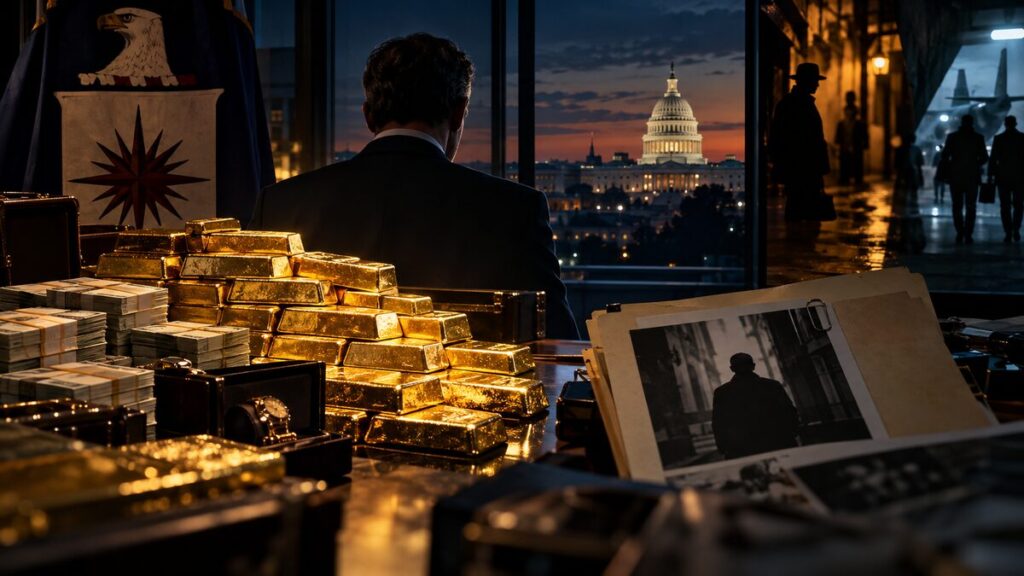
FBI agents raided Rush’s Virginia home in May 2026. They seized 298 gold bars worth $46 million, $2.1 million in cash and dozens of luxury items. Investigators first counted 303 bars. They revised that figure on Tuesday.
Rush did not simply pocket the metal. He manufactured a reason to receive it. Prosecutors say he fabricated a separate programme, which led officials to approve 298 gold bars for him. He then falsely claimed he had distributed the gold in the field.
Court documents describe the control failure bluntly. Rush effectively acted as his own approving official and spent government money without meaningful scrutiny. One January wire transfer moved $45 million. He also spent $1.8 million on private charter flights that a CIA review found served no legitimate requirement.
He had also faked his way in. Rush lied about serving as a Navy pilot and inflated his education and military record to get hired. He held top-secret clearance as a senior executive in the Directorate of Science and Technology. He also liaised with the Pentagon and worked alongside deputy defence secretary Steve Feinberg.
Why Nobody Caught Him
The case exposes architecture, not just a rogue officer.
The Central Intelligence Agency Act of 1949 created a category of money called unvouchered funds. The CIA director personally certifies that spending, which undercuts the ability of external auditors to examine it. Congress built that shield to protect sources and methods. It also strips away the friction that normally catches fraud.
Rush worked precisely inside that blind spot. Gold bars and bundled foreign currency look unremarkable at an agency that genuinely uses both abroad.
A Long Line of Insiders
American counter-intelligence has absorbed worse betrayals. Aldrich Ames ran Soviet counter-intelligence at Langley and sold secrets to the KGB from 1985. He compromised more than 100 covert operations and caused the deaths of at least ten CIA collaborators. Moscow paid him $4.6 million. Ames died in custody in January 2026.
Jerry Chun Shing Lee provides the closest modern parallel. Chinese intelligence officers gave the former case officer more than $840,000, and a court jailed him for 19 years. Some officials still suspect Lee caused the collapse of the CIA’s Chinese spy network, when assets died or defected.
Fraud cases recur too. Garrison Courtney, a former DEA spokesman, posed as a CIA officer for four years and pleaded guilty to wire fraud in 2020. Money drove each man. Rush inverted the sequence. He robbed Washington first, then surrendered a source.
The Dark-Money Tradition
Secret cash has shaped CIA operations for decades, sometimes unlawfully. The Iran-Contra affair remains the sharpest example. Reagan administration officials sold arms to Iran and funnelled the proceeds to Nicaraguan rebels. Congress had expressly banned that funding.
Afghanistan produced a quieter version. CIA officers delivered tens of millions of dollars in suitcases, backpacks and plastic bags to President Hamid Karzai’s office. Afghans called it “ghost money”. American officials said the payments fuelled corruption and empowered warlords instead of buying influence.
Presidents authorised those operations. Nobody authorised Rush’s. The machinery, however, looks identical: money that travels without a paper trail.
What Happens Next
The intelligence community’s inspector general is still investigating how the CIA missed Rush’s falsehoods on his application. CIA director John Ratcliffe says Rush betrayed the public trust and must face full accountability.
Prosecutors have accused no other officials, employees or contractors. That silence invites scrutiny. A $194 million scheme demands approvals, signatures and willing counterparties.
One legal detail will shape January’s hearing. The Intelligence Identities Protection Act criminalises exposing covert agents. Prosecutors chose wire fraud instead. Judges weigh harm at sentencing, and a betrayed human source outweighs any sum of gold.