
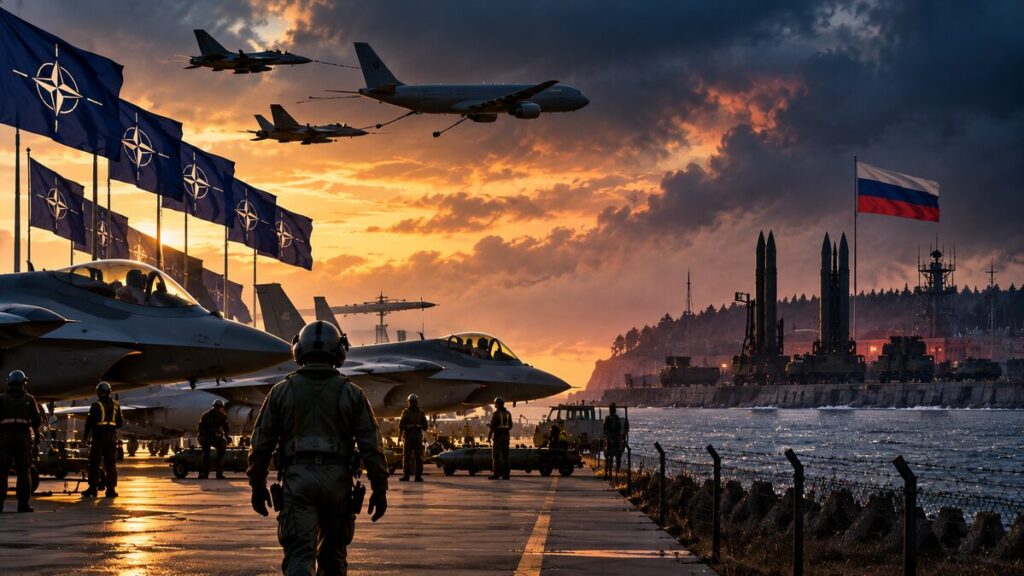
NATO opened its annual nuclear exercise, Steadfast Noon, over Italy on 13 October. The drill comes barely a fortnight after Moscow threatened nuclear retaliation over its Baltic exclave of Kaliningrad. Seventeen of NATO’s 32 members will take part in the 10-day exercise. The alliance insists it threatens nobody, but Moscow’s warnings, and NATO’s own mixed messages, now hang over every sortie.
What the exercise involves
Steadfast Noon tests how allied jets would fly nuclear missions in a crisis. NATO spokesperson Colonel Martin O’Donnell said crews will practise moving jets, staff and equipment between bases, while tanker and security teams rehearse their support roles. No live weapons are used. Italy hosts this year’s edition, and the 17 participants outnumber the 14 nations that joined in 2025.
Putin’s Kaliningrad comments
The row escalated on 30 September, when Moscow sent NATO a written warning over Kaliningrad. The note accused the alliance of a “dangerous and reckless course” and threatened to use every weapon Russia holds, including nuclear arms, if NATO tried to isolate the exclave. It even raised the prospect of Russian strikes on member states’ decision-making centres. Russian embassies in at least three European countries repeated the warning in public statements. A NATO diplomat called the letter one more bid to frighten Europeans.
Russian President Vladimir Putin backed the note at the Valdai Discussion Club in Moscow on 1 October. Any direct attack on Russia, he said, would put “all types of weapons” on the agenda. He also insisted Russia had no plan to attack anyone, whether in 2029, 2030 or 2050, and accused NATO of escalation through repeated Baltic Sea drills and attempts to stop Russian ships. When one questioner suggested both sides were simply trying to intimidate each other, Putin rejected the idea.
“It’s not intimidation, it’s a response to an attempt to intimidate us,” he said. Kremlin spokesman Dmitry Peskov described the embassy statements as a reminder to reckless voices in Europe.
Moscow’s case
Russian embassies say Moscow holds information on NATO plans for an air and naval blockade of Kaliningrad. NATO rejects the claim. Senior Russian official Yulia Zhdanova went further, claiming NATO states were already testing blockade scenarios.
Kaliningrad sits between NATO members Poland and Lithuania, with no land link to mainland Russia. It hosts the main base of Russia’s Baltic Fleet and nuclear-capable Iskander missiles. Moscow points to recent allied activity as evidence: in August, dozens of NATO aircraft rehearsed disrupting communications and suppressing air defences near the region.
A British television drama has also stoked the row. In September, Sky News aired The Wargame, a miniseries imagining a Russian attack on Britain, in which the fictional British response includes operations against Kaliningrad. Russia’s London embassy then warned that Moscow would answer any British or NATO attack with every means, including nuclear arms.
Is NATO targeting Russia?
NATO officials say no. The alliance says Steadfast Noon has no link to current events and targets no country.
Nassima Barrows, a senior NATO nuclear policy official, said the alliance holds the drill every year and has not postponed it this time. “We monitor Russia very closely,” she told reporters, while reporting no alarming change in Moscow’s nuclear posture.
Yet Barrows also named Russia, describing the drill as a “clear message to nations like Russia” that they had nothing to fear. Reassuring or not, the comment singled out one country while the alliance says it targets none. It would not be the first time: in 2024, senior NATO official Angus Lapsley spoke even more plainly.
“We seek to deter any adversaries, and principally Russia,” he told reporters.
Western military officers go further still, regarding Kaliningrad’s key bases as a likely first target if Russia attacks an ally. NATO spokesperson Allison Hart insisted the alliance does not target Kaliningrad, and Secretary General Mark Rutte dismissed fears of a nuclear strike on the Baltic states. “Putin knows that he can never defeat NATO,” Rutte said.
What comes next
Steadfast Noon runs for 10 days, mostly over Italy. Russia typically holds its large annual nuclear exercises in October or later, notes Mark Schneider of the National Institute for Public Policy, though he adds that Moscow already staged one in May this year.
Observers will now watch whether Moscow answers with a show of its own. For now, each side insists it is only responding to the other.