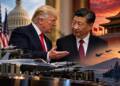
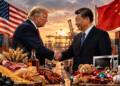
Donald Trump wants the world’s three biggest nuclear powers around one table. On Monday, the US president said he would welcome a three-way summit with Xi Jinping and Vladimir Putin. He suggested China as the venue and put nuclear weapons at the top of the agenda.
The timing matters. For the first time in over half a century, no treaty limits the strategic arsenals of Washington and Moscow. Meanwhile, China is growing its arsenal more quickly than any other nuclear power. Here is what lies behind the Trump nuclear talks push, and why it may stall.
What exactly did Trump say?
Trump spoke to reporters at the White House on 19 October. He said he would take part if Xi wanted the meeting. All three leaders are likely to attend the Asia-Pacific Economic Cooperation (APEC) summit in Shenzhen on 18–19 November.
Putin first floated the idea, and the Kremlin has pushed it since July. Moscow pitched the summit partly as a forum to settle the war in Ukraine. Trump, however, shifted the focus. In his words, “we would have it to talk about denuclearisation”.
China’s foreign ministry said it had no information about any such meeting. Ukraine’s foreign minister, Andrii Sybiha, warned that a summit without Kyiv would only embolden Putin.
What was New START, and why does its end matter?
New START was the last arms control treaty between the United States and Russia. Barack Obama and Dmitry Medvedev signed it in Prague in April 2010. The deal capped each side at 1,550 deployed strategic warheads and 700 deployed missiles and bombers. It also allowed on-site inspections and data exchanges, so each side could check the other.
Russia suspended its participation in February 2023 but promised to respect the numerical limits. The treaty expired on 5 February 2026. Putin had offered to keep the caps for one more year, but Washington never sent a formal reply.
Instead, Trump called New START a bad bargain for the United States. He called for a “new, improved and modernised” treaty. Without the old one, neither side can now verify the other’s forces.
Why does Trump want China at the table?
China sits at the heart of Trump’s thinking. Beijing now holds about 620 warheads, up from roughly 600 a year earlier. That remains far below the US and Russian stockpiles, which each exceed 5,000. But the Pentagon expects China’s arsenal to pass 1,000 warheads by 2030. It also believes China has loaded over 100 missiles into three new silo fields.
Trump has predicted that China could catch up with the US within four or five years. A deal with Russia alone would leave that build-up untouched.
Trump tried to bring China into talks during his first term, but Beijing refused. He raised the idea again with Xi in Beijing in May and at the White House in September.
What else is driving the push?
Money matters. The Congressional Budget Office expects US nuclear forces to cost $946 billion between 2025 and 2034. That works out at about $95 billion a year. Trump has long grumbled about the bill. “There’s no reason for us to be building brand new nuclear weapons,” he said in February 2025.
Rival weapons programmes add pressure. Russia tested a nuclear-powered cruise missile and a nuclear-powered torpedoin October 2025. Trump then ordered the Pentagon to start testing US nuclear weapons “on an equal basis”. Critics warned the move could spark a chain reaction of tests by rivals.
Legacy counts too. Trump first mused about three-way arms talks with Xi and Putin in a 2018 social media post. Last week, he told Newsmax he would “love to denuclearise if possible”. A landmark deal would also hand him a rare diplomatic prize.
Will Beijing and Moscow play along?
So far, neither capital has shown much appetite. China argues that its arsenal bears no comparison with those of the US and Russia. Its foreign ministry has called demands for trilateral talks “unreasonable and unrealistic”. Beijing insists that Washington and Moscow must cut their own stockpiles first. Notably, China’s summary of the September summit did not mention arms control at all.
Russia brings its own conditions. The Kremlin wants any wider deal to cover British and French arsenals too. Moscow also blames US missile defence plans for upsetting the strategic balance. Some analysts argue Trump may need to accept limits on his Golden Dome missile shield.
What happens next?
Much remains uncertain. No one has fixed a date, format or agenda for the meeting. Russia’s deputy foreign minister, Sergei Ryabkov, says Moscow first wants clarity on what the talks would achieve.
Quieter diplomacy continues. US diplomats have already met Chinese officials at least three times this year to discuss nuclear risk reduction. Arms control advocates suggest modest first steps, such as freezing stockpiles and sharing warhead data. A full treaty, however, would take years to negotiate. For now, the ball sits firmly in Beijing’s court.