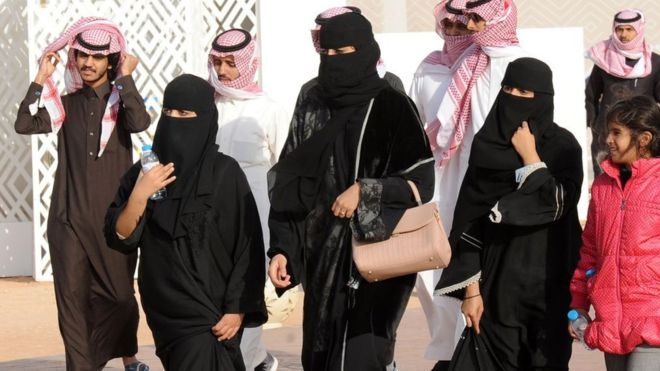
Saudi women have taken to Twitter to protest against the Abaya (Burqa). In a rare form of resistance, women have been posting pictures wearing the compulsory clothing inside out. Nearly 5000 tweets have been posted with the word “inside out abaya”.
https://twitter.com/Howwwra/status/1061477325076881408?ref_src=twsrc%5Etfw%7Ctwcamp%5Etweetembed%7Ctwterm%5E1061477325076881408&ref_url=https%3A%2F%2Fwww.bbc.com%2Fnews%2Fworld-middle-east-46222949
https://twitter.com/Nikkaal/status/1061480607929245696?ref_src=twsrc%5Etfw%7Ctwcamp%5Etweetembed%7Ctwterm%5E1061480607929245696&ref_url=https%3A%2F%2Fwww.bbc.com%2Fnews%2Fworld-middle-east-46222949
https://twitter.com/Shafax6/status/1061544272640532480?ref_src=twsrc%5Etfw%7Ctwcamp%5Etweetembed%7Ctwterm%5E1061544272640532480&ref_url=https%3A%2F%2Fwww.bbc.com%2Fnews%2Fworld-middle-east-46222949
Prescribed for Saudi women to wear in public places, the abaya is a loose, baggy garment meant to cover up the whole body except the hands and feet, often paired with a niqab that covers the face. Any slips and blunders may invite a reprimanding from the religious police. In fact, members of the opposite sex themselves may take the liberty to chastise or remind a woman of the rules. As of late, even the non-black abaya is facing criticism from conservative men.
The Crown Prince, Mohammed Bin Salman (MBS) has stated in an interview to CBS television, “The laws are very clear and stipulated in the laws of Sharia: that women wear decent, respectful clothing, like men.” But then, confusing the audience, he said, “(the law) does not particularly specify a black abaya. (It) is entirely left for women to decide what type of decent and respectful attire to wear.” So he may be “okay” with the rising trend of colourful abayas but the idea of no abayas at all seems distant.
Saudi Arabia is closely aligned with Wahhabism, a strict interpretation of Sharia Law. The country has capped women’s rights to a ghastly extent. But recent reforms momentarily emanated a ray of hope, when King Abdullah granted women the right to vote and stand in the 2015 municipal elections, when the Crown Prince lifted a ban on licensing women drivers and allowed women to enter sports stadiums in 2018. MBS, working towards his “Vision2030” aims to diversify the economy of the petro-state and bring in investments for which he realizes the need for shedding extremist laws and bringing economic and structural reforms. Yet, the Islamist regime is far from closing the abysmal gap in terms of gender parity.
In fact, the entry of MBS to power was initially perceived with optimism given his push for reforms but since then his popularity has plummeted. Royal arrests to remove challengers to the throne, imprisoning of feminists, activists, dissenters and the latest accusation, of the murder of journalist Jamal Khashoggi, on his head are just a few of the reasons to blame.
The regime’s perception of women is still humiliating and ignominious given the inhumane punishment meted out to them for even the slightest of abeyance. In fact, one man’s testimony at court is actually equal to that of two women. Moreover, women still need permission from a male guardian to get married, apply for passports, travel abroad, open bank accounts, get cosmetic surgery, file complaints to the police, leave prison, and so on. They are also pressured to be accompanied by a male guardian when stepping out of the house. In fact, the only Saudi robot citizen, Sophia, appears to have more rights than Saudi women.
It is safe to say that the feminist movement in the Kingdom has only begun. It is ironical, however, how women in West Asia prefer to defer from such clothing more times than not, as to them it represents oppression and lack of control over their own lives, while feminists in freer parts of the world glorify the same clothing and fashion brands, all without a word against the conduct of oppressive regimes such as that of Saudi Arabia. It is also unfortunate that while the women in Islamist countries are protesting against the oppressive practices such as ‘abaya’ and mandatory ‘hijab’, the pseudo-liberal brigade is out to glorify such practices which is clearly undermining the struggle of the women living under oppressive Islamist regimes.