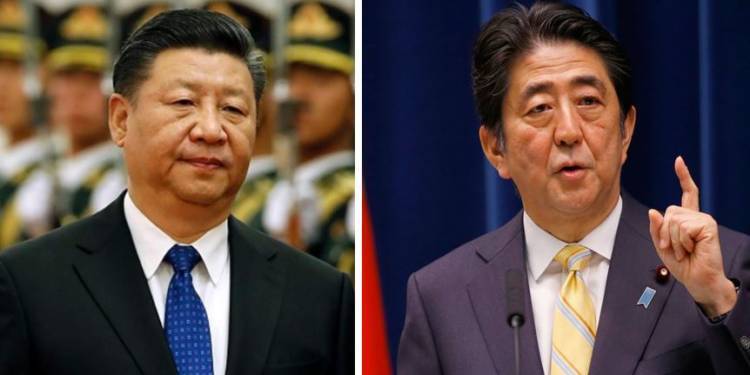
Japan’s outgoing Prime Minister Shinzo Abe is demitting office with some awful news for China. Abe is giving the last push to rid Japan of mindless pacifism in order to check the growing Chinese threat. As he leaves office, the incumbent Japanese PM has set the stage for an offensive defence policy against China, by announcing that Tokyo would come up with a plan to deal with missile threats by the end of this year.
On Friday, Shinzo Abe said that Japan must strengthen its ballistic missile defence. Abe has strongly suggested that Tokyo might have to acquire pre-emptive strike capacity in order to meet the challenges posed by a complex security situation that Japan faces today. Abe even questioned whether Japan could protect itself against missile threats with interception systems alone.
Abe went on to say, “I believe it is necessary to enhance deterrence and thereby further reduce the possibility of an attack against Japan by ballistic missiles and others.” Abe’s statement will have no binding effect on the new government that will be sworn in next week after it becomes clear as to who succeeds the outgoing Japanese Prime Minister. But Abe has sent across a strong message.
In fact, by bringing up the issue at the fag end of his stint as the Japanese Prime Minister, Shinzo Abe is signalling the importance of a missile defence policy for his country. This is more of a hint to his successor that the security threat to Japan coming from China and North Korea must be confronted.
And when Abe says that Tokyo would finalise its missile defence strategy by the end of this year, it suggests that the policymakers have reached close to a consensus which makes the outgoing Prime Minister believe that a missile defence plan could be rolled out soon.
Defence expert and Visiting Professor at Takushoku University in Tokyo, Hideshi Takesada, told AFP, “Missile defense is one of the big issues Prime Minister Abe left unresolved.” Takesada added, “By issuing the statement, Abe aims to pave the way for a new defense policy and leave his legacy to the next government.”
Abe said, “I believe it is necessary to enhance deterrence and thereby further reduce the possibility of an attack against Japan by ballistic missiles and others.” In fact, Abe government did discuss a new missile policy in the backdrop of the Chinese threat that Japan is facing, though the outgoing PM had insisted that such discussions were within the “scope of the constitution and in compliance with international law.
Abe still maintains, “Japan’s exclusively defense-oriented policy will not change at all.” However, within Japan’s strategic circles the idea of pre-emptive strikes on enemy bases as a means of defending Japanese territory is gaining acceptance. To acquire pre-emptive strike capability itself would be a major departure from its post-War, Pacifist Constitution and the Yoshida Doctrine.
In fact, in the month of June this year, Japan scrapped the plan to deploy the American land-based Aegis Ashore missile defence system, because the boosters from the interceptors of the missile defence system could risk residential buildings.
Japanese Defence Minister Taro Kono had disclosed, “The only reason we had to stop the deployment was because we are not able to control where the boosters might fall.” As Aegis Ashore deployment was scrapped, Tokyo had to start considering other means for creating a robust missile defence system and this is where the idea of developing pre-emptive strike capability came into picture.
Japan is therefore growing increasingly aware of how the security challenges are becoming more complex in the Indo-Pacific and how Japan itself is facing a two-front situation. On one hand, North Korea is constantly improving its ballistic missile capability and on the other hand, the Sino-Japanese tensions over the Senkaku Island chain in the East China Sea are also taking a nasty shape.
For Tokyo, it is no longer pragmatic to rely completely on interception capabilities without creating a deterrent effect against its enemies. This is a clear departure from Tokyo’s ‘sword and shield’ relationship with the United States, wherein Washington is the ‘sword’ with offensive capabilities while Japan focuses on defence as the ‘shield’. Japan is therefore coming up with an offensive defence doctrine of its own and this is very bad news for China.