TFIGlobal
TFIGlobal
TFIPOST English
TFIPOST हिन्दी
No Result
View All Result
  • Indo-Pacific
  • Americas
  • Canada
  • Indian Subcontinent
  • West Asia
  • Europe
  • Africa
  • The Caribbean
TFIGlobal
  • Indo-Pacific
  • Americas
  • Canada
  • Indian Subcontinent
  • West Asia
  • Europe
  • Africa
  • The Caribbean
No Result
View All Result
TFIGlobal
TFIGlobal
No Result
View All Result
  • Indo-Pacific
  • Americas
  • Canada
  • Indian Subcontinent
  • West Asia
  • Europe
  • Africa
  • The Caribbean

After months of tough talks with China, the Philippines bolsters its defence capabilities majorly

Sohil Sinha by Sohil Sinha
June 1, 2021
in Indo-Pacific
philippines china military defence
Share on FacebookShare on X

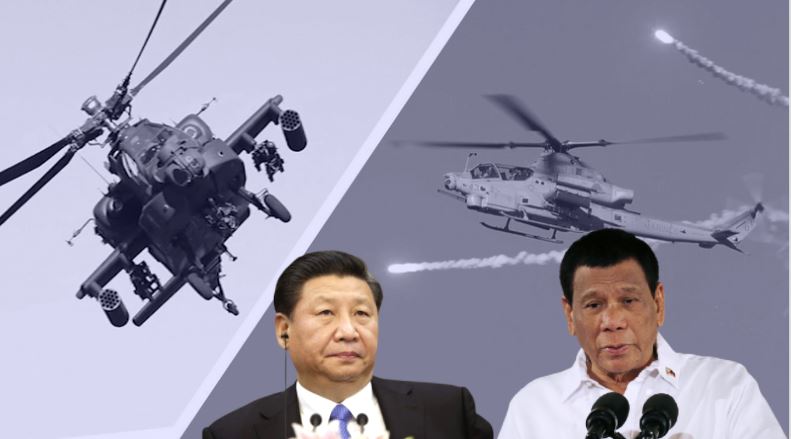
The Philippines plans to receive two T-129 Tactical Reconnaissance and Attack (ATAK) helicopters from Turkey in September, according to the defence department. The delivery is part of a bigger push by Manila to strengthen its defences as it negotiates the renewal of a major military accord with the United States and deals with Chinese incursions in the disputed South China Sea. The Philippines has also been beefing up its defence capabilities, signing agreements with India, South Korea, and Japan.

The Philippine Air Force has purchased six T-129 attack helicopters built by Turkish Aerospace Industries for roughly $269.4 million as part of a modernization programme, according to Defense Secretary Delfin Lorenzana. After a Vietnam War-era Huey helicopter crashed in Bukidnon, killing seven people, President Rodrigo Duterte declared in January that he wants to buy more helicopters. Because the engines powering the helicopters are made by American defence contractor Honeywell and British business Rolls-Royce, the T-129 purchase reportedly needed the US to secure export licences to Turkey.

Also Read

UN votes to redraw the world map – and Africa finally looks its true size

Wired to a Machine: The Hunt for the Leaker Inside America’s Iran war

Trump Renames Lake Ontario ‘Lake America’, and Google Has Already Redrawn the Map

The United States has indicated that it will continue to sanction arms shipments to the Philippines, which it regards as an important Asia-Pacific strategic ally. Despite the opposition of certain Democrats in Congress, who have demanded that security assistance be withheld until the Duterte administration commits to human rights reforms, this has happened. In February, Duterte stated that the United States must “pay” to renew the Visiting Forces Agreement (VFA), a critical military treaty that allows American troops to station in the Philippines.

Last year, the Philippines and Japan agreed to a $103.5 million contract for advanced air surveillance radars, marking Japan’s first complete arms export since 1967. The radars made by Mitsubishi are designed for aerial monitoring at medium to high altitudes. Both Washington and Tokyo have been eager to strengthen their relationships with Manila in order to keep it as an ally in the face of China’s growing influence in the South China Sea – and to temper Duterte’s occasional Beijing-friendly instincts.

Apart from Japan, Philippines has also signed defence deals with India and South korea.  The Philippines and India inked a government-to-government agreement on defence equipment procurement on March 2, 2021, paving the way for the Philippines to purchase the Brahmos missile. The agreement’s primary point is the Philippines’ desire to purchase the BrahMos coastal defence system, which includes supersonic missiles made by the Russian-Indian joint venture BrahMos Aerospace. However, the agreement is not a contract in and of itself.

Moreover, The Philippines and South Korea have continued to discuss cooperation in order to meet the Philippine Navy’s (PN) future submarine requirements. The Philippines’ Assistant Secretary for Logistics and Acquisition, Jesus Rey R Avilla, visited the Republic of Korea Navy’s (RoKN) Submarine Force Command on 12 May to discuss “various areas of co-operation” to enhance the PN’s future submarine capabilities, according to South Korean shipbuilder Daewoo Shipbuilding and Marine Engineering (DSME).

Recent incursions by Chinese ships into Philippine-claimed waters of the South China Sea have sparked outrage in the Philippines. Foreign Secretary Teodoro Locsin used Twitter earlier this month to order China to “get the f**k out” of Philippine maritime waters. Duterte, on the other hand, has tried to preserve a cordial relationship with Beijing, which sponsors several of his administration’s significant infrastructure projects and has given the Philippines Chinese-made vaccinations. As the president has issued a gag order to his cabinet over the South China Sea, Locsin may be requested to log off before engaging in any further diplomacy.

ShareTweetSend
Sohil Sinha

Sohil Sinha

Also Read

A dramatic cyberwarfare illustration showing a shadowy hacker from China launching digital attacks from red-lit servers toward major US government, scientific and industrial facilities, with blue shields marking defended targets and red broken locks indicating compromised systems.

From Victims to Targets: US Quietly Edits Its Chinese Hacking Claims

August 30, 2026
A hooded hacker sits before multiple computer screens as images of the U.S. Capitol, NASA, federal institutions, servers and network data surround them, symbolising a Chinese-linked cyber-espionage hacking campaign targeting American government agencies.

Eight Years in the Dark: Chinese Hacking Campaign Reached NASA, the Fed, and the US Senate

August 27, 2026
A hypersonic glide vehicle streaks through the upper atmosphere as it launches a missile toward a US AWACS radar aircraft, with tanker and support aircraft flying in the distance above dramatic cloud cover.

China’s Hypersonic Gliders Can Now Shoot at Aircraft — And America’s Radar Planes Are the Target

August 25, 2026
A dramatic collage showing Hui Ka Yan in the foreground, Evergrande’s rise symbolised by a luxury skyscraper, car and stacks of cash, and China’s property crisis represented by unfinished buildings, rubble, displaced families and a prison cell. Evergrande founder life sentence

From China’s Richest Man to a Prison Cell: The Evergrande Founder’s Life Sentence Explained

August 24, 2026
A container ship sails through icy Arctic waters toward a snow-covered coastal port, surrounded by floating sea ice and towering mountains under a dramatic sunset.

A Ship Sails North, and the China-Russia Arctic Shipping Route Comes Alive

August 22, 2026
Conceptual illustration of Chinese data infrastructure feeding into a central artificial intelligence system, with glowing data streams spreading toward chatbots and users worldwide, symbolising China’s growing influence over AI training data and information ecosystems.

Explainer: How China Plans to Shape What the World’s AI Knows

August 22, 2026
Youtube Twitter Facebook
TFIGlobalTFIGlobal
Right Arm. Round the World. FAST.
  • About Us
  • Contact Us
  • TFIPOST – English
  • TFIPOST हिन्दी
  • Careers
  • Brand Partnerships
  • Terms of use
  • Privacy Policy

©2026 - TFI MEDIA PRIVATE LIMITED

Welcome Back!

Login to your account below

Forgotten Password?

Retrieve your password

Please enter your username or email address to reset your password.

Log In

Add New Playlist

No Result
View All Result
  • Indo-Pacific
  • Americas
  • Canada
  • Indian Subcontinent
  • West Asia
  • Europe
  • Africa
  • The Caribbean
TFIPOST English
TFIPOST हिन्दी

©2026 - TFI MEDIA PRIVATE LIMITED

This website uses cookies. By continuing to use this website you are giving consent to cookies being used. View our Privacy and Cookie Policy.