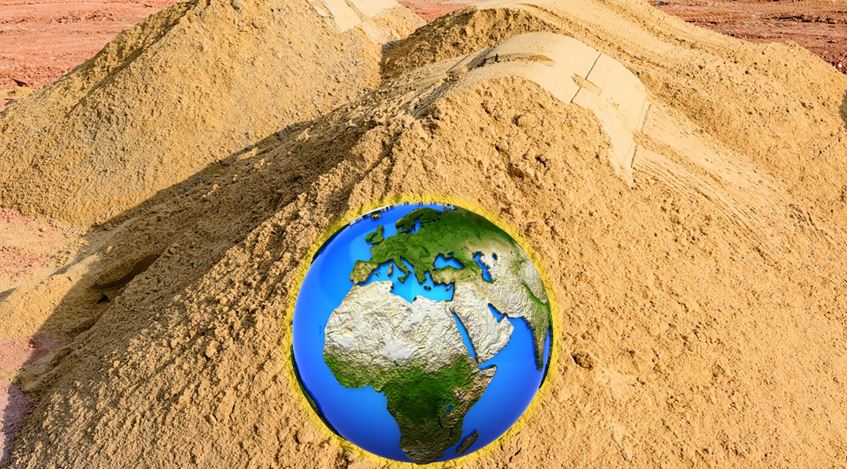
Smartphones, computers, and a wide range of other electronic devices rely on sand — a basic but essential natural resource. Sand looks to be plentiful and is one of the most widely used natural resources on the planet. Sand is used in construction, roads, toothpaste, glass, computer screens, water purifiers, and even natural oil and gas extraction. Sand mining is a $70 billion business, according to the United Nations. A total of 40 billion tonnes of sand and gravel are mined each year, with the building industry using the majority of it.
Also read: Taiwan deals a major blow to Jinping’s semiconductor push, bans all recruitment for jobs in China
The need for sand is expected to rise as the world’s population grows. As a result, sand stocks are slowly depleting, posing a threat to numerous industries around the world as well as gaining importance as a significant natural resource that world powers are eyeing to dominate. As the world powers fight it out to secure rare earth metals and other natural resources necessary to dominate the production of semiconductors and other high tech machinery, the larger geopolitics is entering the arena of sand as well.
Importance of sand and its place in the high-tech supply chains:
Sand is mostly made up of quartz, which is primarily made up of the semiconductors silicon and oxygen. Quartz is a relatively easy mineral to mine because it is a common and abundant mineral. Microchip makers, on the other hand, require crystalline quartz with a high silicon content for production. The difficulty in making computer chips stems from the difficulties in extracting silicon from quartz. The procedure entails a number of processes, each of which raises the cost of the material. Solar panels require 99.999999% pure silicon, while microchips require an even purer material with a silicon composition of 99.99999999999%.
Also read: The problem of illegal sand mining is rampant in Punjab, Govt. helpless against mafia
While building sand may be found in many areas across the world, high-purity quartz resources are more difficult to come by. In the United States, at Spruce Pine (North Carolina), one of the world’s highest quality natural quartz reserves can be found. Xinyi in Jiangsu, Fengyang in Anhui, Gongan in Hubei, and Wucai in Inner Mongolia all have high-quality quartz resources. Acquiring the expertise to extract pure silicon from quartz is another difficulty for newcomers to the industry, as silicon extraction for high-tech electronics is a well-guarded trade secret. As a result, Chinese firms are still working on creating ways for producing competitive goods.
Semiconductors, Supply Chains and the geopolitics of sand:
Although the semiconductor market continues to grow as global demand for technological gadgets grows, the number of semiconductor producers is still relatively limited. As a result, the worldwide chip supply is reliant on a small number of industry leaders. Intel, Samsung, Taiwan Semiconductor Manufacturing (TSMC), GlobalFoundries, Qualcomm, and Broadcom are among the industry’s giants. Of this group, Intel, Samsung, and TSMC have generated the highest revenue, effectively dominating the market.
Sand reserves are vast, and while high quartz reserves are unusual, the quantities required in the semiconductor industry indicate that reserves will not be depleted very soon. The market domination of a few big enterprises, on the other hand, is a major risk.
As a result, interruptions in semiconductor leaders’ supply chains could have a significant impact on the global technology market. One thing the current pandemic has shown us is that the industry’s risks and challenges stem from the supply chain, logistics, manufacturing procedures, production skills, and the safety of manufacturing facilities, rather than the availability of the resource itself.
Also read: Japan joins hands with Taiwan to develop its own semiconductor industry
Going ahead, as countries try to diversify their semiconductor imports as well as try to set up factories in their territories, the importance of who controls the important materials — be it rare earth minerals, metals and obviously sand, will become a deciding factor as to who controls the future markets.