TFIGlobal
TFIGlobal
TFIPOST English
TFIPOST हिन्दी
No Result
View All Result
  • Indo-Pacific
  • Americas
  • Canada
  • Indian Subcontinent
  • West Asia
  • Europe
  • Africa
  • The Caribbean
TFIGlobal
  • Indo-Pacific
  • Americas
  • Canada
  • Indian Subcontinent
  • West Asia
  • Europe
  • Africa
  • The Caribbean
No Result
View All Result
TFIGlobal
TFIGlobal
No Result
View All Result
  • Indo-Pacific
  • Americas
  • Canada
  • Indian Subcontinent
  • West Asia
  • Europe
  • Africa
  • The Caribbean

China’s Genocide Olympics- Day 2: When Chairman Mao killed millions in the name of “Land Reforms”

Abhyoday Sisodia by Abhyoday Sisodia
February 7, 2022
in China
Mao
Share on FacebookShare on X

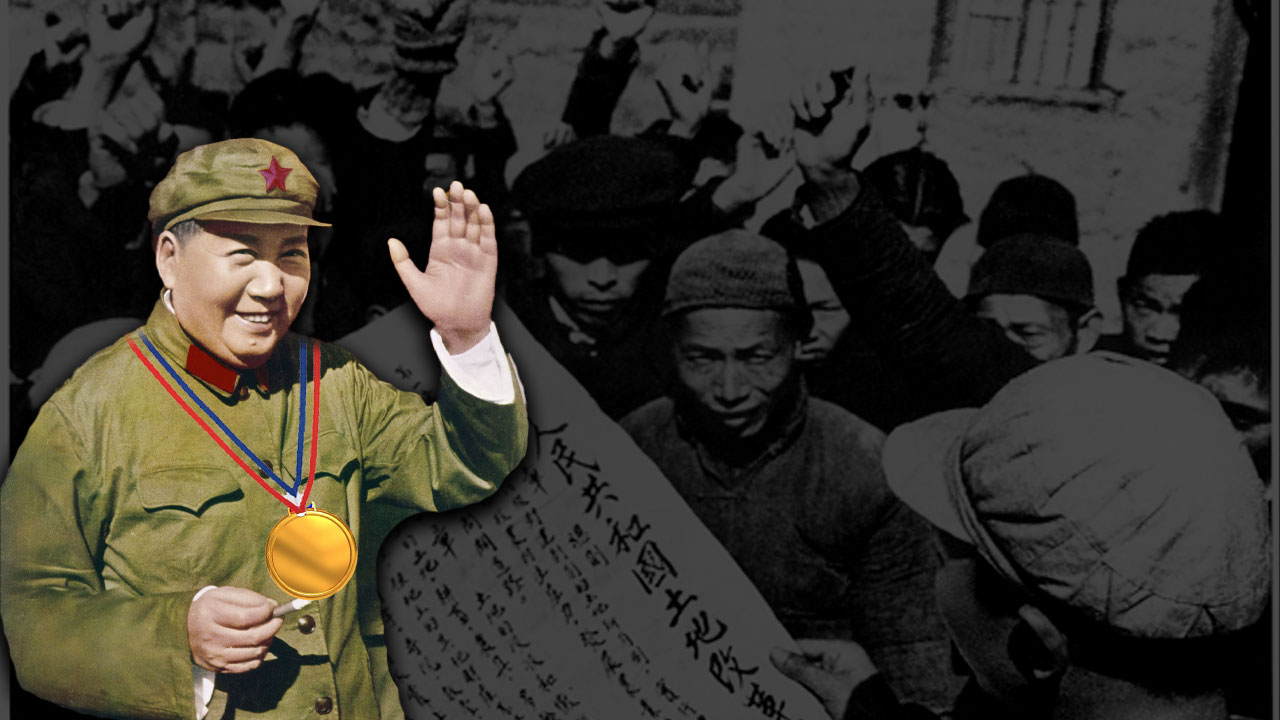
Land Reforms are a very mild set of words and if you do not have any understanding of the early years of Communist China, then it may not seem like a significant event. However, to put things in perspective, this event which spanned multiple years led to the killing of approximately 5,000,000 people as per academic estimates. Not only this but under the direct orders of Mao Zedong, the ideologically blinded Communists sent up to 12.5 million people were sent to reform through labour (Laogai) camps.

The extent of the state-sponsored massacre of millions was the result of a daily purge of landlords and anyone who was remotely considered well off. Landowners killed in the early 1950s land reform campaign were the first people to die violently after 1949. The party ordered security police to set up “people’s tribunals” to target at least one landlord in every village in order to destroy the old landlord elite’s power base in the countryside. Sinologists say at least 1 million people were killed; perhaps as many as 4 million died.

Also Read

The 1,000-Mile Kill Shot: America’s New Missile Plan Puts China in Its Sights

Orca XLUUV Completes 1,852km Uncrewed Patrol Across the Pacific

Cheques and balances: the Beijing-linked money quietly flowing through America’s universities

Mao led the slaughter of millions in so-called “Land Reforms”

After the repression of counter-revolutionaries was done, the new regime’s first order of business in the countryside was to launch a statewide land reform programme. In the early 1930s, the Jiangxi Soviet Republic implemented land reform, confiscating all land and property belonging to landlords and wealthy peasants and distributing it to poor peasants. During the anti-Japanese war, the land reform initiative was shelved in favour of a gentler, less harsh rent-reduction policy.

Mao ‘s goal was to destroy the conventional rural power system, which was dominated by the landlord-gentry elite, once and for all. The campaign’s economic purpose was to encourage a speedy rebound of agricultural productivity, which had been stagnating or worse since the mid-1930s. However, all this spiralled down pretty bad, pretty fast.

According to Jean-Louis Margolin, the killings were not a prerequisite for land reform because land reforms in Taiwan and Japan were implemented without violence. Rather, the violence stemmed from the reality that the land reform was more about eliminating “rural class enemies” and communists assuming local control than it was about redistribution.

Even in the poorest villages (which comprised half of Northern China), when no one could qualify as a landlord, some landowners were “created” so that they might be persecuted, according to Margolin. In Wugong village, 70 houses (out of 387 total) were converted from middling to rich peasants, making them suitable targets for class warfare.

The staggering number of deaths

According to one official, between 180 and 190 thousand landlords were executed in the Kwangsi province alone, and a Catholic school teacher claimed that 2.5 percent of his hamlet was also executed. Some landlords were executed by being buried alive, mutilated, strangled, or shot. Landlords’ wives were “redistributed” as concubines or daughters for peasants in various villages, or forced to marry their husbands’ persecutors.

For the years 1949–1953, estimates range from 200,000 to 800,000 executions to 2,000,000 to 5 million executions, with 1.5 million to 6 million consigned to “reform through labour” (Laogai) camps, where many died.

According to Deng Zihui, Vice Chairman of the Central South Military and Administrative Council, 15% of China’s 50,000,000 landlords and rich peasants have been “sentenced to death,” 25% have been “sent to labour reform camps for remoulding through manual work,” and 60% have been “sent to participation in production work under supervision.”

In the backdrop of the Beijing Winter Olympics, this article is part of a detailed series that tallies all the Genocides and mass killings in China under the Chinese Communist Party.


Tags: Beijing Winter Olympics 2022ChinaCommunistsExhaustive ReadsLaogai campsMao
ShareTweetSend
Abhyoday Sisodia

Abhyoday Sisodia

M.A. in East Asian Studies, Department of East Asian Studies, the University of Delhi, India. Deep interest in geopolitics, foreign policy and world affairs.

Also Read

A dramatic cyberwarfare illustration showing a shadowy hacker from China launching digital attacks from red-lit servers toward major US government, scientific and industrial facilities, with blue shields marking defended targets and red broken locks indicating compromised systems.

From Victims to Targets: US Quietly Edits Its Chinese Hacking Claims

August 30, 2026
A hooded hacker sits before multiple computer screens as images of the U.S. Capitol, NASA, federal institutions, servers and network data surround them, symbolising a Chinese-linked cyber-espionage hacking campaign targeting American government agencies.

Eight Years in the Dark: Chinese Hacking Campaign Reached NASA, the Fed, and the US Senate

August 27, 2026
A hypersonic glide vehicle streaks through the upper atmosphere as it launches a missile toward a US AWACS radar aircraft, with tanker and support aircraft flying in the distance above dramatic cloud cover.

China’s Hypersonic Gliders Can Now Shoot at Aircraft — And America’s Radar Planes Are the Target

August 25, 2026
A dramatic collage showing Hui Ka Yan in the foreground, Evergrande’s rise symbolised by a luxury skyscraper, car and stacks of cash, and China’s property crisis represented by unfinished buildings, rubble, displaced families and a prison cell. Evergrande founder life sentence

From China’s Richest Man to a Prison Cell: The Evergrande Founder’s Life Sentence Explained

August 24, 2026
A container ship sails through icy Arctic waters toward a snow-covered coastal port, surrounded by floating sea ice and towering mountains under a dramatic sunset.

A Ship Sails North, and the China-Russia Arctic Shipping Route Comes Alive

August 22, 2026
Conceptual illustration of Chinese data infrastructure feeding into a central artificial intelligence system, with glowing data streams spreading toward chatbots and users worldwide, symbolising China’s growing influence over AI training data and information ecosystems.

Explainer: How China Plans to Shape What the World’s AI Knows

August 22, 2026
Youtube Twitter Facebook
TFIGlobalTFIGlobal
Right Arm. Round the World. FAST.
  • About Us
  • Contact Us
  • TFIPOST – English
  • TFIPOST हिन्दी
  • Careers
  • Brand Partnerships
  • Terms of use
  • Privacy Policy

©2026 - TFI MEDIA PRIVATE LIMITED

Welcome Back!

Login to your account below

Forgotten Password?

Retrieve your password

Please enter your username or email address to reset your password.

Log In

Add New Playlist

No Result
View All Result
  • Indo-Pacific
  • Americas
  • Canada
  • Indian Subcontinent
  • West Asia
  • Europe
  • Africa
  • The Caribbean
TFIPOST English
TFIPOST हिन्दी

©2026 - TFI MEDIA PRIVATE LIMITED

This website uses cookies. By continuing to use this website you are giving consent to cookies being used. View our Privacy and Cookie Policy.